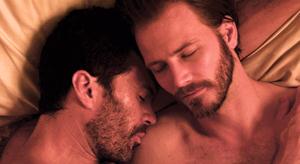
Filmmaker Yen Tan acknowledges he has very little in common with the central characters in his latest film, Pit Stop, screening at the 2013 Inside Out Film Festival. They are, after all, two gay men who live in a small Texas town and have no real desire to move to the big city.
“I’ve always lived in big cities,” Tan says. “I think a lot of gay men now just take it for granted, that we’re out by default. You forget the code of behaviour of being closeted or semi-closeted.”
Such are the lives of the two protagonists in Pit Stop. One has a daughter from his marriage to a woman, who he continues to co-parent with. The other man visits an ex in hospital who is in very bad shape. The two men’s paths will cross but not until late in the film.
Pit Stop shows us their lives in a way that’s never overstated, and Tan has rightly earned praise for creating a low-key film that depicts gay men not typically seen on the screen. He says he was inspired with the idea a decade ago while working on another film.
“I was travelling between Dallas and Houston a lot,” he says. “It’s about a five-hour drive. I became familiar with the route, the gas stations and places to eat. I started paying much closer attention to these smaller places.”
Tan says he then went to online gay sex sites, venturing to specific chat rooms for people living in rural areas. “I would engage in conversation with people, and some of them I managed to talk with regularly. I even met up with a couple of them. People had trouble believing I was doing research. They thought it was some sort of fetish I had. But I got a good sense of where these guys were coming from and what their lives were like.”
He recalls that for the people he spoke with, ending up in a big city was not their ultimate goal. “Many were born and raised there and had families there. They didn’t necessarily have any desire to move to an urban setting.”
Pit Stop stands in contrast to much of the more commercial fare that now dominates local multiplexes. And hearing Tan discuss his influences, that doesn’t come as a big surprise. “When I first saw [Krzysztof] Kieslowski’s trilogy, Blue, White and Red, it had a huge impact on me. It sparked something – I mean, he manages to be very deep and human. I really love films that don’t just show us something but make us think about things. Most movies are about instant gratification now.”
As for specific cinematic influences on Pit Stop, Tan cites Martin Scorsese’s 1974 melodrama Alice Doesn’t Live Here Anymore, in which Ellen Burstyn played a struggling single mother (she would win an Oscar for the role). “I must have seen that film when I was about 14. It was the first time I saw something set in small-town America. The characterizations were so real, and the scenarios were very low-key.”
After a wave of strong reviews on the festival circuit, Tan says his biggest surprise in terms of audience reaction is how much women have taken to Pit Stop. “Someone came out of the women’s washroom at Sundance after a screening and told me there were five women crying their eyes out and talking about how much the film impacted them. Another woman told me how hot and sexy she found the love scene. She turned to me and said, ‘Your movie makes me want to make out with my husband!'”
 Why you can trust Xtra