Elsinore beautifully pays tribute to generations of queer actors who were always playing a role, whether onscreen or off. The film, out in theatres later this month, dramatizes the story of late Scottish actor Ian Charleson, who only now gets renewed appreciation as a queer icon. While Charleson appeared in some landmark films of the early 1980s, including Chariots of Fire, for which he’s best known for playing the devoutly religious runner who refuses to race on Sunday, it might only be through the eyes of another that he truly becomes a household name.
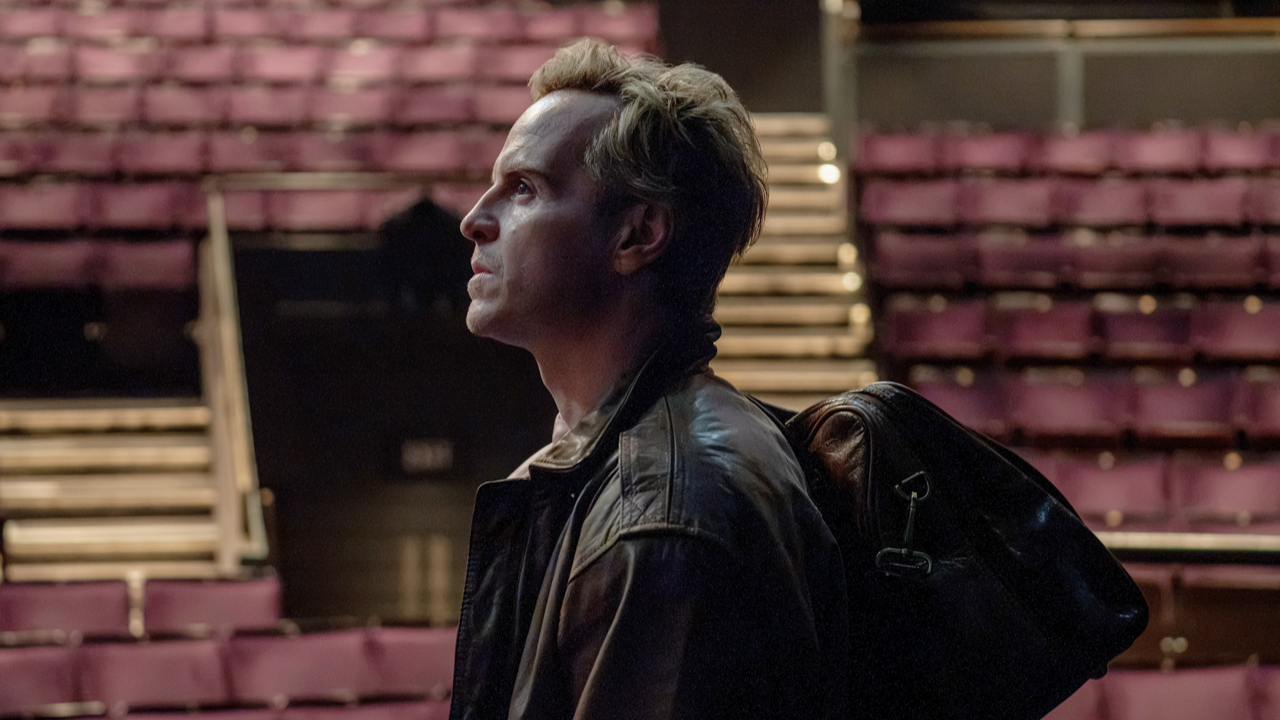
Irish actor Andrew Scott gives the performance of a lifetime playing Charleson as he takes the stage one final time as Hamlet. Elsinore reimagines Charleson’s run with Shakespeare’s tragedy at the National Theatre before dying from AIDS-related causes at age 40 in 1990. After his passing, his cause of death was revealed with his consent, making him the first celebrity in the United Kingdom whose passing was attributed to an AIDS-related illness. Scott has said the role is a passion project for him—he previously played Hamlet on stage to great acclaim and has long been interested in bringing Charleson’s story to the screen. But as an out actor himself, playing Charleson offers a twofold tribute that honours a generation of actors who were forced to deny their true selves in the service of their careers.
Speaking with Xtra, Scott says that his experience navigating the film industry differs notably from Charleson’s day. “There weren’t very many examples of people who were able to get opportunities in film, and that was definitely something that I was worried about,” Scott says, reflecting upon beginning his career in his late teens and considering the question of being an out actor. “But ever since I did come out publicly, which was many years ago, it was a very positive change for me because I think audiences are sophisticated. What we do is to have empathy with other characters and to imagine what it’s like to be somebody else.”
Elsinore sees Charleson avoid being put in a box by taking traditionally masculine roles like cops and heavies. They’re clichéd stock characters, but perfect masking for an actor who just wants to get by. However, the material’s clearly beneath an actor of his calibre.
“I definitely have empathy for actors of a previous generation like Ian because that was difficult,” says Scott. “There just weren’t a lot of positive examples around.”
The risks of being an out artist are at the heart of Elsinore. Charleson has recurring encounters with his friend and former collaborator Derek Jarman, whose 1978 punk scene satire Jubilee was Charleson’s film debut. Jarman, who publicly disclosed his own HIV-positive status in 1986 and centred his illness throughout his work, confronts Charleson about the implications of his silence. Charleson counters that not everybody can make a film showing erect penises like Jarman did with his X-rated debut, Sebastiane.
“You didn’t have to be gay throughout the history of Hollywood to experience homophobia,” Elsinore writer Stephen Beresford adds during Xtra’s conversation with Scott. “If you were to be a heterosexual man who was a little bit more feminine in his nature, the studio would say to you, ‘You’ve got to cut that out.’ Or you could be a woman who was quite masculine, like Katharine Hepburn, with the studio saying, ‘You can’t wear pants all the time; you can’t play baseball; you’ve got to be more feminine.’”
Scott’s turn as Charleson underscores the history of homophobia that countless actors faced. Early praise for Elsinore pegs Scott as an early favourite to win this year’s Oscar for Best Actor. That win could make a historic first in the 99 years of the Oscars. While numerous heterosexual stars have won Oscars for playing LGBTQ2S+ characters in performances lauded as risk-taking (like Hilary Swank, Jared Leto, Tom Hanks and Rami Malek), no out actor has been awarded for playing an overtly queer role. Scott’s soul-baring performance as Charleson shows there’s nothing braver than being authentic.
Scott says Charleson’s encounters with Jarman—recurring meetings mark the passage of time as their respective health declines over the course of the year—provide key moments to illustrate Charleson’s complicated psyche. Keeping his illness a secret allows him to play the stage’s greatest role one final time. “What always moves me, and it’s what Stephen wrote so beautifully in the film when he’s arguing with Derek, is when he goes, ‘Because I’m a fucking actor,’” Scott says. “He goes, ‘I’m an actor, so I want to go out doing the thing that I love.’”
The scene demonstrates how Jarman’s art-house niche allowed him to be out and make queer art on his own terms, but that Charleson’s relative obscurity becomes an asset when he’s ill. “I love that this is a film that is about a vital actor, but it’s not about a famous actor,” Scott says. “They might know his face, but he wouldn’t have been a household name. And he still loved it no matter what. He claimed it right at the end.”
One could, in a way, say the same for Scott. Perhaps best known for playing the “hot priest” on Fleabag, he’s built a diverse body of work across film, theatre and television, appearing in movies like Wake Up Dead Man and Spectre. He has also had queer roles in indie films like Pride, which Beresford wrote, and more recently as enigmatic chameleon Tom Ripley in Netflix’s Ripley. But this open-hearted performance brings his career full circle. Scott owns every frame of Elsinore as he lets Charleson confront his mortality by interpreting Shakespeare’s ill-fated prince anew. Playing Hamlet onscreen through Charleson, Scott adds powerfully introspective nuances and shades of melancholy to a part he knows by heart as Ian goes out on his own terms and acts as if every show could be his last one.
“When you get offered to play Hamlet, for an actor, that is the biggest role and the most important role that you could ever be offered,” says Scott. “It’s very important to say that this is a very unique opportunity at a very unique time. It’s an extraordinary, spiritual thing that came to his lap.”
Scott calls Hamlet an “emotionally exhausting” role to play on stage—he has 1,500 lines, and Charleson had to deliver them at eight shows a week while undergoing treatment. Scott says the hardest part of playing the role within the role was unlearning everything he had absorbed while interpreting Hamlet previously. He says he had to “try and imagine as we go where Ian might go.”
Scott says that he drew upon recollections from people who saw Charleson’s performance. For example, he notes that he plays Hamlet’s famous “to be, or not to be” soliloquy by mirroring Charleson’s interpretation of putting a prolonged pause after the first “to be.” It’s as if his Hamlet can’t bear the thought of crossing over.
“Hamlet itself is about grief, and about the undiscovered country and death and where are we going. It’s a lot of big questions for Prince Hamlet,” says Scott. “It’s staring all of us in the face, but it might be a little further away. But for him, it was really there.”
Elsinore furthers Hamlet’s signature reflections upon mortality by weaving between scenes of the rehearsal process and Charleson’s treatments at a London hospital. Charleson undergoes an experimental treatment pioneered by Margaret Johnson (Olivia Colman), whose attention to patients’ care was far ahead of its time. Charleson faces his own consideration of that “to be, or not to be” question when Dr. Johnson strongly disagrees with his determination to take the stage. Their dispute echoes his altercations with Jarman. To stop acting is to cease living for Charleson.
Beresford says that the idea to emphasize Johnson’s role in this stage of Charleson’s life came about as he was searching for ways to extend the actor’s final role into a bigger-picture story. Once he got Johnson on the phone, he says her sense of humour and empathy immediately clicked.
Colman brings that same light touch to her performance, ensuring that Johnson provides her patients some levity while looking after their health.
Beresford says it therefore became essential for Elsinore to share this chapter of queer history and take audiences into Johnson’s clinic at Royal Free London. “Her clinic started at the time in which men who died from AIDS or AIDS-related illnesses were being buried with concrete because people were worried that they would contaminate the soil,” says Beresford. “She put that clinic in the middle of the hospital. That was her insistence, so that her patients walked in the same entrance as everybody else.”
The film draws stirring parallels between Charleson and Johnson as they both put bodies centre stage during the AIDS crisis. Besides Scott’s warm and humorous exchanges with Colman, Johnson’s ward provides a safe space for men with AIDS. Charleson becomes a mentor to young patients, including one played by Joe Locke, who learns to be open and carefree during his final days. Charleson leads them on escapist larks, like doing a show number to a funky disco remix of an Ethel Merman song. For a few minutes, they let their minds live in the moment.
“Something that really sparked for me was that they had exactly the same culture as you’ll find in the theatre,” Beresford says of the ward. “When you’re doing Hamlet as a company and it’s show number 132 and you’ve got three hours ahead of you and it’s a dark play, people are running around with knickers on their heads. It’s fun and jokes all the time. The way through it is humour.”
“The thing that I really wanted to capture about Ian without a doubt was his sense of fun and his sense of humour,” Scott says. “Hamlet, having played that part myself, is known as the moody prince and the dark prince, but it’s an incredibly witty character.”
Elsinore inspires great catharsis as Charleson takes the stage for his final run, but Scott doesn’t pull at heartstrings. “I think actors are, for the most part, certainly the good ones, not interested in sentimentality,” he notes. “They’re interested in looking toward life. Even in the face of real tragedy, he was looking for fun and that’s why he did play this part: He wanted to be living right up to the end, rather than having no quality of life in the hospital.”
Scott adds that he thinks circumstances are improving for out actors, but he also finds the question exhausting. “What I do feel is that the playing field is becoming a little bit more even,” he says. “When the playing field becomes more even, it helps everybody—not just gay people, everybody, because it helps everybody to do what we’re supposed to do, which is to be empathetic. That’s what acting is.”

 Why you can trust Xtra