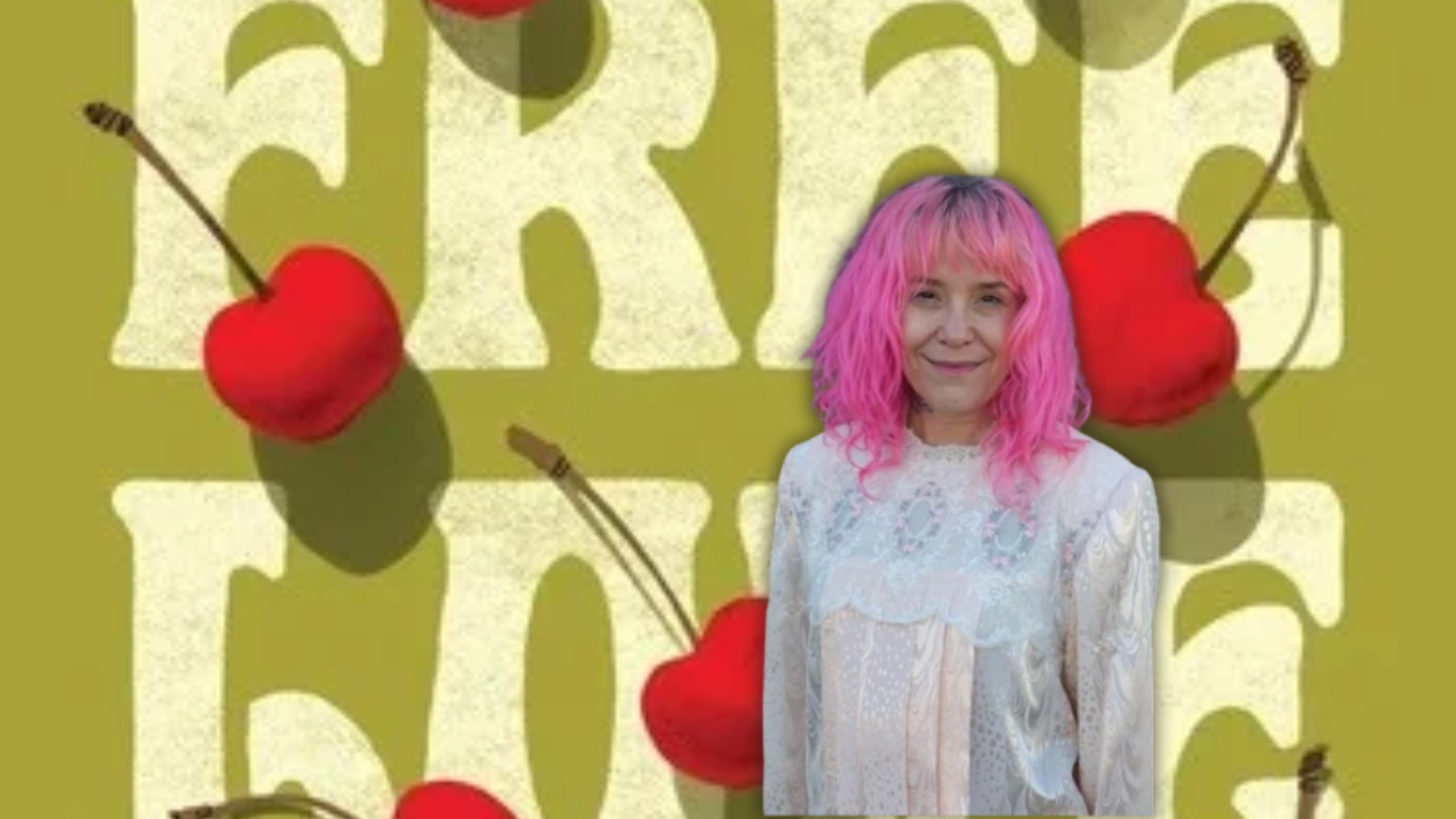
Michelle Tea is the author of more than a dozen books, a tarot reader and the co-founder of DOPAMINE press. Her writing has been a literary companion of mine since I first came out in the early aughts—Tea’s books always seem to arrive right on time, and her newest work, Free Love: Adventures in Marriage and Polyamory, is no exception.
Tea has been non-monogamous for decades and considers polyamory her relationship orientation. In Free Love, she invites readers into the first year of opening her marriage to her second husband, a more monogamously oriented queer man. Her book is dedicated to the therapist who saw them through the joys and challenges of opening up.
Free Love chronicles what it’s like navigating non-monogamy in queer midlife after motherhood, marriage, divorce and a lifetime of forming relationships in defiance of cishet norms. It’s an antidote to contemporary narratives positioning polyamory as the solution to everything that’s wrong with straight marriage.The book blends Tea’s own contemporary and past experiences with historical/cultural analysis and seven chapters that revolve around interviews with other poly people and couples.
At its core, Free Love is a book about what freedom means to Tea as a femme in her mid-50s, and about how prioritizing her wildness is both a spiritual practice and a call to action for her in this season of her life. Free Love invites us all to envision what liberation means to us in our sexual, romantic and relational lives.
I met with Tea virtually to talk about what it was like writing her way through opening up her marriage, how no one gets to tell her to grow up and why you should never cast a love spell.
Why did it feel important to add your voice to the conversation on marriage and polyamory?
Polyamory is a deep part of queer culture historically, especially as you get into subcultures like BDSM, but the representations we’re seeing right now don’t refer to this at all. There’s been a gentrification of polyamory. It’s for everyone, but the media will always pay attention to the straightest, whitest, most normative versions of whatever’s happening. It was really fun for me to dig a little bit deeper and try to correct that story.
Why was it important to you to bring other voices and perspectives into your book? What did you gain from these conversations?
I started Free Love feeling like I had no community for being polyamorous. At the time, a lot of my friends who were more my age were kind of settled. They weren’t open. They didn’t even want to hear about sex, honestly. It was incredibly nourishing and grounding and normalizing to talk to other polyamorous people about sex and relationships. I really felt like I was building community for myself.
I’m very interested in where people hold a need for liberation, especially in their sexual lives. Is it important to them? How do they prioritize it? I didn’t want this book to be all my experience. I loved hearing everybody’s stories and [about their] tools and things they’ve done to help themselves out of tough patches.
What did you gain from writing your way through this experience?
Free Love is like a self-help book I wrote for myself. Writing it helped me link my need for polyamory to other aspects of who I am. It made me feel whole in a weird way that I wasn’t expecting. Polyamory feels as rooted in who I am as any other part of my desire. There’s something about my personal energy that engages with the world in a larger way.
Even going back to edit it, I would think, Oh, I need to hear this right now. Thanks, me. I tried not to write from a place of hurt feelings or personal outrage or feeling misunderstood. Those were true during the process at different times, but writing about it helped force me to zoom out and look at the bigger picture of two people struggling to create a new way of relating to ourselves and other people.
How did you navigate decisions about what to share and what to keep private?
It wasn’t so much a question of what I wanted to share versus not wanting to share, as it was how to share things that felt a little fraught with extra tenderness and awareness. I got a bunch of notes from my editor that were amazing, but some said, “This is TMI,” which struck at the parts of me that felt scared and maybe ashamed.
The stakes for this book felt very high because it’s about my freedom. It’s about my sexuality. [Understanding] this forced me to push back against the idea that I had to be more universal or toned down. I’m 55. I’ve been writing since I was 25. I get to say whatever I want now. I’ve earned it. It’s not TMI. This is how I’m living my life.
What does freedom feel like to you in your mid-50s?
Freedom in my mid-50s feels extreme. I want to be answerable to no one. I’ve been the emotional labourer, overall caretaker, alchemizer of vibes in relationships for literally my whole life. I feel like I’ve spent a lot of my life compromising my wildness, which might sound weird to people who’ve read my books, but I can always go further. And I do believe that one of my reasons for being here is to always go further.
Holding this as a priority can be scary. There’s certainly not a lot of cultural support for it. I’ve come to understand how important it is for me to feel like my wildness is not answerable to anyone, which isn’t the same as wanting to be present and loving to the people in my life. I just want to love people in all of their wholeness and potential, then send them off into the world to get fucked and fall in love, then come back and hopefully fuck and be in love with me.
What would you say to those who would tell you to settle down and grow up?
It’s such a terrible, weird falsehood that there’s such a thing as grown-up. The expectations placed upon us are decades upon decades old and have nothing to do with our actual lives in the here and now. They were never anything but oppressive and capitalistic.
Who benefits from me settling down?
You can yearn for freedom all you want. Then at some point you realize, Oh, it’s there for the taking. I just have to make some choices. And those choices can be really scary and painful, but there’s no reason to yearn for your own possibility. You have total agency. You can change your life at any time.
I appreciated the honesty with which you wrote about some of your breakups that didn’t end in the queer stereotype of becoming best friends with your ex. What has polyamory taught you about endings and learning to live with the ghosts of our worst breakups?
The more you’re polyamorous, the more you bring those potential ruptured connections into your life. When I think of the ones that are ruptured and still kind of cracked for me, I think about how some of it came from me and possibly even them not being fully honest about what we were doing. There’s so much faking going on when I repress my real desire to be as free as I want to try and sync it up with what’s expected of me. It can end up feeling like the relationship is really oppressive or toxic.
Now that I feel like I’m totally balls to the walls about how free I want to be, I’m hoping that between this and my own rigorous honesty, it’s going to weed out people who don’t support that. And ideally the endings can be a little bit smoother and more human.
How do your magical and spiritual practices inform and guide your relationships?
My spiritual practice is very heart-centred right now. Having intense sex or making powerful romantic connections feeds my spiritual body and pushes me to be more heart-centred as I move out into the world.
There’s something mystical about having an aging femme body. It’s this age that we’re all led to be really scared of because supposedly we lose our desirability and are physically uncomfortable and losing our minds. Some of that is true, but actually it’s such an incredibly powerful time physically and energetically.
I feel like my body is becoming more and more of a psychic and emotional conduit. And of course we actually don’t lose our desirability. We gain different types of desirability, which is totally hot and fun and exciting and new. That’s very spiritual to me.
What kinds of spells were you casting when you wrote Free Love?
I’ve been absolutely gripped by the desire to cast love spells in the past year and a half. I don’t want to do that. There’s so much anxiety in a love spell.
When I’m in the grip of something powerful, what I really want is to honour it, so I’ll do a gratitude ritual. Thank you for this moment I’m having with this person. I don’t know what the future holds, but thank you for letting me see myself in a new way through my time with them.
Every time you want to do a love spell, you should transform that energy and do a spell for yourself, a beautiful ritual that’s not asking for anything.
What’s something you hope people will gain from reading Free Love?
I hope it can help people be less afraid and get more honest about what they desire, because I think it’s really common to not be for so many different reasons. I hope reading Free Love helps people take a little bit of a risk, a little bit of a chance to move toward what they really desire out of their lives.
This is your one time in this circumstance. What do you want to get out of it?
This interview has been edited for length and clarity.

 Why you can trust Xtra