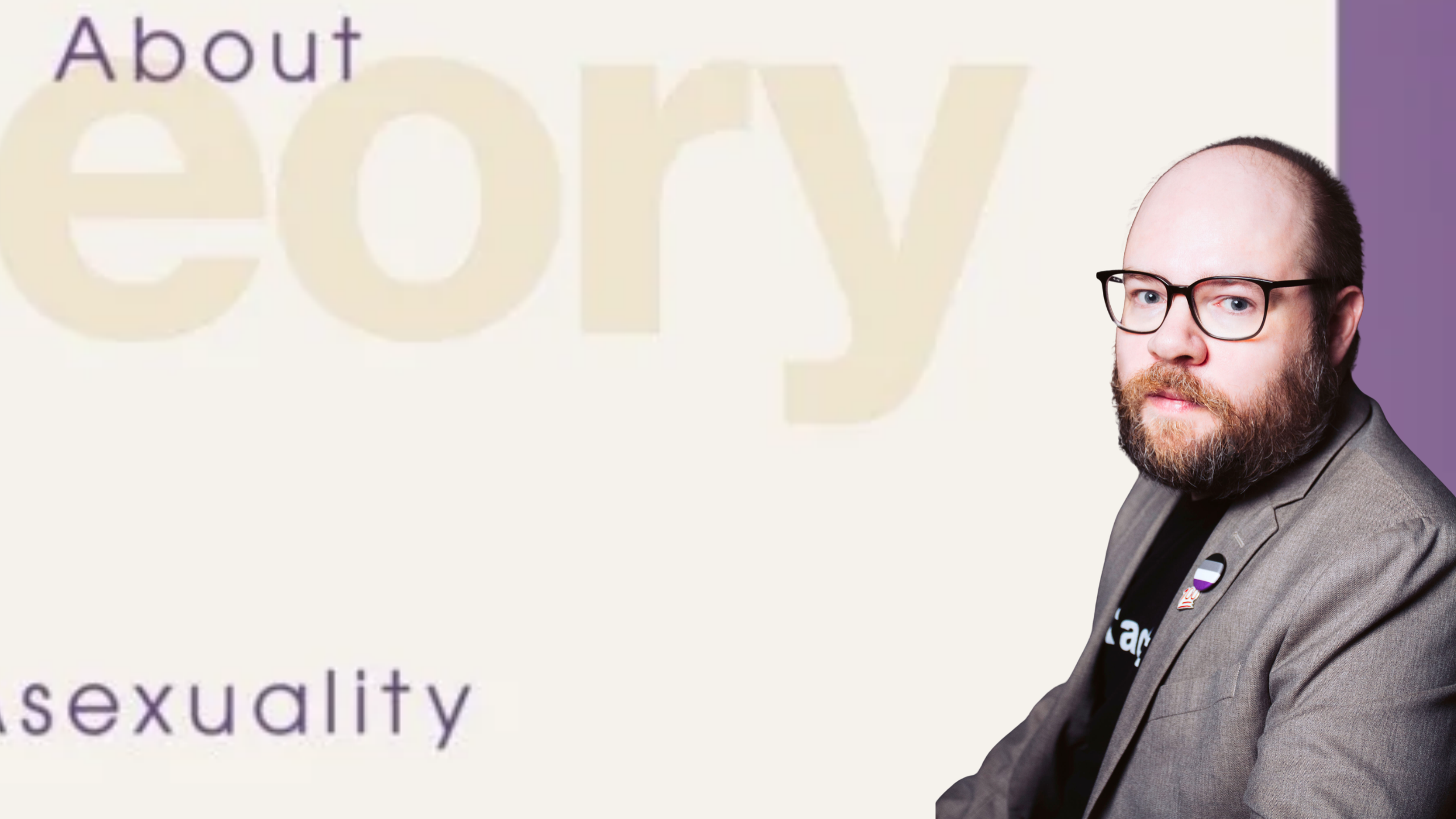
“When I first heard the word asexual, I felt exposed,” writes Ryan Fitzpatrick, the author of Ace Theory: An Essay in Fragments About Asexuality. The critically acclaimed poet was in their late 30s, wading through the early days of the COVID-19 pandemic in Toronto, when the jolt of recognition elicited by the term sent them down a research rabbit hole. They got to work unearthing emerging theories and debates about asexuality from Twitter and Reddit threads, television shows, films, novels, queer academic texts, books of poetry and YouTube clips. This wide-ranging text is the result of that research, a dense and generative assemblage of theory, personal reflection, pop culture analysis and poetry.
This is a rich text for anyone wanting to think through questions of asexuality, whether they identify with the term or not. But don’t pick it up expecting an uplifting memoir, a self-help book or any other type of “it gets better” narrative. Fitzpatrick espouses a refreshing opposition to stories of asexual people overcoming struggle, healing themselves or becoming “whole”: “Fuck that!” they write. Instead, their project poses questions about asexuality from a decidedly unsentimental position.
Fitzpatrick expresses hesitation about defining asexuality at all, for fear that their own personal experiences will be assumed to be the story of asexuality as a whole, or that the truth of their story will get measured uncharitably against people’s existing ideas of asexuality. They would prefer to ask different questions and to construct different definitions: “What is attachment? What is attraction? What is care? What is romance?” Instead of answering the question of what being asexual is or means, Fitzpatrick seeks to dwell in the question itself. They present asexuality less as a static orientation and more as a “complaint” about and against the pressures and assumptions of compulsory sexuality.
Theorizing asexuality as an orientation rather than a medical disorder is a relatively young field of study. Much of the work of defining and analyzing it, as well as figuring out how the normative allosexual world might be interrupted or broken, is happening informally on the internet. Fitzpatrick does cite some key ace theory texts that precede this one: Asexual Erotics by Ela Przybylo and Ace by Angela Chen, published in 2019 and 2020 respectively. They also mention The Asexual Manifesto, a 1972 publication by Lisa Orlando, as well as Valerie Solanas’s infamous S.C.U.M. Manifesto, which they see as a work of “nihilist asexuality.” However, it is rare for all these texts to be brought together in conversation: “Ace theory often feels like a mode of queer theory disoriented by a lack of landmarks,” Fitzpatrick writes.
This disorientation is palpable in Ace Theory itself, which I occasionally found to be a jarring read. Moving through its pages, leaping from fragment to fragment, can feel like a process of getting in and out of a river at multiple different entry points. As a reader, I was never quite comfortable in the text, just as Fitzpatrick describes their own experience of asexuality as one of frequent and pervasive discomfort. They write about their struggles to enter and re-enter the flow of social space and interpersonal relationships without the normative guide posts of sexual desire and coupledom.
In search of asexual representation, they pepper the text with insightful analyses of how asexuals show up in popular culture. Asexuals are often relegated to certain types of roles, mainly the outcast exile (as in Yorgos Lanthimos’s film The Lobster) or the stridently zany character (The Office’s Michael Scott). Recently, there have been more explicitly asexual characters in books and television, including Bojack Horseman’s Todd Chavez, and characters in Heartstopper, Sex Education and Big Mouth.
Is this enough to shift people’s understanding of asexuality? Fitzpatrick suspects that although changing the way asexuality is represented in popular culture is an important project, “when pushed to the wall, representation is too slow.” It will not develop complexity quickly enough to make material differences for actual asexual people.
Ace Theory also touches on the most negative social type associated with asexuality: the incel. Where the incel rages against society, especially women, for denying them sex, thereby reinforcing and sometimes carrying out patriarchal violence, Fitzpatrick’s position is the opposite. They wish to break apart the violent patriarchal society we live in so that everyone is free to have consensual sex if they wish to, and not to have any sex at all if they don’t wish to.
One way to begin breaking the assumptions and norms of the allosexual world is to question the unexamined beliefs inherent to compulsory sexuality. Compulsory sexuality says that everyone experiences sexual attraction and a desire to engage sexually (and often romantically too) with other people. If you don’t experience these things and tell people so, you are likely to be met with disbelief. Fitzpatrick lists a litany of accusations lobbed at the asexual: “You’re immature! You’re a late bloomer! You’re secretly gay! You’ve given up!” They write that asexual people are seen as “clogging up” the normative life trajectory within capitalism, in which coupling up and procreating is the goal, and that this provokes surprise at best and attempts at violation at worst.
Why is it so hard to create a world in which people are free to be sexual or not, as they choose? Much of what it boils down to is the anxiety and precarity of living in this era of late capitalism and neoliberal austerity. In its exploration of how low wages, high rents and devastating cuts to social services severely curtail people’s ability to choose the kinds of lives they want to live, Ace Theory has much in common with another recently published book by a Canadian indie press, Lee Arden’s The Politics of Lonely: Why Is Friendship So Hard? Both texts describe the pressures of wage labour and the need to pay skyrocketing rents as deterrents to forming interpersonal relationships, communities and systems of care outside of traditional coupledom and family units. Those who can’t access or don’t want to access these types of relationships often struggle to get their material and emotional needs met.
Writing about the difficulties of forming friendships and social networks in the 2020s isn’t new, but it’s common for coverage of the “loneliness epidemic” to frame social isolation as an individual problem to solve. (Articles suggest fixes like putting down your phone, joining a club, or going to therapy.) Fitzpatrick and Arden are more interested in how interpersonal disconnect is a collective issue to wrestle with, and how part of the problem is societal over-reliance on the couple and the family unit as the most legitimized relationship structures.
For Fitzpatrick, “the question of asexuality” will only be answered once we find new ways of living together and caring for each other outside of the structures of sex and reproduction. They find this ideal other world hard to imagine, let alone bring into being. Their own later-in-life discovery of asexuality as an orientation and a way of being in the world demonstrates how easy it can be for asexual people not to recognize themselves—or to be recognized by others.
A major tension in Ace Theory is that of visibility vs. invisibility: Invisibility can leave asexual people without social or self-recognition, but visibility isn’t always positive either. Announcing oneself as asexual can lead to medicalization and pathologization, stemming from the allosexual notion that an asexual person is broken and needs to be corrected or fixed.
Often, Fitzpatrick does feel “broken,” they admit, even though identifying with this negative term is not a popular stance. But what they mean is that according to the structures and norms of the allosexual world, they can’t pretend to fit into systems that don’t function for asexual people. “Brokenness is an effect of storytelling,” they write. “Brokenness is also a kind of story.” They reject the myth of personal wholeness, which, they argue, simply means that you can smoothly function as a cog in a machine.
Despite the difficulties of bringing new stories into being against the dominant structures and narratives of the allosexual paradigm, Fitzpatrick is adamant that we must do the work of imagining other ways of living together in the world. It can’t be up to asexual people to “fix” themselves. The solution to asexual experiences of alienation, exile and brokenness can’t be individual, it must be collective. Ace Theory’s prickliness, its pessimism and attention to uncomfortable realities, makes it a refreshing, though challenging, text. It is sure to expand readers’ understandings of their own relationship to compulsory sexuality, whether they identify as asexual or not. It benefits us all to learn to say no to the demands of the normative world, and of capitalism, even if our no is denigrated or ridiculed. Asexuality, as Fitzpatrick reminds us, is a position of refusal, and refusal is an important step in the project of breaking apart our limiting world in order to make a new one.

 Why you can trust Xtra