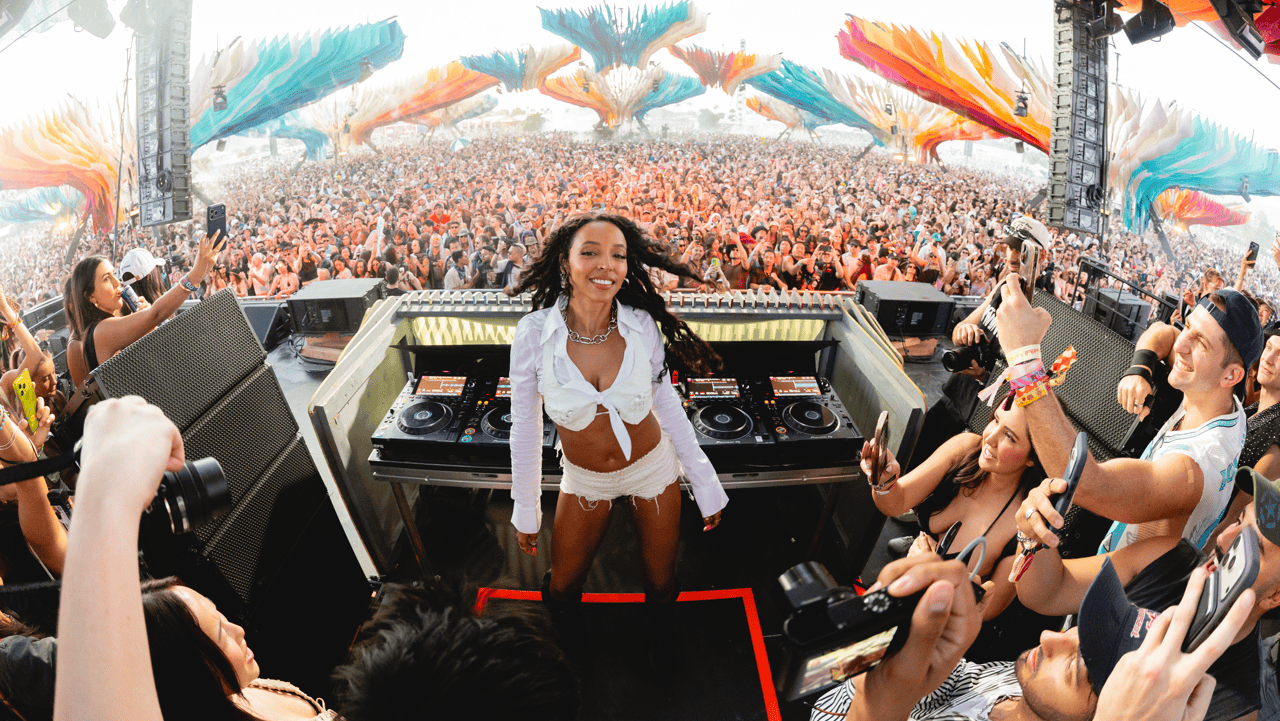
Tinashe’s new album, Popstar, begins with what sounds like a spinning wheel of fortune. We hear the pegs whipping past the pointer, the wheel slowing as her voice comes in. “Eyes straight forward, I see tunnel vision, speaker so loud, music my religion,” she recites. Tinashe is locked in on her art and her calling, laser-focused on the creative destiny laid out in front of her. “Nothing else in the world even matters,” she sings. “Tune it out, turn it all into static.”
It’s fitting that the opening track on Tinashe’s eighth LP is about focusing on her craft in spite of the noise. In the months leading up to Popstar’s release, the discourse around the album reached a fever pitch. Pull up a TikTok from Tinashe’s page from early on in the album’s promo cycle and you’ll likely find a flood of comments making comparisons to K-pop stars and sounds. “every kpop label is writing this downnnnn,” noted one user under a teaser for Popstar’s first single. “expect a Le Sserafim renditions [sic] soon babes,” quipped another.
At first glance, the predictions seem benign and even complimentary, poking at how the popstar package that Tinashe delivers—silky vocals, fresh songwriting, striking visuals, innovative choreography—has long been a source of inspiration for K-pop artists and entertainment agencies. For years, K-pop stans have canonized Tinashe as the blueprint, making memes about her status as a mainstay on idols’ mood boards. Her influence can indeed be found throughout the songs, dance and aesthetics of a genre that, like so many, has origins in Black music. (The uncomfortable resemblance between Korean girl group DIA’s 2018 track and music video “WooWoo” and Tinashe’s 2016 bop “Superlove” is an oft-cited example.)
But the sheer volume and persistence of the comparisons and comments in recent months has been astounding, to the point where Tinashe has spoken out. “This is weird,” she tweeted in July after a fan account for the girl group GIRLSET posted images of her with a tongue-in-cheek caption misidentifying her as GIRLSET member Camila. When asked about the internet discourse around her in an interview in August, Tinashe acknowledged its profound reach. “I think the conversation extends way further than K-pop,” she said. “People are kind of taking it as a joke, and it’s a deadass conversation at this point.”
The rest of her response was diplomatic and exceedingly generous, detailing how “it’s a privilege to be part of the creative conversation.” But in Popstar we find what might be a truer answer: one of an artist resisting being strictly known in relational terms, writing over the deluge of outside opinions to define herself. With this album, Tinashe charts a course through an industry and culture that has failed to truly listen to and understand her. And in her seamless blending of genres—from R&B to country to electronic to hip-hop—into a remarkably cohesive record, it becomes clearer than ever that it’s the limits of our cultural imagination that have held her back from mainstream success.
Tinashe’s career has been anything but the product of chance. The Pasadena-raised artist got her start writing and self-releasing music from her bedroom, eventually getting signed by RCA Records in 2012 and bursting onto the pop-R&B scene with party track “2 On” two years later. In 2019, she left RCA after a seven-year run to go independent, also parting ways with her entire management team. “I really felt, towards the end of those seven years, discouraged about myself as a creative,” she told Polyester Zine in 2022. “I felt that maybe I didn’t have good ideas, maybe I couldn’t write good songs, because the art I would make wasn’t receiving the same amount of energy, excitement, push and dollars.” By then, whether by RCA’s direction or public opinion, Tinashe had become widely seen as an R&B artist, a niche and title she’d never claimed.
Tinashe is at her most self-assured and experimental in Popstar. There’s always been something delightfully discordant and surreal in her music, like a painting deliberately hung a touch askew. She layers pop vocals on a dark trap beat, adds an unconventional twist partway through a song. She challenges us to listen more carefully, and in Popstar, asks us to deconstruct the preconceptions we’ve built around her art.
Popstar’s first three singles are Tinashe’s most brash and pointed responses to external perception on the album. In lead single “Too Easy,” she flexes her pop divadom, playfully declaring “I know that I’m a superstar.” The accompanying music video features Tinashe effortlessly pushing out popstar wannabes, so singular in her artistry and star power that record executives have no choice but to clone her. High-energy track “Melatonin” sees Tinashe asserting that her talent has been slept on and taking shots at the “hella annoying” bitches who point and talk. And in the swaggering “Crash Out,” she calls out the internet haters and warns them to lay off before she loses it.
But Popstar also offers us a glimpse behind the bravado. “I’ve been singing so long and nobody hears it,” she reflects on the starkly grim fourth track, “Empty Stadium.” “I’m standing on the stage just waiting for applause that’ll never exist.” Tinashe interrogates what it means to be committed to her artistry but cursed with a culture that’s obsessed with discourse around, not about, her music. We’re so busy citing her as inspiration, foisting labels upon her and referencing brainrot (which is the apt title of a claustrophobic track on Popstar) that we never take her art at face value.
The arbitrary boxes we use to understand and categorize music have real weight and meaning. That conversation resurfaced this summer as K-pop behemoth BTS announced it wouldn’t be submitting music for Grammy consideration this year, after the Recording Academy introduced a new category for Best Asian Pop Music Performance. “We hope our music can be heard and loved for what it is, rather than being divided by region or language,” wrote BTS’s members in Korean in a joint Instagram statement. The academy’s move was similarly panned by many fans and critics as flattening the diversity of an entire continent’s musical production and insultingly separating so-called “Asian pop” from a real pop implicitly understood to be white and American.
That controversy parallels conversations that Black women artists have been having about labels and boxes in recent months, as culture journalist DeAsia Paige recently observed in music blog Pigeons & Planes. Popstar, with its declarative title, joins the ranks of recent genre-bending projects like Ravyn Lenae’s surprising Blue Island and Jae Stephens’s hyperpop-tinged AUDACITY, pushing us to question the boundaries of pop and untangle our impulses to label Tinashe as a R&B artist first and foremost. Through her craft, Tinashe reclaims a category she’s shone in all along.
On album closer “Heavy Weight,” Tinashe is disarmingly earnest and perhaps the closest to a stripped-back, acoustic singer-songwriter she’s ever been on a regular track. She confesses that the burden—of popstardom, of living up to constant comparison—has been difficult to bear, yet she can’t bring herself to put it down. “I know that I’m being too prideful,” she sings. “It’s the hand I’m dealt and I can’t help it.” In Popstar, she finds a catharsis in channelling those pressures into art and bringing it back to what it’s always been about: the music.

 Why you can trust Xtra