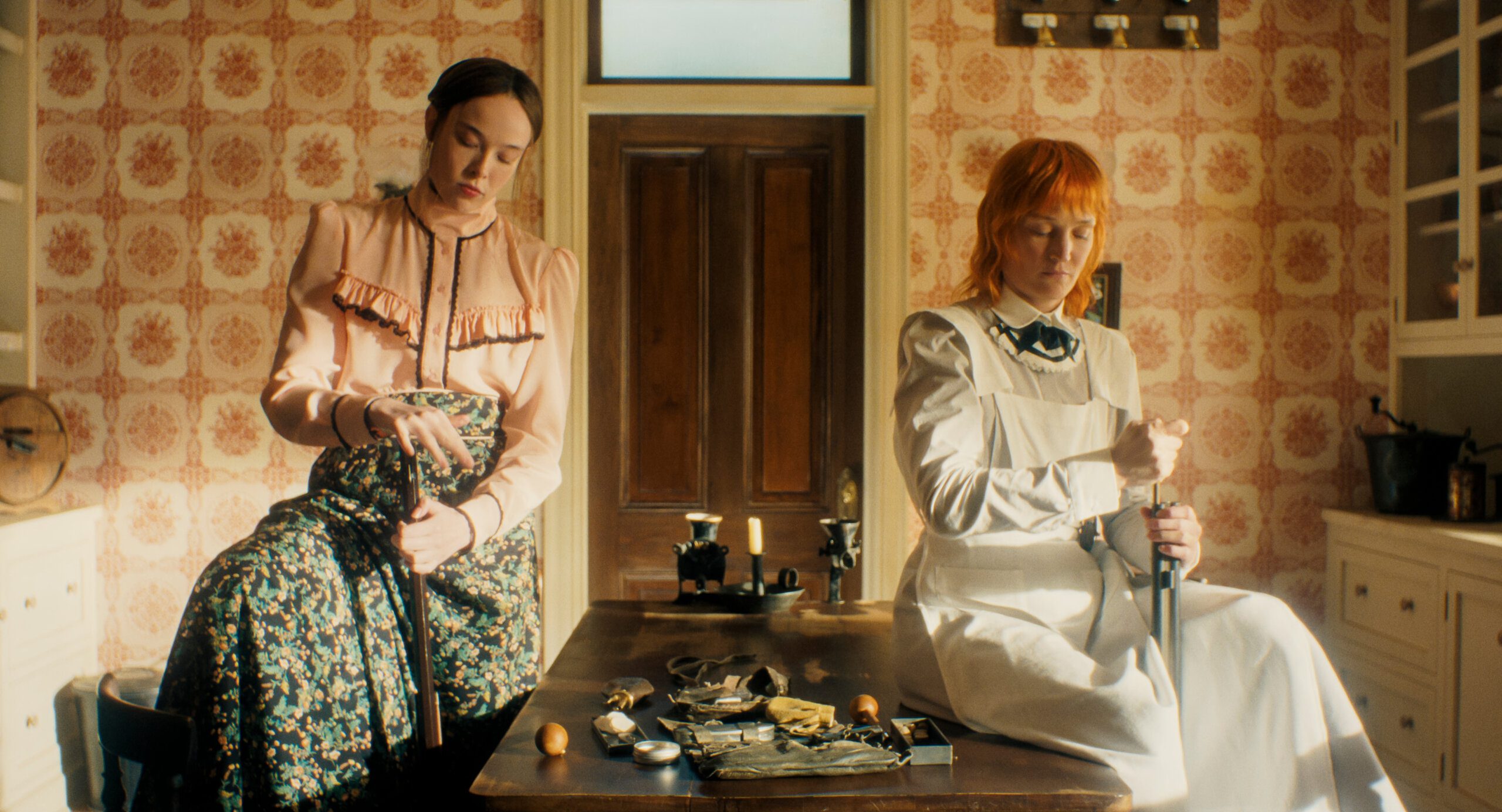
In the fourth, and latest, season of Monster, the true crime anthology created by frequent collaborators Ryan Murphy and Ian Brennan, lesbian rage shapes the series’ first examination of female violence, which is on full display only seconds into the first episode. Combining the lush gothic textures of gory practical effects with the singsong schoolyard rhyme commonly associated with one of America’s most notorious accused killers, the violence cast within the series’ tableau of Victorian girlhood is centre stage.
In an interview with The Hollywood Reporter, Brennan confessed that the writing team had initially hoped to focus on Luigi Mangione for their next project, but it became clear the case was too “new … esoteric … [and] laborious,” so they redirected their attention to another figure Murphy claimed to always want to focus on.
The series’ central focus ultimately landed on accused axe murderer Lizzie Borden (Ella Beatty), who in 1893 was charged with and acquitted of the gruesome double homicide of her father, Andrew Borden (Charlie Hunnam), and stepmother Abby Borden (Rebecca Hall) in Massachusetts. During the trial, her defence attorney argued that Borden must be innocent because murder was “morally and physically impossible for a woman.” Relying on the gender biases of the day, and alongside a lack of physical evidence, Borden’s innocence leaned heavily on her respected image as a white upper-middle-class woman of high social standing—which ultimately aided in exonerating her of the crimes. To this day, the case remains unsolved. But Brennan, the series writer and showrunner, goes to great lengths to prove her involvement in the murders. Monster links Borden’s restrictive home life and a newfound queer awakening with the Bordens’ maid, Bridget “Maggie” Sullivan (Vicki Krieps), to her alleged violent fury.
While the violent murder of Borden’s parents is often discussed in near-mythical terms, Borden’s rumoured lesbianism has taken on a life of its own in the popular imagination since the 1980s. One of the earliest pieces of media to introduce the possibility of her homosexuality was Lizzie, a novel of historical fiction published in 1984 by Evan Hunter (who used the pseudonym Ed McBain). Hunter theorized that Borden’s seduction of Bridget, and eventual outing by her cruel stepmother, was the catalyst for the wealthy New Englander committing the gruesome double homicide. Brennan expands on this theory of the Borden murders throughout Monster’s eight-episode arc. As leads Beatty and Krieps craft fantastically compelling and provocative performances of lesbian longing, intimacy and kinship, the result is more akin to an enchanting dark fairy tale than any sort of historically accurate biopic of the case. Beatty described in an interview with John DiLillo for Netflix’s Tudum, “The show is exploring a legacy of female rage and reaction to the set of circumstances that they are presented with.” Yet we see another legacy emerge as a result: that of the ongoing revisionist interventions of cis men in the pop culture recountings of lesbian violence.
The show’s narrative includes a cross-generational storyline connecting Borden with the two female serial killers, a decision Brennan claimed makes the series “feel much more contemporary and of the moment.” This rifling through lesbian historical records reaches beyond Lizzie Borden’s case to a full triptych of female “monsters,” including the inclusion of Aileen Wuornos (Sarah Paulson), who was once wrongfully referred to as “America’s first female serial killer,” and Elizabeth Báthory (portrayed by Krieps in a dual role).
One of the more fascinating and surreal effects of this type of storyline comes in Episode 6 when Wuornos and her girlfriend Shelby (Jessie Lee) make a pilgrimage to Fall River, Massachusetts, to celebrate their anniversary at the Bordens’ old residence on Second Street. Regarding issues of historical accuracy, the home didn’t open to the public as a bed and breakfast until 1996, with Wuornos being incarcerated in Florida in 1991 and remaining on death row until her execution in 2002. This meddling of timelines allows for an unexpected communion between the two women at the site of the crime. In a later scene, after following the apparition of Borden up to the candlelit attic, Wuornos confides to her the horrific and violent details of her childhood, including extensive abuse by family members. Time-warping here seems to function as an opportunity to dramatize Wuornos’s trauma as its own horror trope. On including Wuornos (and “the blood countess” Báthory) into the storyline, Brennan said that they “were able to look at rage, female rage, and women who kill as less of an aberration throughout time than actually a throughline … The cages that we put women in and the things they will do to get out of those cages was really interesting.” But what to make of the potentially new genre trappings created in the process?
In an age of rapidly increasing AI-generated art, deepfakes and far-right censorship infiltrating our queer media landscapes, issues of authenticity and accuracy, particularly when it comes to the use of marginalized identities within pop culture, are more prescient than ever. It might seem too minor to mention, but in fictionalizing the past, these newly constructed depictions impact and distort public understanding of real women, enforcing other forms of erasure in the process. Queer history has always been hard to access and document, and queer filmmakers working within historical archives continue to forge cinematic practices through speculative approaches. For instance, Cheryl Dunye, director of The Watermelon Woman, the first feature-length American film directed by aBlack openly lesbian filmmaker, began referring to her style of filmmaking as “Dunyementaries” in the ’90s while promoting the film, speaking to the personal, imaginative and hybrid possibilities of telling queer, personal stories. But when dealing with true crime, the stakes arguably change.
There’s always the risk that when these stories get mishandled, further violence and violations are done to already vulnerable identities. The revisions made to queer cultural history compromise the validity of memory, historical accuracy and subjectivity within popular culture. How we archive and remember our dead is an ethical practice we can all actively participate in as fans and viewers of larger mainstream works. No doubt unintentionally, Monster: The Lizzie Borden Story encourages its viewers to investigate these stories further as part of the viewing process as a way to counter the show’s blunderings of historical facts.
The series’ creation and circulation of fictive images of Borden, Wuornos and Báthory might fall within the definition of what English professor Dana Heller calls “prosthetic feminisms” in an essay published in the journal Tulsa Studies in Women’s Literature. For Heller, this refers to the “mass cultural narratives that work to intercept and interact with public memory of feminism’s histories,” changing our collective memory through media distortions. In warping the past, feminist and queer history is not only rewritten but rewired, generating false histories within the popular imagination. The problem with these fictional interventions into certain queer pasts is that the damage becomes part of the ever-growing legacy, through the stories we continue to tell of women’s histories of violence and trauma.

 Why you can trust Xtra