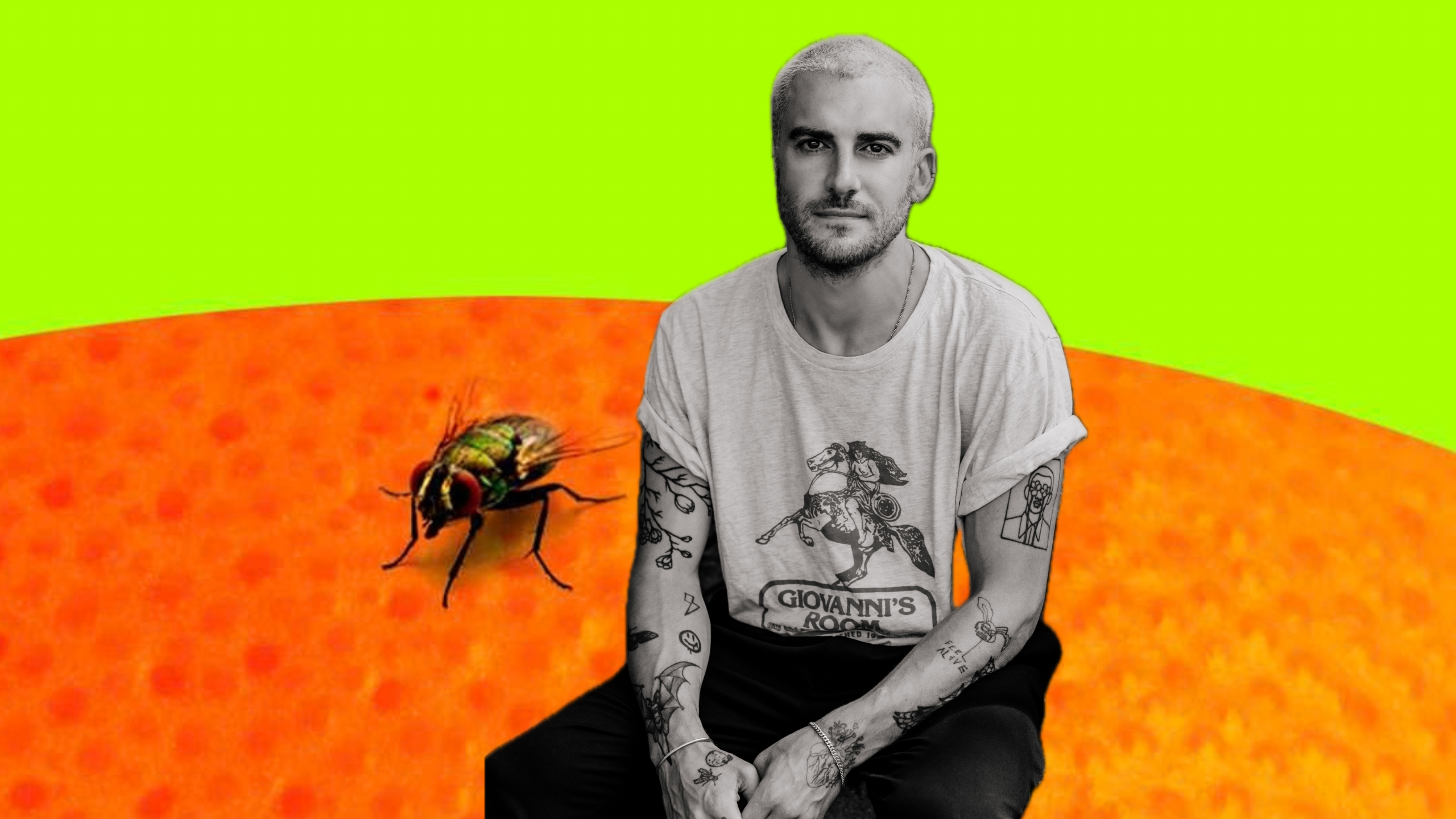
One thing Fruit Fly author Josh Silver loves about America? The cultural obsession with cinnamon. He says it’s simply not the same back home in England.
We are walking along Manhattan’s Greenwich Avenue the day after Labour Day, cold brews in hand. We initially planned to meet in the LGBT Center’s café, but the gentle breeze and lack of sticky humidity inspired us to take our drinks outside. Passengers in taxis and helmet-less twinks on Citi Bikes drift by. That’s when Silver notices a cinnamon bun in a bakery’s display window and stops to stare.
Silver has been in New York City for seven weeks now, where he’s been on a jam-packed media tour promoting his queer page-turner, Fruit Fly, now an international hit. The book has sold out at independent retailers, received glowing reviews online and will soon be adapted into a TV series by A24.
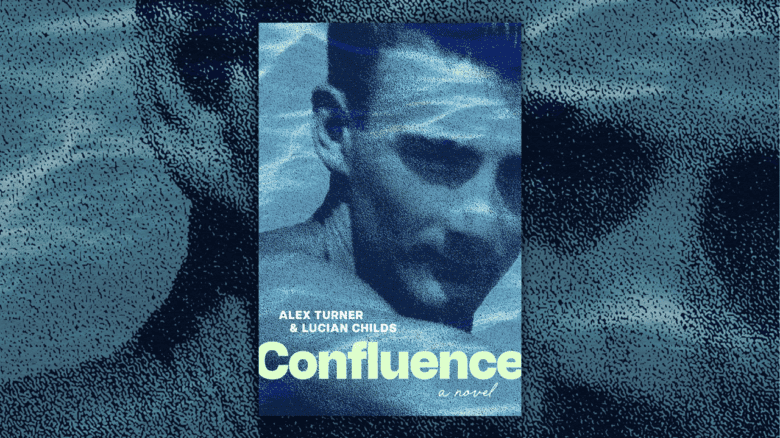
The book follows Mallory Maddox, a struggling author and therapist who becomes enamoured by a homeless young gay man struggling with addiction named Leo. The character’s undercover sleuthing into the gay world fuels her new manuscript, Slay, but as she continues to scheme, stalk and Grindr-swipe her way closer to Leo, her lies—and her own dark past—start to swarm around and consume her.
The story is equal parts thriller and farce. It provides page-flipping tension while skewering the way the publishing industry exploits queer people in the name of championing diversity. The easiest way to describe the book is Yellowface meets A Little Life, but the story is really more of a tango. It’s about two people from very different circumstances who are trying to extract as much as they can from each other to survive—while also finding unexpected common ground.
The book is also a major milestone for Silver, who is a former actor-turned-mental-health-nurse-turned-author. After writing three young adult novels, Fruit Fly is his first stab at writing fiction aimed at grown-ups.
The day I meet Silver for our interview, we aren’t thinking about the publishing industry, depictions of queer tragedy or Silver’s own winding career path. We are simply a Brit (him) and a Canadian (me) in a Manhattan bakery, debating whether to purchase a regular cinnamon bun or a caramel-drizzled, apple-pie-flavoured one.
We land on apple pie. It’s more American. We take the bun outside and sit on a bench by the New York City AIDS memorial. With two forks, we indulge. Then the conversation shifts to Mallory, Leo and Josh’s taste of literary stardom after writing the summer’s buzziest book.
Fruit Fly is your first novel for adults, and it defies easy genre categorization. There are both elements of thriller and tragedy in it, but also some dark comedy and a deep sense of empathy for all the characters involved. After writing three young adult novels, how did you market this book to your agent?
I didn’t really set out to write a thriller, so those elements of tension come with the story that’s being told, which is a really lovely add-on. It was always supposed to be a social satire and a Yellowface-style send-up of the publishing industry. I always like when there’s tension in my writing, and I love when the plot twists keep the reader guessing.
Your book portrays Leo’s perspective in a raw and honest way, including his struggle with addiction and his tendency to self-sabotage. In a story that’s all about authenticity, what research did you do to make sure you got Leo’s story right?
Becoming a nurse was hugely liberating for my creativity. I’d been an actor, and I sort of lived in this fairly small bubble of what it is to be an actor in London, and constantly obsessing over auditions, and you know, not really being in the real world, if I’m honest.
As soon as I became a nurse, I felt a shift because I started to be around people that were not all the same, and I found that incredibly useful creatively. And I started to get angry and frustrated about things that I was seeing, and that sparked my desire to write about it.
Also my own personal experience informed some of what he’s going through. I’m sober. I’ve been sober for a while now, and some of the stuff that he is experiencing was a world that I’d been involved with, or that I’d experienced myself, and I just wanted to put that on the page.
You don’t sanitize Leo and the tough choices he makes for survival, and you don’t make him out to be the stereotype of a hapless victim either. Why was it important to give Leo’s character agency, rather than portraying him as someone who needs to be rescued?
The ultimate thing for Leo is he needs to rescue himself, and he’s very, very far from doing that. And the excuses he’s building and the narrative he’s building to avoid doing that is his own problem.
I remember when I was getting sober, someone said to me, “No one’s coming. No one’s coming. You’ve got to do this yourself.” That was probably one of the most important pieces of advice I was given: the desire to change has to come from you. And Leo does not want to accept that.
The character that appears less similar to you—at least at the surface level—is Mallory. Yet you do such an amazing job expanding on all the details in her life, including describing her house and the specific supermarket delivery service she uses. How did you get into the head of this middle-aged British lady?
A lot of the character comes from my own experience. I’ve certainly experienced her inability to feel happy with what she’s got and wanting to change things and sort of throw bombs around her life to create drama in order to cause some kind of excitement or chaos that she can latch on to. I feel like I can relate to that.
I had a few female friends beta-read behind me. I would have them point me in the right direction, or say, “That’s absolutely not what would happen.” I found that very useful.
One of the points of the books is that people are more similar than you might think. My twin brother read the book, and he was like, “You are both of these people.”
The tagline for your book is “Go Gay. Go Sad. Go Dark.” It points to a major theme of the novel, which is how the publishing industry has exploited queer people’s lives, and even queer trauma, into something marketable.
We also have a propensity as a culture to want to view pain and trauma. In the publishing industry, a selling point of a book is if it makes you cry. You want to have proximity to someone else’s trauma, but you don’t want to be in the middle of it.
Mallory goes into the middle of it and finds it incredibly uncomfortable, but she still can’t quite look away. But the reality of it is too much for her. There’s parts of our community that people still aren’t willing to look at or ready for, or actually know that much about.
As a culture, there are parts of our community that people still aren’t willing to look at or ready for. I was in a panel not that long ago where I started talking about PrEP, and I asked the audience, who I assume were mostly straight people, if they knew what it was, and they didn’t.
Both Mallory and Leo are constantly trying to manipulate each other, but there is also this odd sense of mutual respect and even obsession between them. Do you view this book as a kind of romance between Mallory and Leo?
I think there’s a sort of toxic love between them. They are infatuated with each other in a certain way. It’s not a sexual desire, but it’s certainly rooted in a kind of connection.
Leo’s kind of obsessed with her too. He goes into her house. I think there’s something safe about her and the way she lives that he wants, and he wants to sort of be taken under her wing and looked after.
Digital media plays an important role in this story. Early in the book, Mallory takes pictures of her naked husband to make a Grindr account so she can catfish gay men to research her book. Meanwhile, Leo is an anonymous Instagram poet, and the novel is interspersed with his poems. Why was it important for you to portray dating apps and social media?
Social media is about performance, I suppose, but it’s also about connectivity in its purest, greatest form.
But it can also be so toxic in terms of its addictive qualities and how it hijacks your dopamine system. Leo is absolutely getting a kick out of being on Instagram. It totally works for his validation system. He can present this fucked-up-boy-with-depth-who-writes-poetry version of himself. He knows he’s going to get something from other people online who are looking for that kind of thing.
How have you learned to navigate social media yourself, now that you’re a successful and recognizable author?
Social media is how Fruit Fly has reached people. I’m very grateful that people online share and talk about it.
Doing press and interviews, it’s important, but it has its own version of being addictive and potentially unhealthy, and I’m learning my boundaries. It’s something that’s incredibly useful as a writer. There’s also an undertone to it all, isn’t there? That can feel all-consuming.
I have to assume some persona to do some of this stuff, and I want to be as authentic as possible, but there’s a line with how much I allow people in. Sometimes I don’t want to be in front of people, but it’s part of the job, so the performance is required.
It’s survival. Performance is survival.
This conversation has been edited for length and clarity.

 Why you can trust Xtra