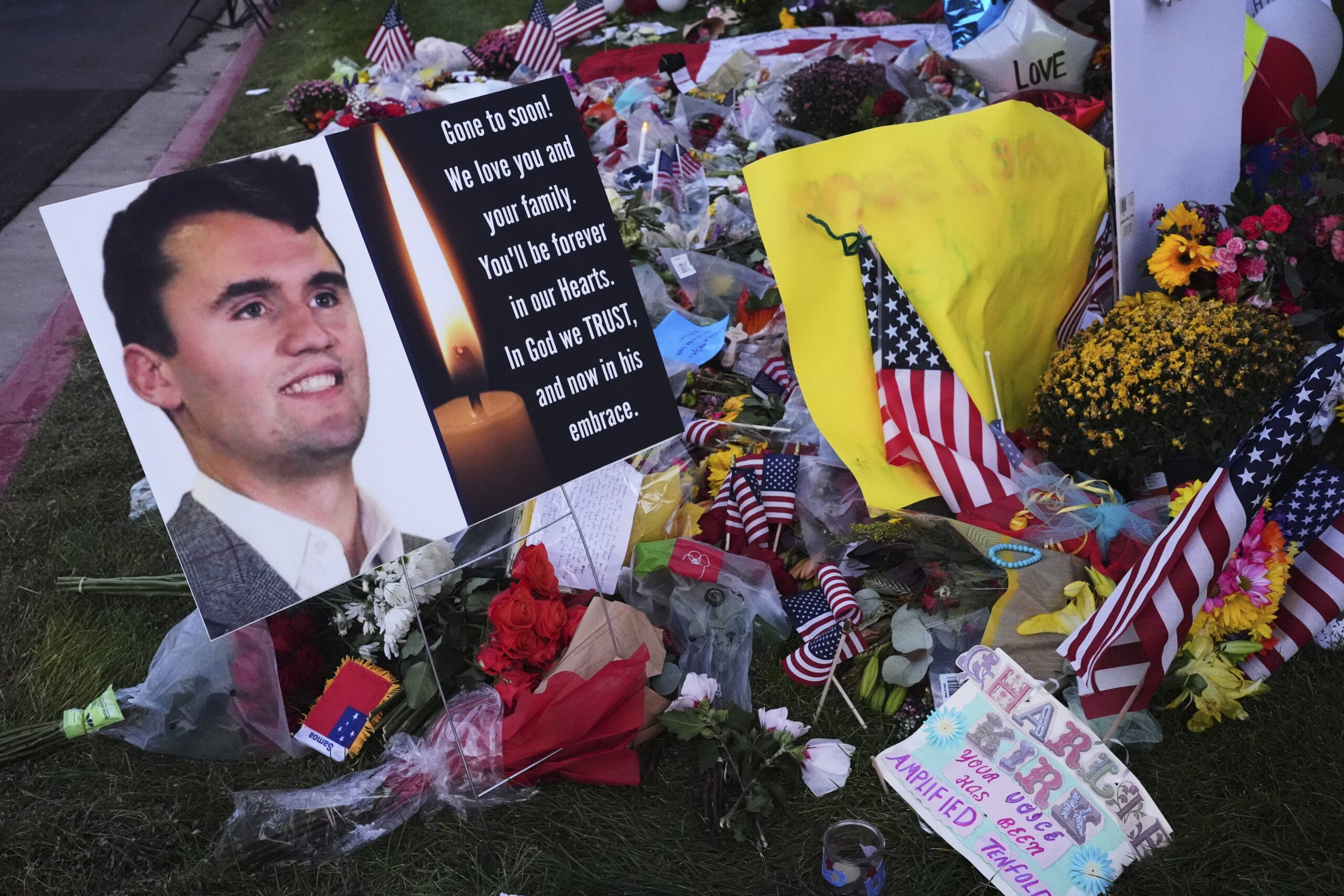
One year ago, a lone gunman shot and killed conservative commentator Charlie Kirk at an event at a university in Utah. Kirk, an influential ally of U.S. president Donald Trump and the co-founder of the conservative advocacy group Turning Point USA, was answering audience questions when he was killed.
Less than 24 hours later, while the shooter was still at large, the Wall Street Journal falsely reported that bullet casings bearing “anti-fascist” and “transgender ideology”—itself a nebulous phrase carrying political connotations—were found at the site of the shooting. While clarified within a few hours, this initial report set off a wave of media misinformation—at least 43 media outlets shared anti-trans misinformation in the days following the attack, according to a report from the Trans Journalists Association.
“This reporting was reckless and irresponsible, and it led to a wave of threats against the trans community from right-wing influencers—and a resulting wave of terror for a community that is already living in fear,” the Human Rights Campaign wrote in an open letter demanding an official retraction from the Wall Street Journal.
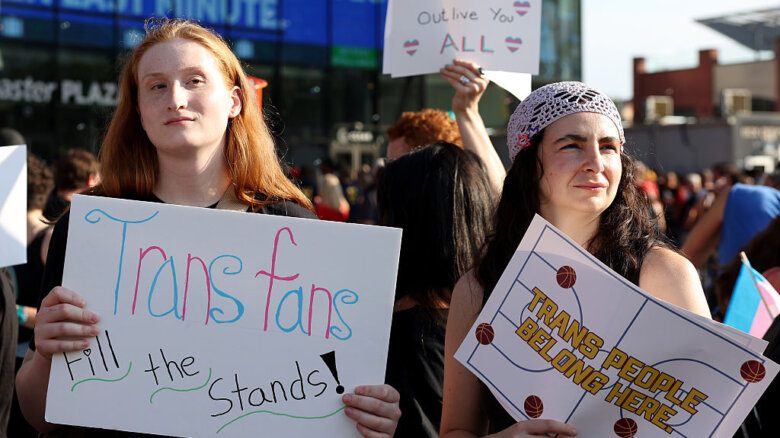
Google searches for “transgender ideology” spiked in the U.S. the day following the shooting. Speculation around the shooter’s identity ran rampant, with far-right social media accounts sharing AI-generated images of the supposed shooter, suggesting it was a trans woman. Dozens of people, including a trans professor in Alberta, were fired or put on leave in response to online comments they made interpreted to be celebrating Kirk’s death. And conservative officials, including Trump himself, mused about banning Pride flags and cracking down on trans rights as a direct response to the shooting.
“Nothing good will come of this,” I wrote here in Xtra after the shooting. “We now have to live in fear that this violent incident will further galvanize the wrong people. When we speak out publically, or protest or march in the streets for our rights, we have to worry that the wrong person will get the wrong idea and come and hurt us. That they will see it as ‘revenge’ for Kirk’s death, or as justified retribution. Political violence begets more political violence.”
And while I’m certainly glad large-scale political violence against trans people has not transpired to the degree many of us feared in those immediate hours following Kirk’s death, the shooting has still dangerously shifted the way trans people and violence are associated by the broader public in North America.
The day after the shooting, 22-year-old Tyler James Robinson—who, for the record, is presumably a cis man—turned himself in. He’s now facing seven criminal charges, including aggravated murder. During a court appearance earlier this month, Utah County prosecutor Ryan McBride argued that Robinson targeted Kirk for his anti-LGBTQ2S+ and particularly anti-trans stances, and that this political motivation warranted the death penalty under Utah law. Prosecutors and the public have focused on his roommate and former partner, who is reportedly trans. The roommate has fully co-operated with officials and shared various evidence and communications with Robinson around the shooting with authorities.
Robinson pled not guilty, and his case will now go to trial. A date has not yet been set, but a pretrial conference is currently scheduled for Oct. 23.
Like any high-profile perpetrator of violence, Robinson’s motivations—and particularly any link to trans people—have been endlessly obsessed over and litigated in the past year. This rush to link transness to violence, unfortunately, has been the case for basically a decade now, despite overwhelming evidence that the vast majority of gun violence is committed by cis men with absolutely no link to trans people. Ongoing analysis from the Violence Prevention Project shows that cis men were the perpetrators in 98 percent of mass shootings in America, female shooters accounted for 2 percent of attacks and trans people accounted for less than 1 percent. And an analysis by Wired last year found at least 12 violent events between 2022 and 2025 that were falsely blamed on trans people by prominent right-wing figures in America.
This phenomenon was complicated further in February, when a shooter opened fire at a school in Tumbler Ridge, B.C. The usual anti-trans panic of social media misinformation from far-right media and influencers stirred up in the immediate hours as the event was still transpiring, but Tumbler Ridge ended up being the rare case where the perpetrator actually was a trans woman.
Authorities have found no link between her identity and the shooting—rather, she seems to have been radicalized online and through AI chatbots. But still the event was seized by right-wing politicians and media voices as “proof” for restricting trans rights in Canada, with B.C. MLA Tara Armstrong the worst offender, calling out a supposed “epidemic of transgender violence.”
These fringe cases where some connection can be drawn to trans people, no matter how tenuous, take up vastly more airtime and cultural conversation than the countless horrific acts of violence committed by far-right actors and/or cis men every day. In 2026 alone, at least 338 people have been killed and 1,396 people have been wounded in 332 mass shootings in the U.S.—defined as having four or more people injured—according to the crowd-sourced Mass Shooting Tracker. Yet the identities or motivating factors in those incidents have not been litigated and unpacked to the degree that the Kirk shooting or Tumbler Ridge have been.
To be clear, there are tangible policy changes that can be made to save lives when it comes to gun violence. Research shows that fewer shootings happen in states where accessing firearms is more challenging. And in the case of Tumbler Ridge, where the shooter’s ChatGPT use was flagged by moderation ahead of the shooting, there are very real questions to be asked about how AI platforms are moderated and regulated.
Restricting trans peoples’ access to firearms, hormones or gender-affirming therapy—all things that have been suggested in the year since Kirk’s death and the seven months since the shooting in Tumbler Ridge—will do none of that.
None of this is over. As Robinson’s case goes to trial, prosecutors will continue to try to draw these links between transness and violence, and keep this discourse in the mainstream conversation. And the next time something happens, both the killing of Kirk and the shooting in Tumbler Ridge will likely be held up as “proof” of a trend where there is none. The cycle will continue, and people will continue to get needlessly pulled into it. A year later, the wheel continues to turn.

 Why you can trust Xtra