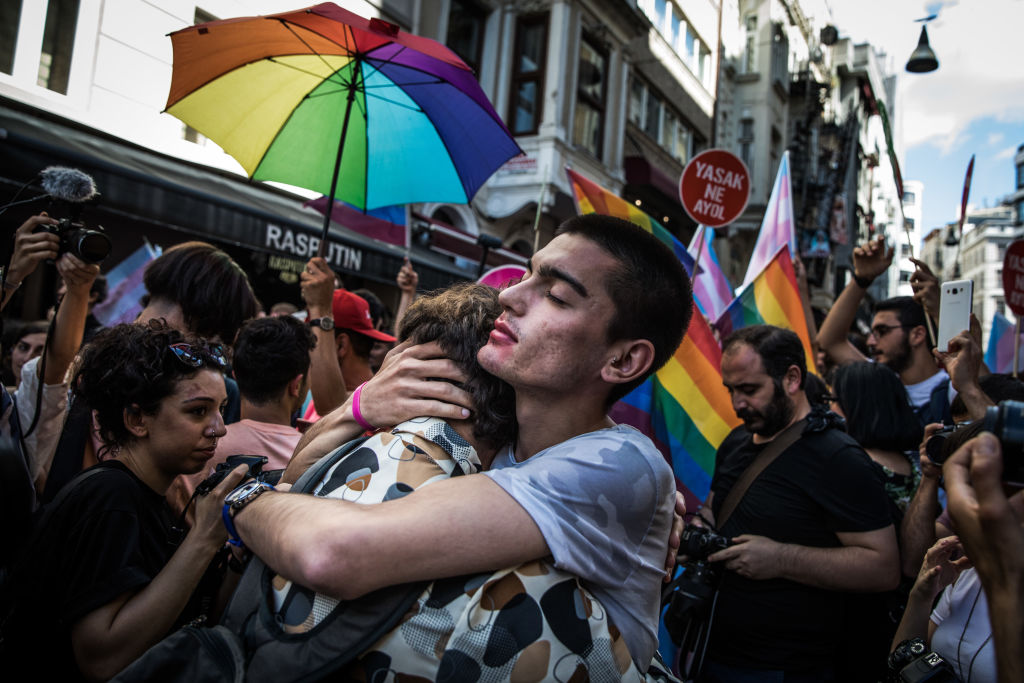
On Sept. 12 and 13, the government of Türkiye conducted raids on the offices of LGBTQ+ associations, the homes of activists and community venues, affecting nine organizations that include not only the LGBTQ+ communities but also those dealing with gender equality, HIV/AIDS and sex workers’ rights. One hundred and sixty-two people were arrested and charged under an operation titled “My Family is Safe,” and announced that the Financial Crimes Investigation Board would examine funding received by the organizations from public institutions abroad.
While several European countries and numerous organizations have spoken out against the crackdown, the Canadian government did not join in with any of those statements or issue one of their own. This has led to speculation that they were uninterested in being vocal critics of the Erdoğan regime in Türkiye as they are in the process of negotiating a bilateral trade agreement.
When pressed by reporters at an event on Sept. 25, foreign affairs minister Anita Anand insisted that Canada’s position relating to LGBTQ2S+ rights and the rights of minorities is clear.
“We do not stand for discrimination, mistreatment or in any way bias, systemic or otherwise explicit, against LGBTQ2S+, period,” Anand said. “It is routine for countries to come together to make joint statements. The fact that we weren’t on that joint statement should not be taken at all as a sign that we do not stand with the LGBTQ2S+ community. Our position is clear. It has not changed. And Prime Minister Carney, at his level, has also been clear on this point.”
Anand’s office would only repeat her statement at the press conference and not comment further.
Global Affairs Canada did not respond to Xtra’s queries, but told The Canadian Press that they are “in close contact with LGBTQ+ organizations and advocates in the countries where we serve. These trusted partners provide valuable insight into conditions on the ground and help guide Canada’s support for individuals facing discrimination or persecution.”
The Canadian Parliamentary Pride Caucus did issue a statement of their own, condemning the crackdown and rejecting the use of “family values” and the supposed protection of children or public morality as justification to engage in discrimination, intimidation and the suppression of fundamental human rights.
“Part of the role and responsibility of the Canadian Parliamentary Pride Caucus is to ensure the voices and concerns of LGBTQ2S+ Canadians are heard in Parliament, including when LGBTQ+ people and human rights defenders are being targeted abroad,” Progressive senator Kristopher Wells, chair of the Pride Caucus, tells Xtra. “The direct targeting of LGBTQ+ communities and organizations in Türkiye is particularly concerning and is part of a disturbing global trend that demands intervention.”
Wells notes that while the government has been clear that they support LGBTQ+ rights around the world, the Pride Caucus encourages the government to use “every appropriate diplomatic channel to advocate for the safety, dignity and fundamental rights of LGBTQ+ people in Türkiye and wherever threats to democracy occur.”
The crackdown on queer and trans people is concerning and forms part of a larger pattern across countries.
“Türkiye is a country that says it’s a democracy and respects human rights, and other countries are looking at what’s happening [there],” says Doug Kerr, executive director of Dignity Network Canada, an umbrella organization working with over 60 civil society groups to advance LGBTQ+ rights. “The bigger picture is that there is a rise in criminalization and restrictive laws, and this is a very direct attack on the civic space and human rights in the country.”
Kerr notes that LGBTQ+ people are being used as a political target as part of the broader perspective.
“We can’t stop every crackdown, but there is a lot going on,” Kerr says. “In the last few months in Senegal, there has been a really bad wave of arrests and targeting, along with a number of other west African countries, but Canada can decide when we show up and how we show up, and this is one of those moments. We really started seeing this a decade ago in Russia, and look what’s happened since.”
Kerr points to the presence of a large number of civil society groups in Türkiye, and there are still opposition parties that present a challenge to the dominant political party. That the government intentionally targeted the LGBTQ+ component of it was a way to crack down on civic society.
“This isn’t just an attack on LGBTQ+ people, it’s an attack in a country that, in its context in the region, has been a country where queer people can live, organize, and meet,” Kerr says. “This is an attack on democracy.”
@xtramagazine A brand-new LGBTQ2S+ Canadian national monument is set to be unveiled in Ottawa this week. Officially named Thunderhead, the monument serves as a space to commemorate and reflect the hardships, experiences and achievements of queer and trans people in Canada. The main structure is a 30-foot-tall cylinder, with the imprint of a thundercloud hollowed out of its centre. The interior is lined with thousands of mirrored tiles, meant to invoke disco balls while reflecting and refracting light. The site also includes a garden, stage and a fruit orchard—a nod to the pejorative term “fruit” used to refer to LGBTQ2S+ people and a reference to the “fruit machine” device of the 1950s and 1960s, which supposedly identified homosexuals based on physiological responses. The monument is located in downtown Ottawa near Portage Bridge. The structure is funded from a successful class-action lawsuit against the Government of Canada by survivors of the LGBT Purge—a systematic campaign targeting LGBTQ2S+ members of the RCMP, public service and military in the second half of the 20th century. We break down what you need to know. #lgbtqnews #canada #canadanews #lgbtqhistory #ottawa ♬ original sound – Xtra Magazine Advertisement
In recent months, a court decision in Türkiye removed the party chair of the main opposition party, which Human Rights Watch denounced as an effort to undermine civil and democratic rights, as well as the country’s democratic process.
But with trade negotiations being an apparent consideration, Kerr says that Canada should not be looking at engagement and human rights as either/or, and that there are lots of countries that have bad human rights records all around the world, and things can go either way.
Canada has been pursuing closer ties with other especially repressive regimes such as Qatar and Saudi Arabia, and Kerr says that while we can’t ask Canada to choose between engagement and human rights, rights need to be part of the engagement.
“Canada has to show up through our diplomacy, through the work of our embassies, and some of that work might be quieter, and some of it might be more public in this moment, as we saw from some European countries that have made statements, and some of those countries have agreements with Türkiye,” Kerr says. “Iceland has a free trade agreement with Türkiye and they were still able to make a criticism of its trade partner. Canada can still show up.”
Asya Gunduz, board chair of LubunTO, a group dedicated to LGBTQ+ immigrants “from Türkiye and beyond,” says that there is concern that there will be further crackdowns and harassment ahead of the planned 2028 elections.
“I want Global Affairs to take a clearer stance,” Gunduz says. “Canada needs to take a clear, deliberate stance before signing with the agreement. What’s happening in Türkiye is an autocracy, and Canada needs to stand against the regime’s anti-LGBTQ+ surveillance and homophobia and transphobia.”
In Canada, the NDP have called for a suspension of trade talks with Türkiye over the crackdown.
Kerr says that deeper economic relationships can sometimes create more opportunities for countries like Canada to raise human rights, but they also can’t negotiate an arrangement while ignoring the dismantling of civil society.
Kerr says that while trade gives Canada influence and a channel for engagement, the U.S. has been withdrawing from the democratic space internationally, and there is the impetus for Canada to show up more.
The notion that more trade will improve human rights has long been the assumption in this country, but that hasn’t happened in some of the biggest examples, like China. Kerr notes, however, that it has worked in places like Thailand and the Philippines.
“It’s not a linear path,” Kerr says. “It’s complex and not directly tied to the trade relationship, but it is tied to being part of the global community.”
Kerr also cites Hungary as a country that was on the path to illiberalism that was changed after their last election.
“Türkiye is still a democracy,” Kerr says. “They are trying to create fear, and using LGBTQ+ people as a bogeyman, but that still happens here in Canada. It’s something that has to be part of the conversation when you’re engaging with countries that are supposed to be our friends and allies.”
Kerr says he is still hopeful that the Liberal government will follow through on their promises from the last election to continue to support LGBTQ+ rights in our international assistance, as well as support refugees, even though foreign aid has been cut and the government has moved to restrict the number of asylum claims accepted.
“Right now, the 2SLGBTQI+ Action Plan is up for renewal,” he says. “This shows why the international pillar of the Action Plan is important and should be renewed. It’s a tough moment—things are not going to change overnight in Türkiye. It’s going to take years, but this is the moment where Canada can recommit to doing this work, whether it’s through our international assistance or our foreign policy over all, this is the moment where Canada can say what we stand for.”

 Why you can trust Xtra