It wasn’t the tattoo that first drew me to Ace, but the first time I saw it—endless, etched in bold letters, slightly faded green ink, Helvetica font stretched across his chest—I knew we’d get along.
It began on Instagram, as most relationships seemed to start back in the late 2010s. I followed him; he followed me back. I liked a post; he liked one back. I commented on a photo; he commented back. It was a familiar game of probing to see if, maybe, there was some shared interest. I treated each photo on his feed like a hieroglyph, inferring meaning from images to cook up an idea of the life we could have together. A headless photo of him in pleated trousers, a leather belt and a ribbed tank top meant we’d bond over fashion; a photo of him in front of the Louvre in Paris meant he enjoyed travelling the same way I did; a shot of him drinking coffee at the latest café in Toronto’s West End meant he had cultivated an aesthetic I was chasing so desperately in my early 20s. But a cropped photo of his chest, with endless stamped across it, meant he was a Frank Ocean fan. It was the post that finally gave me a way in.
I was in my early 20s when I met Ace, but Frank Ocean had already soundtracked my first love.
I came out in the summer after eighth grade with a Facebook post featuring a photo of me holding an embarrassingly long Sicilian squash. It’s not as sexual as it sounds—I was simply holding a squash my grandfather picked from his garden. Still, as September creeped closer, I felt anxious about starting high school gay.
Growing up in a distinctly Italian neighbourhood just north of Toronto, I attended a Catholic high school. My typical teenage angst was compounded by being mixed-race Black, raised by a single mother and the only boy at school who had come out. But I was used to being different.
I don’t remember meeting Jacob. I only remember that my friends introduced us. Jacob.
Jacob was shy when I first met him, but as I got to know him, I realized Jacob was funny. Jacob was also cool. Jacob played his music on a speaker as he rode his longboard to school, Nicki Minaj thumping from a red Beats Pill as he approached the school doors. Jacob was—to my surprise, to my delight—also gay.
He soon became part of my friend group, and eventually, we started hanging out alone. A lot.
In the winter, my friends and I would pile onto the big leather sofa in my basement and watch movies for hours. My basement also became the place where I hung out most with Jacob, watching queer foreign films. It was the setting for our first kiss.
It was Grade 9 and we were warming up from the cold November air, sharing heat on the leather couch. We were in my basement, but Jacob chose the song: “Practice” by Drake, a song I haven’t listened to much since then.
Most of the details of that kiss are lost to me. I remember that we held hands, and that I shifted myself awkwardly on the couch, aware of my weight against him as the leather contoured beneath us. The sweet smell of his drugstore hair product lingered on my fingers. A smell I came to love.
Mydriasis. It’s the scientific word for pupil dilation, which can happen when you feel intense emotions like love. It’s the best explanation I’ve found for why the world seemed so much brighter when Jacob was around. Why life, which had once seemed so dull and fuzzy, suddenly became sharp and colourful whenever I saw the curve and swoop of the uppercase J and the rounded lowercase letters that followed it glowing on my phone when he called.
channel ORANGE, Ocean’s debut studio album, came out in the July of the summer after Grade 10, when the Japanese maple my mom had planted in the middle of our backyard was already in full bloom.
It was under that tree where I spent many summer days with Jacob, chasing its shadow across the grass with a blanket. We would lounge in its shade, listening to music as the afternoon sun grew hotter. It was there that Jacob and I fumbled with the hard plastic of the channel Orange CD when I first bought it.
A week before, Ocean released an open letter on Tumblr. In it, Ocean describes falling in love with a man during his 19th summer.
“By the time I realized I was in love, it was malignant … It was my first love, it changed my life,” Ocean wrote. It was his coming out letter. The letter later appeared in the album booklet that came with the CD.
Having the physical letter in my hand was like holding an amulet. I ran my fingers over the glossy orange paper, tracing Ocean’s coming out story. Ocean was queer like me. Black like me. He felt like mine. And listening with Jacob under the shade of my maple tree, he felt like ours.
I adopted Ocean as a sort of gay godfather. I even changed my Twitter and Instagram handle to dannyocean.
Over the summer, Jacob and I listened to that album together, contemplating the lyrics and their meaning. And as my infatuation with Ocean deepened, so did my love for Jacob. The more time we spent together, the more I expected him to be near me. I began withdrawing from other friends, keeping my schedule open in case he called me. During sleepovers, I’d press my ear against his chest and hold my breath, willing our heartbeats into sync. But the more interested I became, the more he withdrew: he cancelled plans, fell asleep on me, left me waiting and made plans with other friends. I pulled; he pushed.
“I can never make him love me. Never make him love me,” Ocean moans on “Bad Religion.”
There was no finality between me and Jacob. No brave conversation like the one Ocean describes in his letter, no admission, no honest confession in a Nissan Maxima on a summer night. Turns out I wasn’t as bold as Ocean. I had adopted the name, but not the courage.
Instead, things faded gradually between us. Jacob told me we couldn’t hook up anymore. Weekend-long sleepovers eventually turned into me begging him to stay over even just for a night. If we wouldn’t hook up, at least I could feel the curve of his back against my belly as we cuddled. If we wouldn’t kiss, at least I’d wake to his soft breaths on my nose in the morning. If he wouldn’t be mine, at least I could smell the scent of his hair as it lingered on my pillow for a few days after.
I stayed close friends with Jacob long after it stopped being romantic.
“I kept up a peculiar friendship with him because I couldn’t imagine keeping up my life without him. I struggled to master myself and my emotions. I wasn’t always successful,” Ocean wrote in his letter.
Each time Ocean dropped a new album or new music, Jacob and I listened together. But even when Ocean dropped Blonde in 2016, widely considered his best album, none of it hit for me like channel ORANGE did.
Until I met Ace.
By the time I met Ace, I had outgrown dannyocean. I left the suburbs to attend university in Toronto, and I was finding a queer community at parties across the city.
The follows, likes and comments eventually progressed to a message on Instagram.
“Hey, I’m going to Paris soon and I’d love some advice on places to go,” I wrote.
“Sure, let’s hang out and I’ll give you some recommendations,” he wrote back.
My first memory of him was his outfit. It was the first week of May and probably around 12 degrees that evening, but after enduring nearly six months of winter, Canadians devour every scrap of warmth with a ravenous appetite. So Ace wore shorts. I met him at Bathurst Station, lit a cigarette outside its doors and watched as he emerged in a baggy Harley-Davidson shirt, black shorts and an oversize navy-blue trench coat that draped perfectly over his frame—a coat we’d spend the next three years sharing custody of.
We met under the pretense of me asking him for advice on Paris, but spent the night walking around the city, talking about where we came from and where we hoped to go.
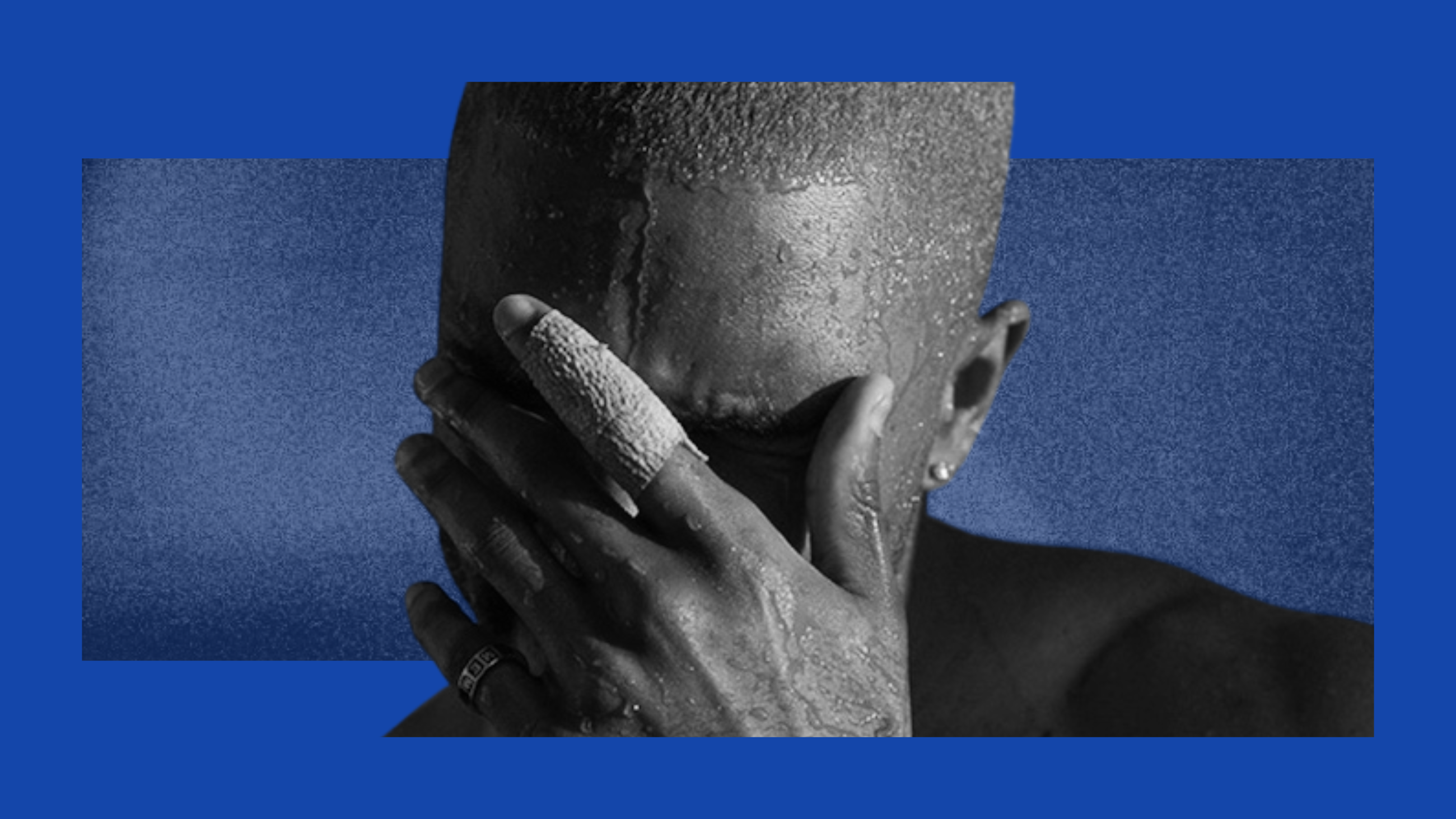
After three dates, Ace invited me over to his home—a small house in the Annex that he shared with a roommate. His room was quaint and cozy. A framed poster of Frank Ocean hung above his bed like the idol of the Madonna my Italian grandmother displayed above hers. It was the album cover for Blonde.
Blonde’s lyrics feel like diary entries. Where channel ORANGE used characters like those in “Super Rich Kids” to examine class, the insecurity of growing up queer and Black and the shame of unrequited love, Blonde turned inward to explore isolation, nostalgia and identity. The shift felt confident, as if Ocean had decided he no longer needed to hide behind characters or music that felt grand, cinematic, familiar. This is where I’m at, he seemed to say. Take it or leave it.
Perhaps I felt Ocean belonged in my past, just as I thought Jacob did, along with all the memories Ocean’s music had come to represent for me. But Blonde was Ace’s favourite Ocean album, and eventually, it became mine.
Our song was “Skyline To.” “This is joy, this is summer,” Ocean sings. “Making sweet love, takin’ time.” Four years after he released channel ORANGE, Ocean’s love finally felt reciprocated, and I was finally in a relationship where the love felt mutual.
About a year into our relationship, Ace made me his emergency contact, after an abscess inflamed his molar and sent him to the hospital. I was 24 and he was 25. I couldn’t afford to move out, or to move in with him, but being his emergency contact—having my name documented on an official hospital record—made the relationship feel mature, legitimate.
“Why did you break up?” has always felt like an unfair question. How do you capture three years of love and the gradual erosion of a complex relationship with a short answer? I could tell you that I cheated. I could tell you that, in trying to find my tribe in my mid-20s, I often confused philia with eros. I could tell you that I apologized to Ace at a packed Lebanese restaurant—why I chose Paramount to admit to cheating is beyond me—and that he cried into his lentil soup.
But none of those answers capture the nuance or slow deterioration of the relationship: the way Ace tried, but couldn’t find it in himself to forgive me. The way he grew suspicious of even my most mundane texting. The way I understood. The way I tried to remain patient, but eventually got tired of him looking over my shoulder.
Ocean released Blonde a decade ago. It was his second and, so far, last studio album.
There’s no news or rumours of an upcoming album. For now, I’ve satiated myself with what I have: “Pink + White” played beachside, “Ivy” during a hot shower, “Self Control” belted out during a long summer drive. Ocean’s music helped me understand myself. It soundtracked two great loves in my life. But I’m in a new relationship now, one that I’ve built over many years. As for the music, Ocean’s songs don’t belong to anyone anymore. They’re beach songs, shower songs, driving songs. I’ve earned that.

 Why you can trust Xtra