A young woman is dropped off at Stanford by her parents for her first semester of college. Her mother looks around reverently, telling her daughter about how when she first immigrated to the United States from India, she pictured herself studying here—and now her own child is attending the prestigious school for real. Rishi, short for Rishika, is eager to leave her mother’s expectations behind, and is soon running around campus with a queer friend group, choosing creative writing classes and first gay hookups and interpersonal drama over career planning.
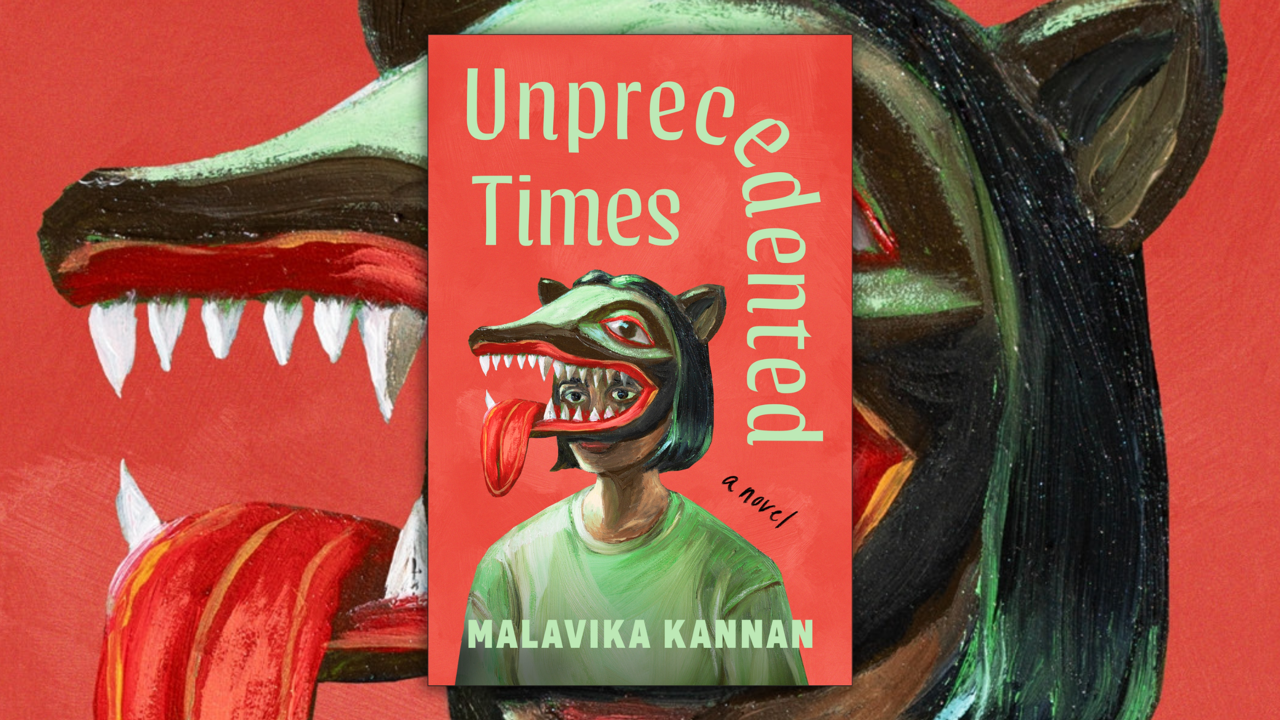
Malavika Kannan’s debut novel, Unprecedented Times, has all the makings of a classic campus novel—albeit one narrated by a queer brown woman instead of the more usual white protagonist—in which a school environment acts as a closed setting, ruled by its own hierarchies, systems, assumptions and rituals. It’s a heady atmosphere in which its characters are untethered, for better or worse, from their families and places of origin.
Though it shares some similarities with campus novels by other Asian American women writers, like Elif Batuman’s The Idiot (in which a Gen X Turkish American woman navigates questions of love and existentialism at Harvard in the 1990s) and Elaine Hsieh Chou’s Disorientation (in which a millennial Taiwanese American PhD student is radicalized when a hitch in her dissertation causes campus-wide chaos), it diverges from the genre after the first act.
Midway through Rishi’s second semester as a freshman, the COVID-19 pandemic hits the United States. The ensuing country-wide lockdowns and shuttering of college campuses bring her college experience to an abrupt halt. Campus suddenly ceases to exist as the university becomes a conceptual space rather than a physical one, conducted over Zoom, and Kannan’s characters must remake themselves—again.
Unprecedented Times is an unmistakably Gen Z coming-of-age tale. Its teen characters, unlike their generational predecessors, have already been highly online for years, achieving political jadedness and in some cases viral fame well before starting freshman year. Rishi and her friend Clara, veterans of the youth climate movement, are already embittered from fighting a nation of adults who are seemingly immune to the pleas of their children to stop destroying the planet. “Burned out at eighteen,” Rishi and Clara joke. “At least it’s better than pregnant.”
Like Kannan, Rishi was, in her later high school years, briefly famous for organizing die-ins and walkouts with other youth to protest fossil fuel use while debating climate change deniers on Twitter. She has already learned, via her activism, as well as the backlash of the #MeToo movement and the unstopped “tidal wave of mass shootings,” that widespread protest and online discourse do not necessarily lead to material change.
However, Kannan is careful to show us that although Rishi and her friends are world-weary at such a young age, they are still naive and inexperienced in their personal lives. Rishi has come to Stanford determined to break away from the fears and expectations of her mother, and start living life as a lesbian. At her primarily white straight high school, she avoided making close friends or dating. Now, plunging into intimate relationships with other queer and racialized people, she is as clumsy and anxious as someone her age is likely to be, especially when navigating queer sex and intimacy for the first time. “Is this what it feels like to be hate-crimed?” Rishi wonders, with her signature mix of self-pity and self-deprecating humour, when she is broken up with by her first-ever regular hookup, a white bisexual named Esme. Later, this experience of rejection is dwarfed by far more devastating heartbreaks that seasoned queers will read about with painful recognition.
Kannan’s characters, most of them queer and racialized, are just beginning to figure out who they might be, away from high school and family expectations; but the pandemic forces them back to the homes they just left, and for some, including Rishi, the closets they just came out of, as if their nascent college selves were just a dream. The book slowly reveals a subtle parallel between this collective experience of rupture, and the more dramatic rupture that Rishi’s mother, like many other young immigrants, was shaped by when she chose to leave her family in India to make a life for herself in the United States. Kannan is able to illuminate both the pain and frustration of Rishi’s relationship with her anxious, overbearing and homophobic mom, and the slow dawning of understanding that arises between them as the events of the book unfold.
Despite its buzzy title that references the political malaise of the 2020s, Unprecedented Times is less of a political book than an intimate personal novel about surviving the vertiginous years between adolescence and adulthood, within a political landscape that polarizes increasingly the harder the world burns. “How dizzying it is to be thunderously big in some moments and crushingly small in others,” Rishi remarks partway through the book, reeling at how a seemingly minor event can have life-altering consequences while a seemingly major happening can lack a discernible impact. Getting accepted to a prestigious summer academic program can lead to nothing when the pandemic cancels everyone’s trips abroad; meanwhile, failure to process one moment of intimacy can lead to months of heartache.
Unable to stomach the idea of returning to Stanford via Zoom for their sophomore year, Rishi, her best friend Georgia, Clara and a couple of others convince their families that it’s a better opportunity to take a gap year and go live on a communal farm in rural Pennsylvania. The project is run by a Stanford alum and former McKinsey consultant who has decided that living off the land in small groups is the key to surviving the climate apocalypse. Big Sky Farm, its leader and his hangers-on provide a clear opportunity for political satire about the hypocrisies and foibles of idealistic leftists, but instead, Kannan mostly focuses on the mounting tensions in the original friend group that arise in this closed setting. In a way, the farm is merely another campus for her characters, closed off from the rest of the world. Just like their college campus, the farm can only serve as a haven for so long before another set of circumstances pushes Rishi and the others to make yet another set of life decisions.
Throughout Unprecedented Times, Rishi and her peers navigate the waves of uncertainty and dread caused by the pandemic, all of it stirred into the cocktail of anxiety, horniness, excitement and heartbreak that characterizes the lives of people in their late teens and early twenties. Kannan skillfully portrays how her characters, young as they are, are able to continually invent new ways of moving through their years of young adulthood. Often, this imperfect navigation means enduring painful personal losses; at other times, it can lead to hard-won understandings between mothers and daughters, and important nuggets of self-understanding.
When the pandemic shutdowns are initially announced, Rishi laments: “I am not ready. My life has just begun, and now it is changing again, so fast it leaves me dizzy.” Nevertheless, she keeps making it up as she goes, sometimes alone, sometimes accompanied by her friends and family. All signs point to these unprecedented times continuing to buck us all onto our asses over and over again, but Kannan imbues her novel with a hopeful reminder: that queer survival has always been about continuous reinvention and creativity in the face of adversity, no matter what the world may bring next.

 Why you can trust Xtra