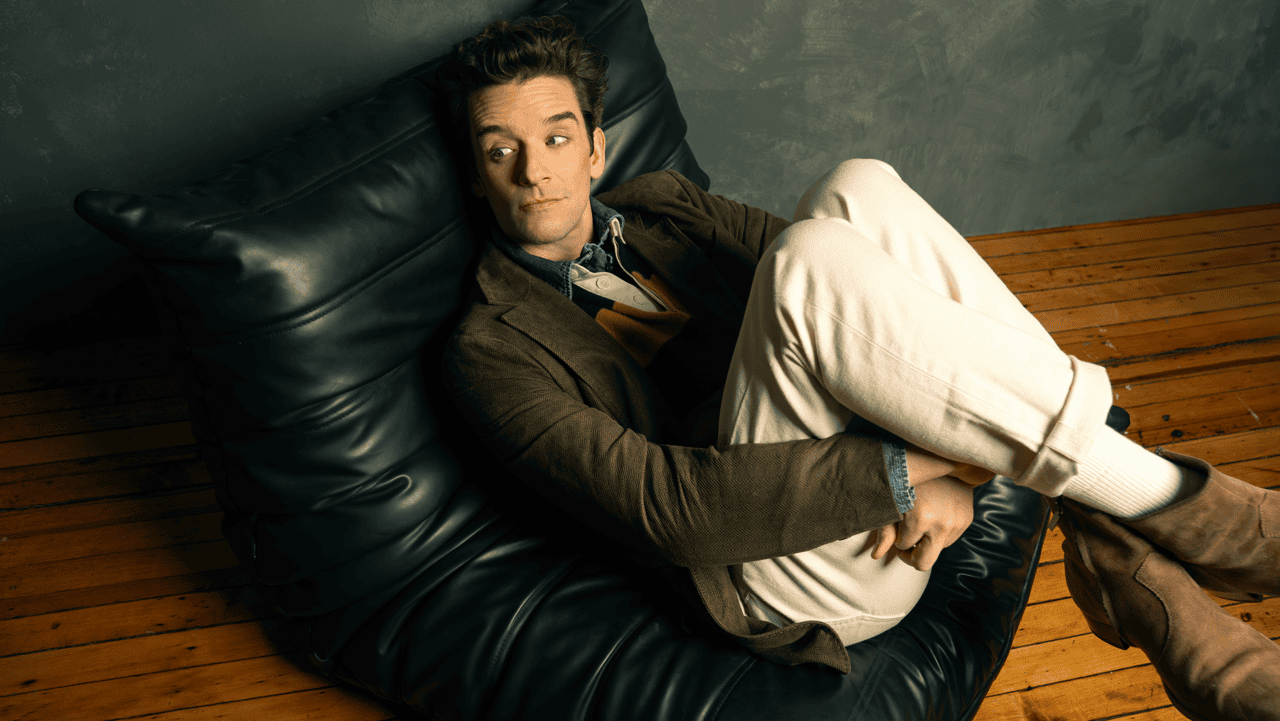
Michael Urie is having quite the year. He stars in the Apple TV+ comedy series Shrinking as the fast-talking lawyer Brian, who is handling the highs and lows of being a queer parent. His performance in the third season earned him his second Emmy nomination. He’s just wrapped his West End debut as Mary’s Teacher alongside Cole Escola in Oh, Mary! after playing alongside Jinkx Monsoon on Broadway. And September marks the 20th anniversary of Ugly Betty, which featured his breakout role as Marc St. James, the gloriously gay assistant to creative director Wilhelmina Slater (Vanessa Williams).
I met with Urie at a London bar a few minutes from Trafalgar Theatre, where he was performing Oh, Mary! eight times a week alongside Escola, a few days before he was heading back to Los Angeles to film Season 4 of Shrinking. He’s every bit as charming as you’d expect him to be, exuding a warmth becoming of someone who’s been able to do what he loves for over 20 years. We spoke about the queer appeal of Oh, Mary!, the lasting influence of Ugly Betty and the importance of being visibly queer on screen and stage.
What’s it like to make your West End debut in Oh, Mary!, reprising your Broadway role as Mary’s Teacher? On Broadway, you performed alongside Jinkx Monsoon’s Mary. Now, you’re with Cole Escola, who created the show.
Every step of this has been a crazy surprise. I saw the show off Broadway. I saw the show on Broadway. I never imagined that I could be part of it. So when I got to do it with Jinkx, that was already a dream come true. It’s been the gift that keeps on giving. Working with Cole … they’re like Oscar Wilde, but way less predictable. It’s more like Mozart. I often wonder, “Where did this come from, and how did they think of that?”
I defy anyone not to laugh at it. It’s not just for gays and women. I have many straight dudes tell me it’s the funniest play they’ve ever seen.
What do you think makes Oh, Mary! queer art?
As a community, I think we’re protective and obsessive over our broken women like Judy Garland. We also love great actors who play these complicated women: Bette Davis, Parker Posey, Glenn Close, Melanie Griffith, Meg Ryan. I think about these performances I respond to—I feel more like them than the men grabbing them, and Oh, Mary! is a composite of all these amazing women. Without giving anything away, there’s also a lot of heterosexual posturing going on in the play, and watching queer actors do that is really satisfying.
What’s it like for you to inhabit that in Oh Mary! every night?
When l went to Juilliard, we studied the classics and I gravitated toward roles like Benedick in Much Ado About Nothing, or even Harry in When Harry Met Sally… I wanted to play great comic scenes with leading ladies. That didn’t happen for me. I got to play all these amazing queer characters—sidekicks, evil queens, sweet queens—-but I never got to play the romantic hero. In Oh, Mary! I get to stretch that muscle.
Everyone involved in the play grew up on heterosexual media. I also cut my teeth on queer media. To get to do a play that has notes of both feels so fresh and new. I’m so proud to be in queer theatre, and it’s incredible that something like this can be a Broadway juggernaut.
Queer theatre has taken over. You have Oh, Mary! and Cats: The Jellicle Ball, you have non-binary and trans artists winning Tonys. What do you think it is about theatre that makes it kind of ahead of the curve?
It doesn’t demand as big of an audience, which allows you to be more niche. You don’t need to pull millions of viewers, so you can take chances. I think there’s a greater patience to a theatre audience. There are no phones! There’s more patience to understand the human condition. Amazingly, straight people respond to such queer stories. Queer stories don’t have to just be for queer people.
You’re about to start filming Season 4 of Shrinking. Do you feel a particular responsibility when playing queer characters like Brian, especially since he’s a parent?
It’s cool. What I like even more than playing a queer parent is how flawed Brian is. We’re allowed to be a mess too!
Sometimes people who make TV feel a responsibility to do it right. I appreciate when they’re not afraid to take risks. On Ugly Betty, when they introduced my character’s mom, she turned her back on him. That was bold. It was hard for us to play and hard for me to put out there, but it meant a lot to people.
I go back and forth. Sometimes I think it’s important for us to show the way the world can be, and sometimes I think it’s really important to remind people of how it is for those kids growing up in a small town, who are the minority in their own family.
Ugly Betty, which turns 20 this year, straddles both lines. Marc St. James was a character who had struggles, but got a truly happy ending. I’m curious if the representation you saw on TV growing up influenced how you brought Marc to life. Ugly Betty is such a spectacularly queer show.
It was! We had a queer child, we had a trans woman and Marc had love interests. And then we had lots of designer types that would come. Vanessa Williams is a queer diva icon, and we had a whole queer-friendly family. It was radical.
The shows I grew up with definitely influenced my performance. There was a sitcom called Brothers on Showtime [in the ’80s]. I don’t even know how I saw it, but there were two gay characters. I remember watching and asking my mom all sorts of questions and she answered them—my parents were always very cool.
Then Will & Grace came along, and I loved that. It was allowing these queer characters to be lovable and have power, and they weren’t traumatized. For Ugly Betty, we took things to another level and really embraced the camp. It was based on a telenovela, and Vanessa and I were the villains. I always thought of us as Shakespearean villains who would come out and tell the audience what they’re about to do, and when they’d go do it, they’d say to the audience, “Did you see what I just did?”
There’s something about gay characters where there’s another level of self-awareness. In the [1980 parody] movie Airplane!, there’s a minor character named Johnny. He doesn’t say he’s gay, but it’s obviously there. He was the only one who knew the movie was a comedy. He’s in on it in ways that nobody else is. I tried to bring that sensibility to Marc.
What do you think Ugly Betty’s legacy is today?
Let your freak flag fly!
There’s a lot of joy in being queer, but there’s also a lot of hatred surrounding the community. You’ve been in visibly queer roles for over 20 years. Why do you think that visibility is so important?
Media is so powerful and so far-reaching, whether it’s on screen or stage. It shows us who else is out there. It can be so easy to stay in our small worlds, wherever we are from. It’s the easiest and safest choice. Some people are born into places where they might not fit in, they might not belong, they might not be happy or comfortable, and the media gives them options.
You can see that you could be a fireman, a doctor. I could be a gay guy working in fashion in New York City like Marc in Ugly Betty—or I could be a gay guy who’s a lawyer and has a bunch of straight friends, like Brian on Shrinking. There are so many options out there and I’m grateful to be part of shows that highlight those possibilities.

 Why you can trust Xtra