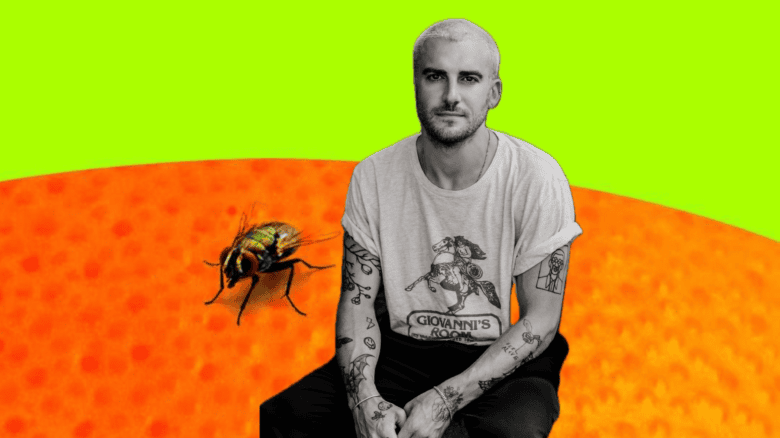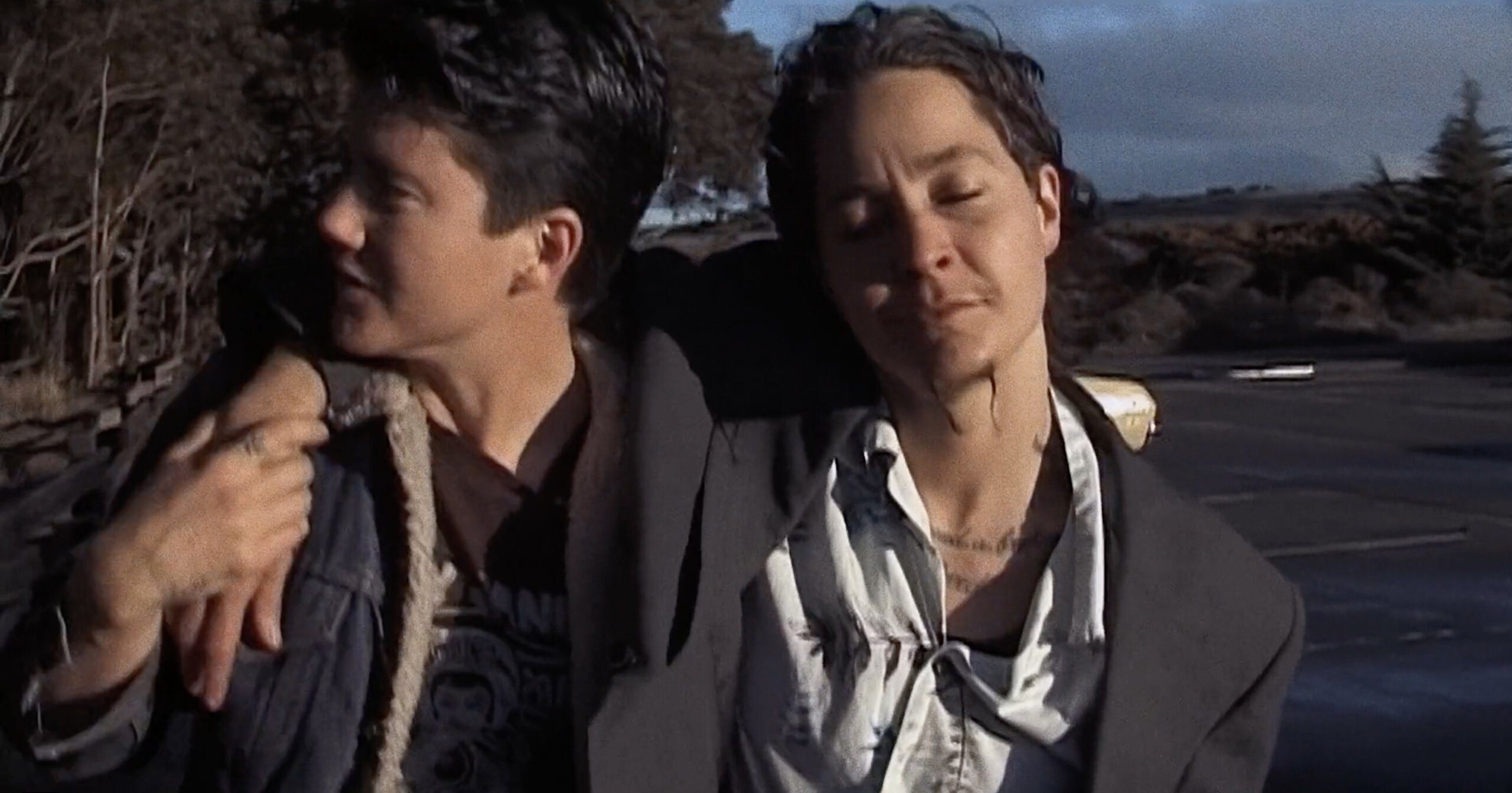
Harry Dodge and Silas Howard, the stars and co-directors of By Hook or by Crook, never set out to make a movie that was a landmark of representation. Yet, by leaning into the idiosyncrasies of their experiences, and into the unglamorous realities of many working-class queer people, they did just that.
The two collaborators met in San Francisco in its pre-gentrification heyday, drawing from their experiences in the city’s queer underground arts scenes to create the characters of Shy and Valentine: two vagabonds who cross paths one fateful night and form a touching brotherhood. Without spoiling too much, By Hook or by Crook is the filmic epitome of “be gay, do crime,” way before that phrase became an overused meme, and way before the overly sanitized wave of LGBTQ2S+ representation that resulted from the mainstream push for marriage equality and respectability. It’s an incredibly refreshing watch, one that stands the test of time and one that viewers can now see as intended thanks to a years-in-the-making restoration, rereleased in theaters this summer and available at home on-demand.
Xtra spoke with Dodge and Howard, touching on the film’s lasting resonance, the importance of butch identity in the film and what people get wrong about representation.
This year marks the 25th anniversary of By Hook or by Crook, and it seems as though the remaster is leading to a new audience. Watching the movie, I was also struck by how contemporary it feels. Why do you think it still holds up today?
Harry Dodge: For the last 25 years, Silas and I have both been getting emails from people who have just discovered the movie, or they saw it when they were a kid, or they saw it 10 years ago and now they want to show their friend. It’s never dipped and disappeared. This idea of the restoration seemed perfect because it had really gotten degraded over years with all those film transfers and the weird way it would lose info. We were down to, like, 10 pixels on a few of the shots.
As far as why it stands the test of time … I don’t know what Silas thinks, but we didn’t want the movie to be in time. We didn’t use contemporary vehicles. Cellphones were already a thing, but we found the last three phone booths in California. And we love ’70s movies, so even the costumes have a vintage ’70s aesthetic that we were after.
Silas Howard: There’s something that’s beautiful about this intergenerational love and conversation, and that it’s held up is one of the biggest compliments, honestly. And I think the timelessness is part of what Harry said. We were definitely in queer time. But I think what we also had was full permission to do what we wanted to do. We had the support of Steakhaus, we had the support of our community, we had the support of everyone who mattered that helped us make this movie. And I don’t think I’ve had that since. It’s really difficult. It’s a very conservative medium.
And to have that kind of freedom and permission to do your weird ideas is what straight cis white guys get all the time. And they get to make these radical movies in the ’70s and these movements like Dogme 95. But we need to take that strategy and take those obstacles and do it with our own stories.
“We definitely were making a film where the weirdos didn’t die.”
This restoration feels particularly well timed because right now feels like such an exciting moment in trans filmmaking. It feels as though we’ve moved from the respectability politics of the 2010s to something a little more punk and confrontational. What are your thoughts on the current aesthetic movement of trans cinema, and how your film fits into that lineage?
SH: It’s the time for DIY. We need to make things outside the system. And I love the films that I’m seeing of this generation that’s younger. The kids are all right.
HD: Silas and I had both wanted to be actors when we were little kids, you know, and we …
SH: We also both auditioned for Boys Don’t Cry …
HD: Hillary Swank is a very good actor. In those audition tapes, you’re kind of like, oh!
SH: I think we hold our own. I think I’m gonna say she did a great job.
HD: My audition’s awful. It’s hilarious. But I was gonna say that at the time, there were very few little tomboy kids running around. We didn’t see parts that we would be able to play even if we did try out for stuff.
We talked about gender a lot [in the mid-’90s]. And it took me a long time to get to the word “butch,” because I was reading Joan Nestle’s book The Persistent Desire, and it seemed like all the butches in that book were very suave. They were way cooler than I could ever be. Very swashbuckling. And I’m such a dork, and I’m so wiggly. You can see an alter ego of mine as Valentine in the movie, so wiggly. And we talked and talked, and eventually I opened that word up enough to be able to just take it and break it and be like, “Well, I’m not suave, but this is my word.” And it’s a word that’s really important to me. Even when I went on to take testosterone, for me, that was a manner of butchness.
So I’m still wanting By Hook or by Crook to carry that suitcase along, even as the world has improved with everybody’s understanding about all the different weird ways gender can work. At the time, we didn’t explain anything, but weirdly, now, in the copy for the movie, we had to add “trans and butch buddy movie” to it, otherwise it gets schlupped over into just a trans movie.
So having said that, I would also add that I agree with Silas that queerness, in some ways, has to do with being out of time, or cycling in time. To me, it has to do with the underground thing again. Like, the alternative world-building. Like, you know what? I’m refusing your value system.
Fuck off! We’re looking at our values every day, and we’re trying to be the people we want to be, and make the events that we want to be at, every day. And that seems to me like that kind of world-building, that kind of community-making and togetherness, that was the real power of those times, and I feel like in the face of this authoritarianism, those times are coming back and need to come back.
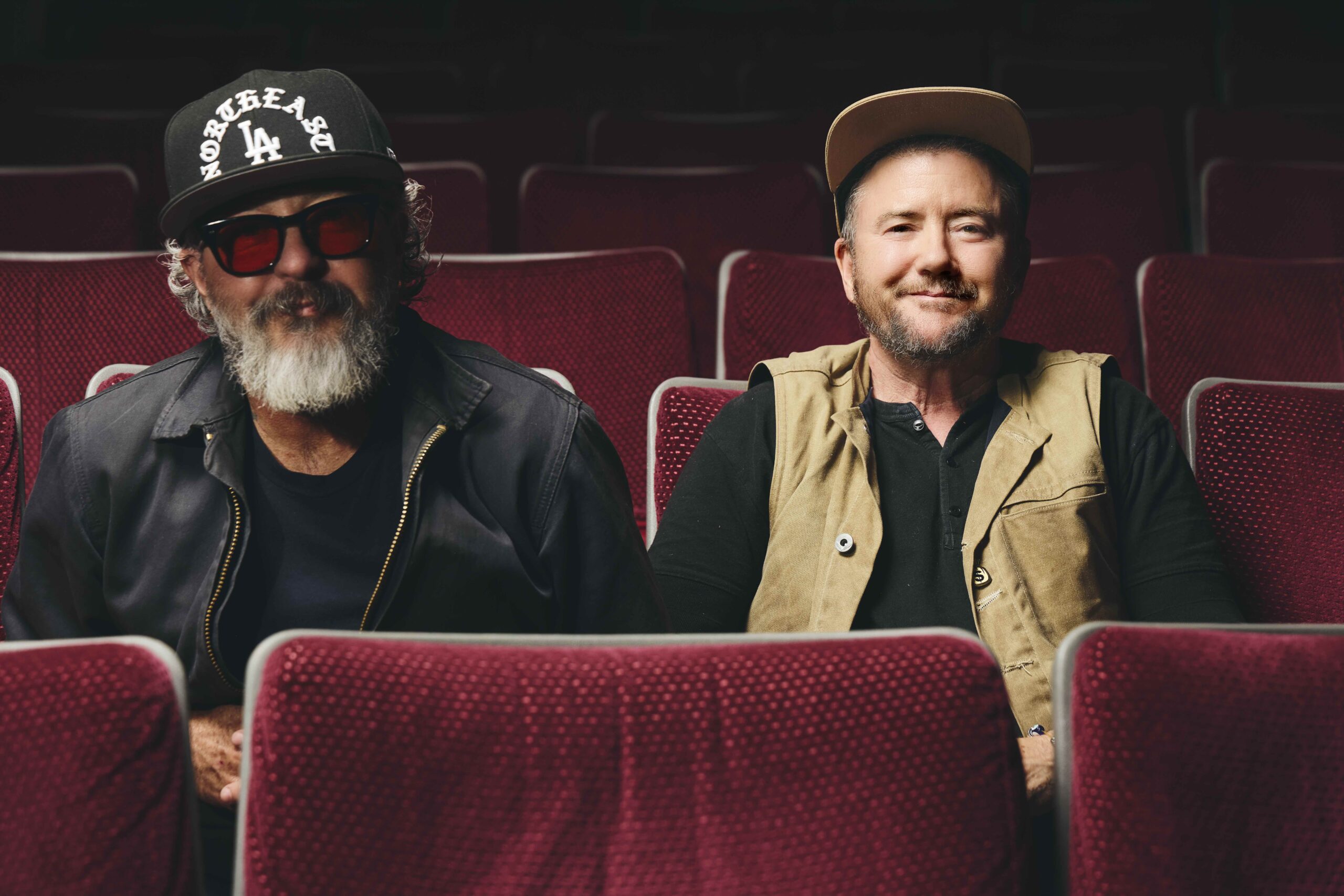
Credit: Jen Rosenstein; courtesy of Altered Innocence
It’s funny that you both brought up Boys Don’t Cry, because something that struck me watching the film was its unapologetic depictions of butch and trans eroticism, which still feel comparatively rare, sadly. Was the inclusion of those scenes a response to that relative absence?
SH: We definitely were making a film where the weirdos didn’t die, because at that point, there were very few trans characters that were portrayed that weren’t either serial killers or killed.
And no offence to Boys Don’t Cry, but the sex scene was really problematic for me in that film. Like, it was traumatic for me, actually. I can’t even talk about it. So, it was important to us to have our representation of a particular kind of sex, which doesn’t even begin to represent all the variations and wonderful ways that we all, as outsiders, get to have sex.
HD: If there was lesbian content in a movie, and they would start to have sex, they’d cut to the window and the curtains would move, you know? We wanted to push on it and see what we could do. I am not an exhibitionist, and so it was really, really hard for me.
SH: He’s a prude, he’s a prude.
HD: But everyone was like, this is important, this is important, and I was like, I know, I know, we have to do this.
SH: I’m a prude too.
HD: I remember we went to, of all places, I think it was Smith College [in Massachusetts]? Some of the people there were like, “Why do you only have straight sex in your movie?”
SH: Yeah, it’s hard to win with any of that, it’s true.
HD: You’re saying that straight people own a position? That’s crazy!
Representation fails. You can represent a story that you want to tell. That doesn’t fail. That’s like, “I’m sharing something with you. This is a story that I felt like telling.” That’s all we’re doing, you know? So, to go out and say, “I want to represent this,” or “I want to represent that,” would be noble, but it would be a well-meaning mistake. Because it’s not gonna work. Because we’re not a monolith.
So the point is hopefully we can tell a story, we can tell it well enough, we can tell it specifically enough, with all its weird idiosyncrasies, without doing it the violence of trying to be general, so that people can “relate,” which is a common mistake. I think when you’re specific, paradoxically, it opens up to being relatable. Hopefully, it can open doors for other people to also tell a story, and then those stories become so numerous that they start to capture and delight people.
SH: I’ve been thinking a lot about the personal versus the commentary on human nature, and again, there’s a paradox where your straight cis white man is telling stories that are not personal, they’re about our society. But they’re all fucking personal, and our personal stories are also saying a lot about ourselves. The cracks in the facade that we see, from our point of view, are so important for everybody.
HD: It’s the same thing in literature, it’s the same thing in theory and philosophy, you know. The minute you mention a self, it’s suddenly a problem, or it’s biographical. But the thing is, everything has a point of view. So this whole idea of a universal point of view is an impossibility.
SH: Objectivity is basically code for white supremacy.
What do you want viewers to take away from the film, especially first-timers?
HD: At the risk of sounding cheesy, I’m interested in the social power of togetherness, which I also call love, broadly defined. This thing that pulls us together, this human urge to be together, and how often we’re a little healthier for having seen each other. Versus just scrolling all day, you know? Or, in my case, writing or making art all day. I gotta actually leave the house and see somebody, or I start to suffer, and I don’t even know why I’m suffering. I wrote a book called My Meteorite that came out a few years ago, and I’m working on another book, which is also about the tension between loneliness and togetherness and finding people. And I feel like that’s also what By Hook or by Crook is about.
So there’s something that I am continually interested in—talking to people about love, talking to them about daring to find each other, daring to say hello, daring to speak words to each other, daring to touch each other, all of these things, and especially right now with AI and all of this pressure to start replacing all of that relationality with a corporate sort of avatar. How nuts is that?
I’m really interested in love, I’m interested in bonding, but also, what I want to talk to you about is the risk and the fear that it takes when you’re at the beginning of an encounter.
SH: The thing that we often say about the movie is that Shy wants to have these grand gestures, nihilistic or not, of being a robber, a product liberationer. And then he realizes the grand gesture is showing up for somebody right in front of him and forming this bond. I think that connection is everything.
If they come away from the movie wanting to go see things in person and not online, that would be a great gift. That’s the spirit of the community that we made it in—we were in rooms together, and on the streets together.

 Why you can trust Xtra