A couple of years ago, I was lying in bed with a younger man when the subject of Madonna came up. We were exchanging bits of pillow talk, two new lovers getting to know each other via their musical taste.
He told me he loved Madonna in part because he had fond memories of his father playing one of her albums when he was a young child. I paused and braced myself, anticipating my own horror at what his response might be, given our decade-plus age gap, which I was already self-conscious about.
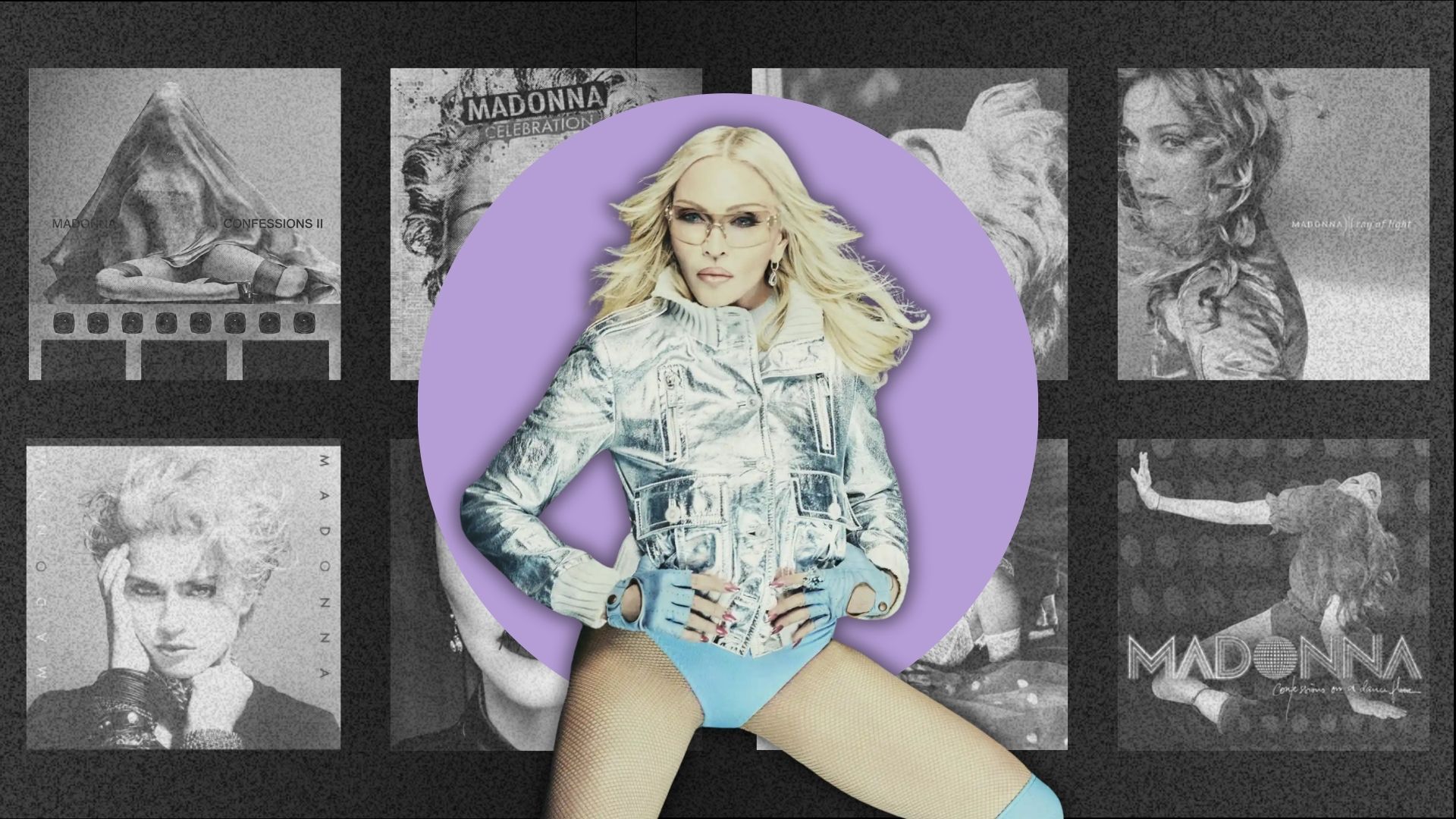
He told me it was 1998’s Ray of Light. By the time that album came out, I was in middle school, watching the video for “Frozen” on MuchMusic between Britney Spears and Backstreet Boys videos. I’d discovered Madonna much earlier via my mom’s cassette of her 1983 self-titled debut. Gay men often call Madonna “Mother,” but in my case, it could theoretically be true: my mother was born just four years before the Queen of Pop.
In bed with the 25-year-old, who was bright and funny and remarkably well versed in culture, I had two thoughts: first, that this man would make a very good boyfriend for someone much younger than me. And second, that the disco ball of gay life had spun around to the point where I was on a different part of the dance floor than before, looking at a younger man who’d grown up with a different Madonna than me.
I was him once. Actually, I was one year younger than my new lover when I fell in love with an older Madonna fan. That boyfriend was in high school during Madge’s imperial phase in the ’80s—he introduced me to her 1991 documentary, Truth or Dare, and told me stories about each Madonna era as I dove into her catalogue.
It was a gift, him passing Madonna on to me. The pop icon is one of the great texts of modern culture, a prism through which we can understand everything from gender to musical genre, fashion and, most importantly, ourselves. She is, especially for anyone who came of age in gay clubs at any point from 1983 to at least the late 2000s, part of the fabric of queer life. In broader culture, she’s also one of our greatest barometers of how young or old we understand any particular age to be.
At 67, Madonna just released an album, Confessions II, that blasted across gay bar dance floors this past weekend from the West Village in New York to West Hollywood and beyond. It’s a sequel to 2005’s Confessions on a Dance Floor, which was the last time she defied gravity and shot a body of work straight into the cultural zeitgeist despite being far older than the age at which the music industry has decided a woman’s relevance expires.
It might be a stretch to say she’s done that again, but Confessions II is by many metrics the biggest cultural event a new Madonna record’s arrival has been since at least 2012, when MDNA was buoyed by her career-spanning Super Bowl Halftime Show. Madonna made headlines this spring by appearing during Sabrina Carpenter’s Coachella set to debut her collaboration with the much younger star, “Bring Your Love.” She appeared in Times Square for a performance sponsored by Grindr, an app that has been plastered with ads for Confessions II. And she cast It Girls of the moment, like Odessa A’zion of Marty Supreme, alongside ones of her vintage, like her OG club friend Debi Mazar, in the Confessions II short film, which debuted at the Tribeca Festival.
Madonna once dominated a monoculture that no longer exists. Now we live in cultural siloes, and she is dominating the one I call home: the world of gay guys. This past weekend, the drag queen Alaska arrived on Fire Island draped in a piece of pink fabric just like the one Madonna wears on the cover of Confessions II. The record store down the street from my apartment in Toronto, Pop Music, hosted two floors of sweaty dudes dancing to Madonna at its album release party. And my social media feeds are full of men posting deranged stuff like “Stuart Price may your balls be forever drained” (a reference, to translate for anyone whose brain is still intact, to the producer of both Confessions and its sequel, who indeed deserves praise for his contributions).
It feels electric to have a great Madonna record after a string of subpar ones: MDNA and Rebel Heart have redeeming qualities, but are among Madonna’s weakest, and Madame X may be the Material Girl’s first bad album. Part of that charge comes from how revolutionary it is for Madonna to put out an album that succeeds at Main Pop Girl metrics at her age; a bar she cleared before any sales or streaming numbers even came in by receiving an 8.1 rating from Pitchfork, which is one of the best scores for a big pop album in recent memory. Almost all the reviews have been positive, softening the need for Madonna to sell records at the scale of younger stars in order to seem relevant. As it turns out, though, she’s surprisingly commercially viable: the album debuted with a career-best 13 million streams and early estimates suggest it will move at least 100,000 album equivalent units in the U.S. its first week, outselling the first-week haul of recent albums from Dua Lipa, Miley Cyrus, Katy Perry and Doja Cat.
The media started calling Madonna a grandma before she’d given birth to her first child. But, against all odds, she dominated pop for three decades, remaking the field in her image as her career progressed despite so many telling her to pack it up. By the time she entered her 60s, most of Madonna’s contemporaries, like Michael Jackson and Prince, were dead. Cher, now 80, broke new ground when she scored a Billboard Hot 100 number one at age 52 with “Believe,” a song that notably similarly catered to her gay audience. But most other pop stars shift into singing in floor-length gowns as they age and either stick to playing the hits or fade away.
Madonna has kept being Madonna, regardless of age. In Times Square this spring, she wore fishnets and a corset and gyrated her hips all over the stage, more or less the same package of pop stardom as when she skyrocketed to infamy for humping the stage at the VMAs in a wedding dress decades ago. Madonna has refused to age gracefully, to dress appropriately or to stop doing whatever it is she does to her face to make it defy human biology and/or reveal her insecurities, depending both on the year of her life and one’s perspective on the matter.
Cosmetic tweaks aside, it’s inarguably unprecedented for Madonna to hold the perch in culture she does at this moment at age 67. In some ways, Madonna is in pace with others in her generation: Boomers who look, feel and act younger than any generation before them as they cruise through their sunset years. My mom, now 71, wears a bikini to the beach in Puerto Vallarta, where she spends her winters alongside many Madonna fans. She goes salsa dancing, wears her hair long and listens to Tate McRae. When I was the age her granddaughters are now, my mom’s mom tucked her short grey curls under a babushka, spent most of her time in her vegetable garden and didn’t bother to shave the hairs on her chin.
Aging has changed in part because women like Madonna made it change. She said it best during her acceptance speech for her 2016 Billboard Woman of the Year award a decade ago: “the most controversial thing I’ve done is stick around.”
Few public figures have faced as much ageism as Madonna. Even in writing this, my fixation on her age could be considered ageist and misogynistic, but it’s worth exploring because the way that Madonna has aged has provided a blueprint not only for future Main Pop Girls but for us all.
Gay men in particular can be horribly ageist to one another. We have whole categories based on age that determine everything from position in bed to what bars you’ll feel welcome at. To age in gay life is to be a son until you’re a daddy. Or at least that’s how it’s been in the past.
Each new generation of queer people resets the terms of gay life. They bring with them new politics, new sensibilities, new tastes. The 25-year-old Madonna fan and I continued to casually sleep together for a couple years, and during that time, I discovered his excellent musical taste extended far beyond Madonna. Then he told me he couldn’t sleep with me anymore because he’d fallen in love and was, like many Gen Z gay guys I know, embracing monogamy, unlike my millennial peers and the Gen X gay men in my orbit who continue on in open relationships through their daddy years.
He’s 27 now, four decades younger than Madonna. The divas his generation worships are different from the ones my cohort adores, but he’s also witnessing an expansion of just how far a pop diva can go—not only with Confessions II but with Kylie Minogue launching a super-viral meme at 55 with 2023’s “Padam Padam,” and Beyoncé maintaining her status as a central pop figure in her forties, most recently snagging a Hot 100 number one with “Texas Hold ’Em” at age 42.
Age changes as we age. I’m 38, which I sometimes joke is ancient for a former twink, but maybe I should stop making that joke. Somewhere in Palm Springs or Provincetown, I imagine there’s a gay guy exactly the same age as Madonna, and I might as well be 27 to him. We’re all old to someone and young to someone else. I like to imagine this fictive 67-year-old spent the past weekend just like I did, by the pool, blasting Madonna and feeling forever young. Maybe, like Madonna, we should all act as young as we’d like to.
There’s one track on Confessions II, “Fragile,” which I keep returning to because it makes me feel solace about the seasons of life, grief and the passage of time. The song is a tribute to Madonna’s late brother Christopher Ciccone, who passed away at age 63 in 2024. On it, she says, with a trademark seriousness that verges on camp, “People really think that there’s a beginning and ending to this thing called life. But energy never dies. This is just a portal we’re going through.”
I think she’s right that energy never dies. But new energy is also always being created, and in her 67 years, Madonna has created more energy than perhaps any pop star in history. And maybe there’s no beginning or end to this thing called Madonna. She’s just us a portal we’re going through.

 Why you can trust Xtra