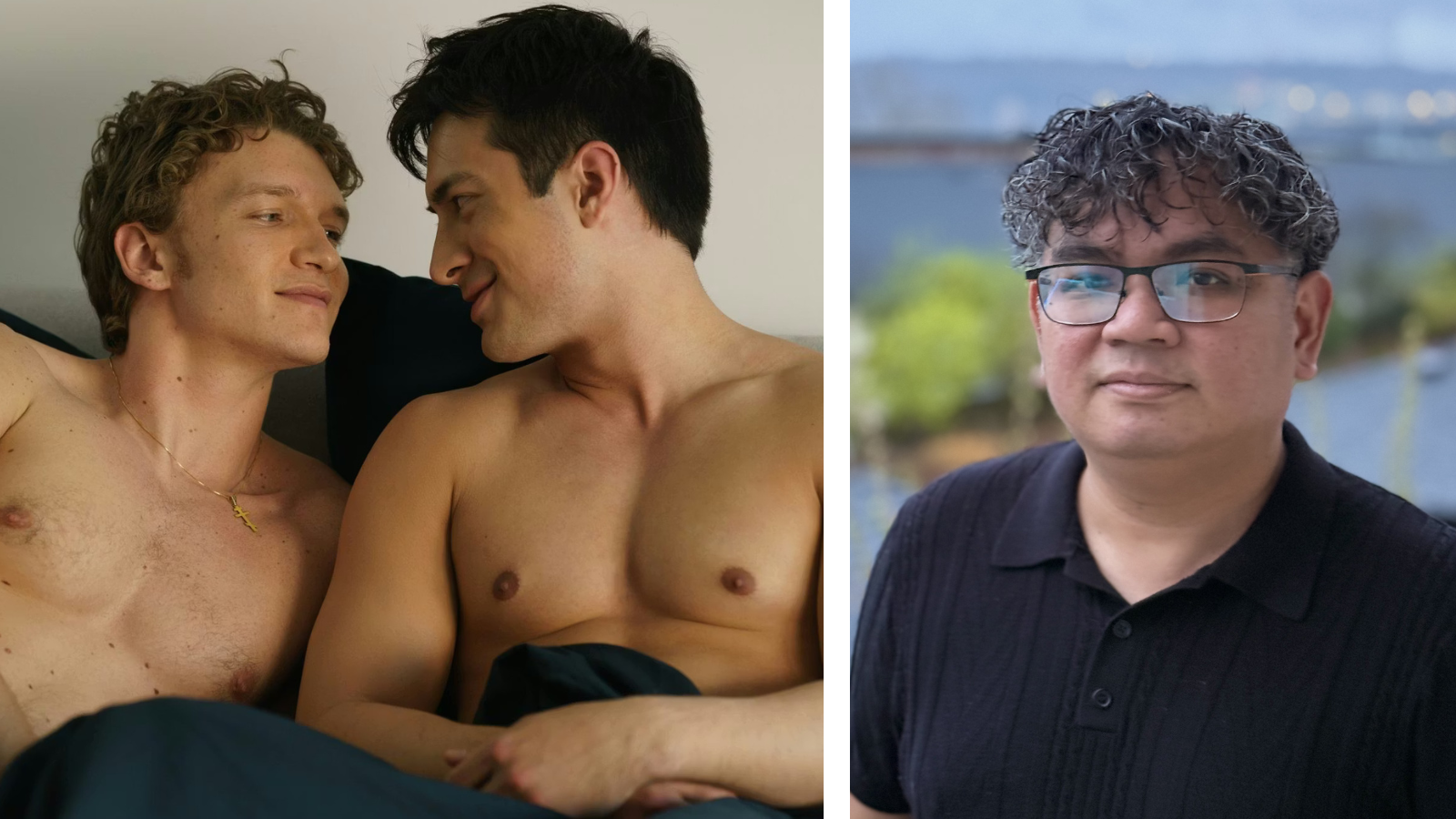
Days after Heated Rivalry aired its first season’s last episode in December, John Paul (JP) Catungal was, like many fans of the hit Crave show, still buzzing with energy. On New Year’s Day, the University of British Columbia professor found himself creating a full syllabus unpacking the issues in the show.
Catungal, an assistant professor at UBC’s Institute for Gender, Race, Sexuality & Social Justice, became consumed with everything Heated Rivalry and quickly started analyzing the show through the lens of his field. “I’m a geek at heart in some ways, and I’m an academic at heart,” he says. “I could not watch the show and be a fan of it without thinking about these issues that it brings up and the kinds of scholarship on these issues.”
His syllabus explores topics such as the geopolitics of hockey, how the respective cultural backgrounds of Russian player Ilya Rozanov and Japanese Canadian player Shane Hollander shape their perspectives and interactions within the hockey world and of course, how the show found its home with a ginormous global fandom. Catungal describes the Heated Rivalry craze as a social phenomenon that “forces” audiences to ponder about perspectives entrenched in racialization, queerness and their intersectionality.
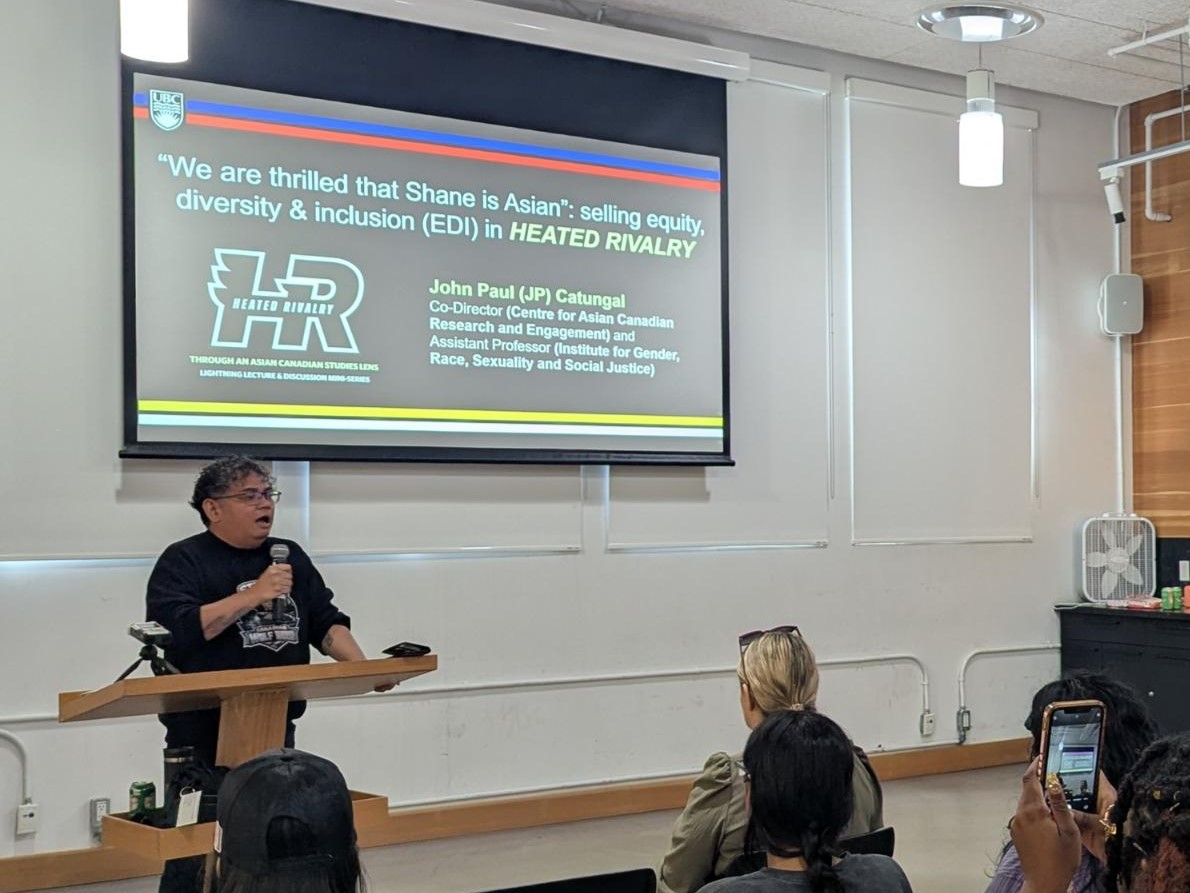
Heated Rivalry, Catungal points out, created a space for people to think critically about racialized, queer and transnational dynamics beyond the show’s origins as essentially hockey smut. Since fans already took liberty in fervently discussing these topics online, Catungal felt that bringing his two passions together made sense. While the syllabus isn’t tied to an actual course (yet), he chose to highlight parts of this syllabus through an ongoing in-person lecture series at UBC about the show: “Heated Rivalry through an Asian Canadian Studies Lens.”
Catungal is no stranger to speaking about Heated Rivalry in an academic context. In the past six months, his appearances included a virtual talk at Ontario’s York University, guesting on local podcasts and radio segments and partaking in in-person talks in Vancouver, the very same city where star Hudson Williams spent his days as a student actor. This particular lecture series runs under UBC’s Centre for Asian Canadian Research and Engagement (ACRE), where Catungal serves as co-director. He says the lecture series “grows from” past queer-related initiatives that the centre has held, such as hosting annual drag performances by individuals in the Asian Canadian community.
At this free event, up to 30 participants get to explore three central themes: equity, diversity and inclusion within the show; Shane Hollander within the model minority image; and unpacking queer Asian sexuality and masculinity.
“In some ways it’s a kind of classic driving-off-into-the sunset, happy-ending type thing, but they are driving home to a world that continues to be shaped by cis heteronormativity and racialization.”
Catungal chose these three topics based on what he wanted to discuss and what fit within the “framework” of Asian Canadian studies, but he knows this summer “trial run” of lectures will likely expand. Fans who attended the first lecture were ecstatic to dive into the series through an academic lens. Though held at a scholarly institution, the event encourages individuals of all backgrounds to participate. “Fandom is not just watching the show,” he says. “It’s also sharing our knowledge, our perspectives [and] our analysis.”
Though the first season of Heated Rivalry ended, he says the lecture series’ themes will continue to persist throughout the show. If it continues on the trajectory of its source material, the Game Changers book series by author Rachel Reid, he says the discussions will be endless. Shane and Ilya officially getting together at the end of Heated Rivalry Season 1 doesn’t eliminate the recurring issues such as dealing with hockey’s “oppressive” culture or Asian Canadians’ struggles to live up to the model minority image. “In some ways it’s a kind of classic driving-off-into-the sunset, happy-ending type thing, but they are driving home to a world that continues to be shaped by cis heteronormativity and racialization.”
At its core, “Heated Rivalry through an Asian Canadian Studies Lens” wants to entice more discussion about the show while highlighting key underlying themes that make the show what it is. Catungal points to all the interpersonal factors that go into the world of hockey off-ice, the interactions with teammates, the expectations from parents and family, the perception from the media included.
“We see very few minutes of actual on-the-ice hockey, but on the other hand, hockey is everywhere in the show,” he says. “If we understand hockey to be about much bigger than what happens on the ice, I would say something similarly about Shane’s Asianness: that it is atmospheric.”
Tying back to Asian Canadian studies, he also says that Shane’s identity plays a central role in the show’s set-up, starting with his drafting into the Montreal Metros team. The series’ first lecture, which focused on equity, inclusion and diversity within Heated Rivalry, brought up how hockey executives mention Shane’s heritage as a marker of progress within the league. Similarly, the next lecture, held on June 24, will discuss the pressures Shane faces from his family, the league and fans as a Japanese Canadian player. “He cannot not embody Asian,” Catungal says. “It’s the body he travels the world in, including the world of hockey.”
The show quickly establishing Shane as an “exemplar” of representation contextualizes how he deals with heavy expectations throughout the season. In essence, Shane’s cultural background is essential to the show. As Catungal puts it, “[While] his Asianness is not constantly mentioned, that is just part of how he is placed in this white world of hockey.”
Credit: Szu Shen
“Heated Rivalry through an Asian Canadian Studies Lens” is also part of an ACRE sub-initiative close to his heart, a series of community-focused public engagements through Browning Asian Canada. Catungal describes Browning Asian Canada as a project within ACRE to ensure a broader, more nuanced exploration of the Asian community that accounts for identities that exist outside of East Asian-centric heteronormative assumptions. As a queer first-generation Filipino immigrant, he makes sure that addressing these perspectives come embedded into the work at ACRE.
“I always half joke that browning is a really instructive culinary metaphor,” says Catungal, referring to how chefs often subject food to intense heat to deepen a food’s flavour profile, achieving a caramelized colour. He says Browning Asian Canada uses a similar method by “putting fire” to assumptions about what topics truly are central to Asian Canadian studies.
While participants may not actually cook at these events, the topics spark passionate discussions from academics and the general public alike. The structure starts with a 15-minute lecture by Catungal, but the real meat of the event lies in the 45-minute open-discussion period among the attendees. Catungal says the response to the first lecture showed how much “demand for” Heated Rivalry content exists, despite the centre’s relatively lower reach compared to initiatives run by more well-known institutions.
“We don’t have as big of a reach as a research centre, but people from all over the place found out about the lecture series through the fandom networks that they’re a part of,” he says, noting that he heard a Vancouver-based Heated Rivalry WhatsApp group shared information about the event.
Future lectures will also take on a more meta view of the series, discussing the marketing and reception. Heated Rivalry is an undoubtedly Canadian show, and the country has shown up for it—all the way up to Prime Minister Mark Carney. In focusing on how prideful everyone feels toward this Canadian production, positioned as “the epitome of progress,” Catungal says that mindset can ignore that work still needs to be done. “My worry is that will mask the reality that issues of homophobia and transphobia and racism are not absent from this country.”
Event Details:
Heated Rivalry Lightning Lecture and Discussion Mini-Series—Lecture 2: Wed., June 24, 2026, 4 p.m.-5:30 p.m. PT at the UBC Arts Research Centre in Vancouver (RSVP).
Heated Rivalry Lightning Lecture and Discussion Mini-Series—Lecture 3: Wed., July 29, 2026, at a to-be-determined time and location (RSVP information opens 30 days prior to the event).

 Why you can trust Xtra