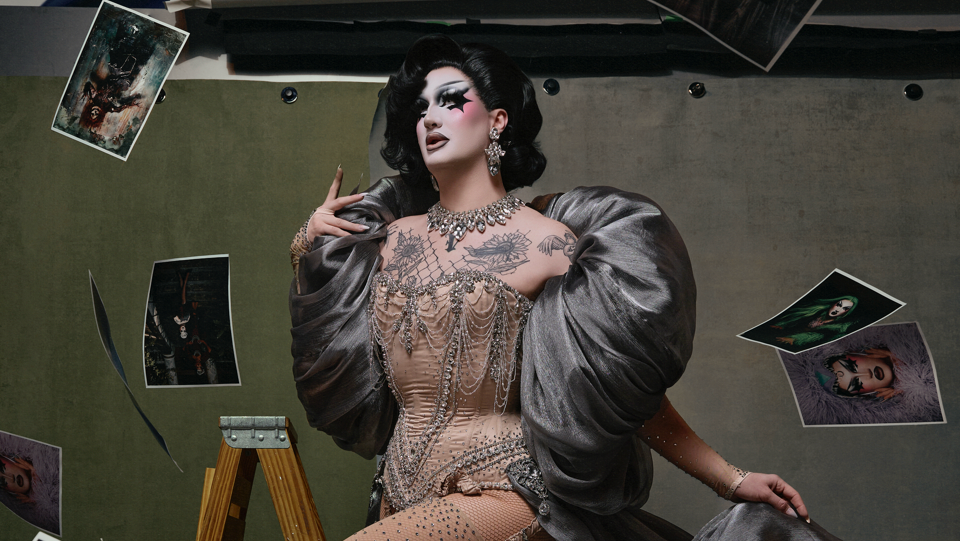
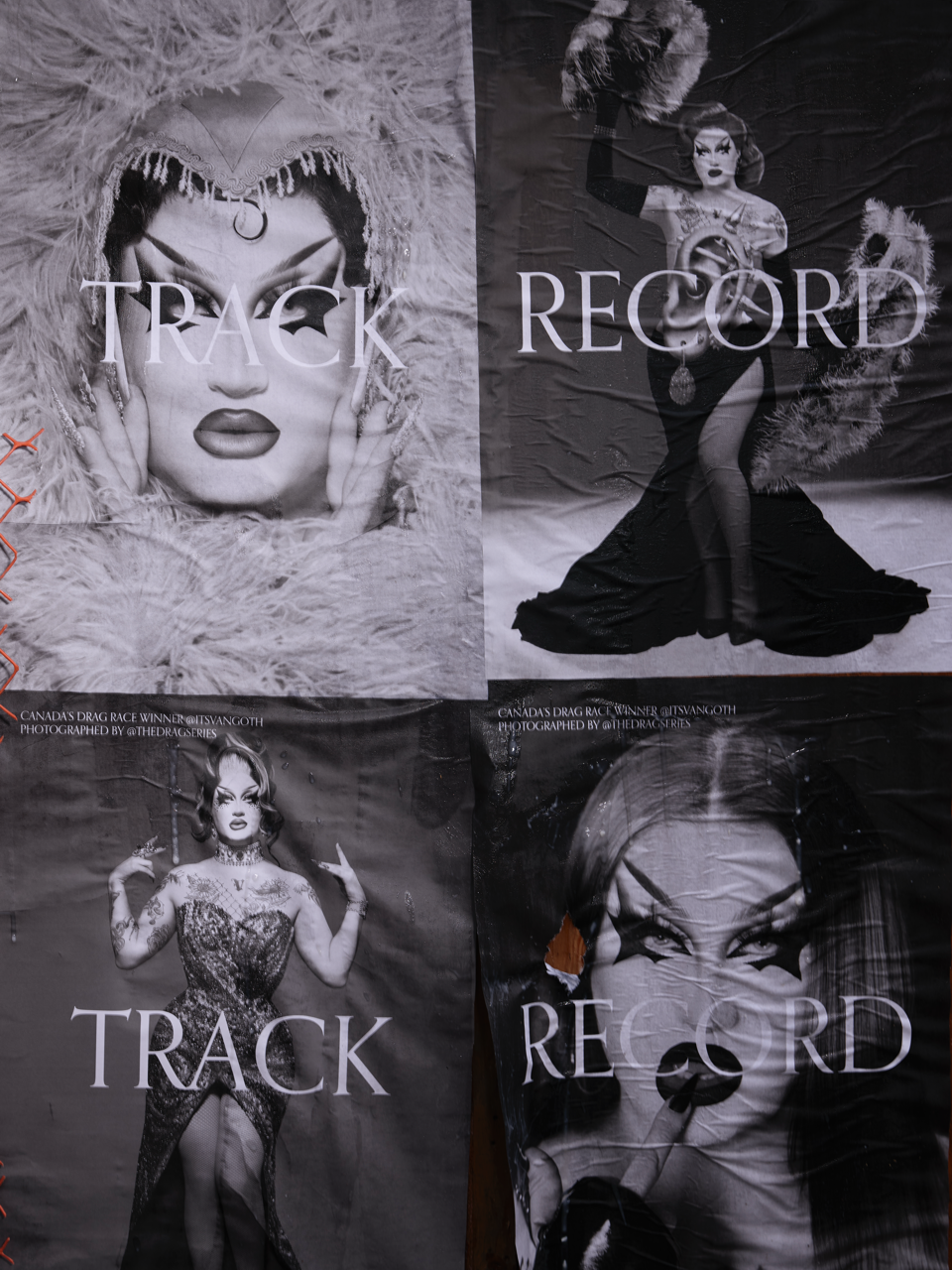
From my phone, I watch as Van Goth navigates the postage stamp-sized stage of Pieces, a famously tiny gay bar in New York’s West Village. Patrons with a high standard for drag are squeezed together, watching, drinks in hand. Van has little room to perform, but she still manages to flip into a handstand then tuck and roll—a move she has become known for. Dollar bills rain from the sky, and the video shakes as the crowd whoops and stomps. Blake Harris tells me he doesn’t want to sound arrogant; but, performing as Van Goth—his drag alter ego—is “easy, now.” He tells me that Van Goth can just walk on the stage, play “Cold Hearted,” and the audience is already on her side. Harris is well aware that what they want from Van is an in-real-life moment of top-tier television entertainment, and he is more than willing to give it to them.
When we speak for the first time in February, just four weeks after he was crowned the winner of the sixth season of Canada’s Drag Race, Harris is at home in Toronto. Despite the ease and ferocity he tells me he feels as Van Goth on stage, Harris is already thinking about when her reign will end.
He rattles off a list of opportunities, collaborations, gigs abroad, tours, content and projects he has scheduled for Van Goth. He is excited by all this, but by the time he nears the end of the list, he is already in the fourth fiscal quarter of 2026. Whatever excitement he is feeling seems to be tempered by an entrepreneurial and logistic pragmatism of how to get it all done, and how to best capitalize and sustain the newfound attention.
He is quite aware of how fleeting it can be. “In the last quarter of the year,” he says, “Season 7 will be airing.” Harris tells me he is already thinking about what Van Goth will wear for the finale of Canada’s Drag Race’s seventh season, when the next winner is chosen. “It’s a really weird mind fuck,” he says, “because you have to start planning what it’s going to be like when you give up the crown.”
The step-down look is typically a moment when the previous season’s winner can show off how much they’ve achieved since winning the show. It’s always highly anticipated and expected to be a show-stopper and an elevation of their style from their season. Harris’s design prowess and his mix of rock ’n’ roll and burlesque aesthetics were key to his Drag Race win; he is aware of what a high bar he has set for himself. But the confidence he displayed on TV seems to give way to a creative anxiety over how he’s going to top his performance on Season 6, especially since his reign is barely a month old. “I have to show growth and elevation, but I don’t have any of the time or life experience to back it up.”
Now that Van Goth is a star on the rise, Harris has been navigating how much time he puts into Van Goth versus how much time he puts into Blake. When I ask if there is a distinction between the two, an expressive “ohmigod” slips out of his mouth as if he’s been dying to share an epiphany. “Now, even more so!”
Before the show, he would have said there were few differences between Van Goth and Blake Harris. But after winning, a separation might be necessary. “I feel like [Van Goth] is a character, a persona,” he says. “It’s a business. I can clock in and clock out of it in a way that I didn’t feel like I could beforehand.”
Credit: The Drag Series
Harris describes his early life as one where he moved around a lot. He was born in Markham, Ontario, and moved to the town of Aurora then the city of Vaughan as a kid. His family finally settled in Richmond Hill, a city near Toronto. He has two older stepsisters and an older brother who he says he had nothing in common with, “except for when we both played rugby.” Sports were always in Harris’s life. With all the moving to new schools, it helped him make friends. However unstable this all sounds, Harris is clear that he didn’t grow up struggling. He grew up in an upper-middle-class family. The constant change forced Harris to become adaptable. He learned how to pivot to a new direction when something wasn’t working out.
Harris had an early love for performance. At his first high school, he was so intrigued by it that he took an extra course every semester just to be in drama class. But, he didn’t exactly fit in. “I was outed by a friend of mine, and that became a thing,” he says. He unspools the drama of what happened after telling a friend he was gay, a typical high school tale of telling one person who told another. He’s clearly over it, but it is an important precursor to what happened next.
Often, to support a friend’s recitals and performances, he would find himself at a different high school in nearby Thornhill. “I just loved the energy in the room,” he tells me. “Everyone was talking about the songs or plays they were working on.” The school was also home to a well-known regional arts program. In his graduating year, Harris decided to take a chance and transfer.
His time there only lasted a year, but Harris gushes about how much he loved that time of his life, calling it the best decision he’s ever made. With an air of nostalgia, he talks about designing costumes for his school’s production of Cinderella. “I felt like I belonged there.”
At the time, his ambitions were angled toward fashion. As a teenager, he found his grandmother’s sewing machine from East Germany and taught himself how to use it. He even made a dress for a friend. “I had no experience at all. We bought white satin fabric. I didn’t even know about thread matching, so I used black thread,” he says. “It looked crazy.” His friend didn’t end up wearing the dress because it was too see-through, but the act of making it did something for Harris. In lieu of a 16th birthday party, he asked his parents for a year of sewing classes. It was no surprise to anyone when he decided to go to fashion school.
He attended Ryerson University (which was renamed Toronto Metropolitan University in 2022) from 2015 to 2019, which also boasts Canada’s Drag Race queens Kyne, Priyanka and Synthia Kiss as alumni. Harris says he generally enjoyed university, but with graduation looming, reality started to set in. In his last year, he made an odd choice by presenting menswear for his final collection. “Biggest regret of my life,” he mutters when I ask him about it. “In my mind, my biggest fear was ‘I’m not going to have a job,’” he says, which is part of the reason why the menswear collection came together. He was trying to be strategic. “I wanted to make something that was sellable so someone would hire me.” It didn’t exactly pan out that way. The menswear collection was fine, and Harris ended up working in clothing retail after graduation. At least for a time.
After university, Harris was enjoying Toronto. He returned to his childhood method of making friends and joined a queer rugby team. Surprisingly, this led to Harris trying drag for the first time. As Scarlett BoBo tells it, Harris entered the 2019 Empire’s Ball with his rugby team. At the time, BoBo was operating at the top level a drag queen could operate at in Canada. Canada’s Drag Race didn’t exist yet (BoBo went on to become the first season’s runner-up), but she had over a decade of experience as a drag performer and was a seasoned producer and talent scout. The Empire’s Ball is an inclusive drag competition conceptualized by BoBo that encourages drag kings and other types of drag artists to participate. “My ex-producer was on [Harris’s] rugby team, so he convinced [the team] to join,” BoBo recounts. “The team was just there to have a good time, but I could tell there was something in Van, a little sparkle.” BoBo remembers Harris’s team lost the Empire’s Ball that year, but it led to a connection. “She was very adamant about hitting me up, and we became friends. She was like, ‘I really want to do this, how do I make this a career?’”
The ensuing 2020 pandemic put a pause on opportunities to perform again in public. But the experience of the Empire’s Ball solidified one—of two—of Harris’s most enduring collaborators: Aurora Matrix. It was Aurora who was responsible for painting the faces of Blake and his rugby teammates at the first Empire’s Ball. Aurora had only been doing drag for six months and was living outside of Toronto when the pair met on Instagram. Once the pandemic restrictions were lifted, and Aurora did eventually move to Toronto, the pair began their journey of trying to make a name for themselves in the Toronto scene.
Perla joined the trio later. When I ask her how she met Blake, she giggles and tells me that she had seen a video of a drag queen in Toronto falling off of a railing. “I think I quote-tweeted it, asking, ‘Who is this diva? I need to know her.’” Harris messaged her to introduce herself and the pair started talking on Instagram. Perla had already set her sights on moving to Toronto, so when she finally did in 2021, Blake helped her get settled into her first apartment and introduced her to Aurora. The trio’s friendship deepened and they named themselves the PowderPuff Girls, performing as a group and hosting the multi-award nominated podcast The Powder Room.
And slowly, but surely, Van Goth—along with Matrix and Perla—became staples of the Toronto drag scene, each performing five nights a week and doing 15 to 20 numbers a night.
Despite the ease and ferocity he tells me he feels as Van Goth on stage, Harris is already thinking about when her reign will end.
Harris was so committed to turning Van Goth into a star that she began to overtake his life. He shaved off his eyebrows to make it easier to put on Van Goth’s face and spent more money on rhinestones than clothes for himself. He flung himself into performances, sometimes recklessly. In addition to falling off a railing, he also broke his nose during a Christmas show.
All the while, the trio was trying out for Canada’s Drag Race. Matrix and Perla vied for—and lost—the crown in Seasons 4 and 5, respectively. When the pair speak about Van’s win on Season 6, it’s clear that they are proud. “It was kind of vindicating for us,” Perla says. “She finished what we all started.”
Harris tells me that he was making a living as a full-time drag queen at least a couple years before he appeared on the show. When I ask him when he knew it was time to leave his day job and focus on Van Goth, he admits that it wasn’t exactly a decision he crunched numbers over. But when he started to realize he was coming into his retail job exhausted from working late nights, and that he was frequently taking more days off to accept gigs and out-of-town projects, it was clear that the retail job was starting to get in the way. During his lunch break one day, he called his partner and told him he thought he was making enough money performing to quit his retail job. His partner was supportive, so Harris returned from his lunch break, handed over the keys to the store and quit. “It was a leap of faith.”
While I’m sure the moment may have felt like a leap of faith for Harris, it echoes his teenage habit of confidently pivoting towards the thing that feels right. Beyond the diligence Harris has in honing the look and performance of Van Goth, this decision also demonstrated Harris’s entrepreneurial instincts.
By quitting his day job and freeing up his time, Harris was able to say yes to more opportunities and to diversify his income. Van Goth wasn’t just a showgirl making money at the bar anymore. She was also doing sponsored posts on Instagram, selling branded merch, hosting podcasts, doing background work on television shows and starting to make a name for herself as a costume designer. Matrix tells me Harris was responsible for the Shimmering Showgirls outfit she wore on the first episode of her season of Canada’s Drag Race, as well as a custom corset with hip fins. These endeavours weren’t just about getting Van Goth out there; they were also an effort at trying to build longevity. It wasn’t just about booking huge Pride gigs anymore. “Obviously, that’s amazing,” Harris says. “But the hallmark of a good drag queen or drag business is not that you got a gig, it’s how you keep a gig.” And Harris was keeping gigs.
Despite all his success, Drag Race continued to elude him. He was almost cast on Season 5, but his PowderPuff Girls sister, Perla, made it on, instead. “I watched my best friend get on and I was envious of that,” Harris tells me.
After getting so close to being casted, only to be rejected, Harris was considering another pivot. He was hitting a ceiling of how much Van Goth could grow economically and creatively. Part of why Harris was so eager to take on the challenge of a reality competition show was because he wanted to show off his other skills. “As a local bar queen, it’s very hard to turn a look,” Harris tells me. “I can go onstage and be like, ‘I made this whole thing,’ and no one cares.” That’s why Harris was eager to get Van Goth on TV. “I wanted to show my design skills, my sewing, my fashion sense.”
During the casting call for Season 6, Harris was exhausted. “It sounds crazy, but [Season 6] was probably gonna be the last time I applied to Drag Race,” he says. “If I didn’t get on, it was going to be time to look for something else.”
He didn’t need to look for something else. Van Goth was cast in Season 6. With an influx of cash from his parents, an uncle and his late grandparents—who left behind money for him and his brother to invest in their future—Harris spent somewhere between $50,000 and $60,000 on Van Goth’s package of outfits, wigs, shoes and accessories. He could have cut costs, of course, but he didn’t want to have any regrets and he saw this as a business investment. One that he tells me he’s already recouped.
Credit: The Drag Series
By the midpoint of the sixth season of Canada’s Drag Race, Van Goth was clearly the frontrunner. She won the first episode, affording her the opportunity to lip-sync with host Brooke Lynn Hytes to Paula Abdul’s “Cold Hearted—in front of Abdul herself, who was the guest judge for the episode. While Brooke Lynn was the star of the lip sync, Van held her own and proved to be an athletic performer who could put on an entertaining show. She demonstrated she could be dangerous to end up in the bottom two with.
She also won the third challenge of the season where, in a “Pick Your Poison” twist, Van chose to participate in a design challenge instead of the Snatch Game. She flawlessly executed a head-to-toe black-and-white concept, complete with a zebra bodysuit and a wide, feather-brimmed hat. Van had already shown off her aesthetic by this point in the season, but this win proved she also had the skillset to pull it off herself.
Beyond her skills, Van was also chaotically entertaining at the gameplay elements of the show. She was happy to bill herself as a villain. “She’s a sickening bitch, you know?” says castmate Paolo Perfección during a confessional in the second episode of the season. “But she’s also a bitch.” When she wasn’t sparring with her sisters, she was blindsiding them, making alliances that she admits in her confessionals she had no intention of honouring. She frequently pissed her cast members off and sent them into a tailspin of confusion about what she was going to do next. Fans of the show either loved her or hated her. Either way, we were coming back every week just to see what chaos she would turn.
Then in the fifth episode, the antagonistic hotshot softened and showed a vulnerable side. Prompted by the episode’s runway category, “A Perp Walk to Remember,” where the contestants were tasked with presenting crime-themed looks, Van Goth revealed that her look was coming from a personal place. In a shaky voice uncharacteristic of the loudly confident queen, she disclosed that a year prior, she was diagnosed as HIV-positive.
Credit: The Drag Series
Van Goth is not the first drag queen to disclose her HIV status within the Drag Race universe. HIV has been present in the franchise since 2009, when RuPaul’s Drag Race’s first season aired on Logo in the United States.
In its fourth episode, Filipino contestant Ongina secured her second win for a challenge where the contestants were tasked with filming a screen test as spokesmodels for MAC Cosmetics’s VIVA GLAM product line. Proceeds from the line famously go to the MAC AIDS Fund, which fights HIV/AIDS. When Ongina was announced as the winner of the challenge, she was overcome with emotion and broke down into tears. She then disclosed that she had been living with HIV for the past two years, making the win for this particular challenge deeply meaningful for her. She said she’d been hesitant to say it on national TV because her parents didn’t know.
It’s a scene that makes me emotional no matter how many times I watch it, especially in the context of the entire episode. If you knew nothing about HIV/AIDS, this episode introduced it to you. The challenge activated the queens into a spectrum of emotions. BeBe Zahara Benet, the Cameroonian queen who would go on to win the season, described the epidemic as “very rampant” in her home country. Rebecca Glasscock at first seemed drawn to the idea of filming a screen test for “makeup with a purpose,” but the moment she stepped in front of the camera, she was overwhelmed thinking about her friend living with HIV. “He’s my sister,” she said in her confessional, “and, you know, he’s gonna die,” clearly rattled by the realization. Her screen test was stilted and sombre before she walked off set, shaking and in tears.
Ongina’s disclosure brought a different representation of HIV/AIDS. She seemed to be alive and well, and was dominating a competition show. It was an important narrative to see in 2009, especially as—I would learn the following year, when I got my own HIV-positive diagnosis—the experience of living with HIV had changed, for some, from a death sentence to a manageable chronic illness.
Harris was so committed to turning Van Goth into a star that she began to overtake his life.
And this is where the narrative of HIV/AIDS in the Drag Race universe has largely stayed. Since Ongina, at least six contestants across four different international franchises have disclosed their HIV-positive status during their time on the show; at least two franchises are hosted by openly HIV-positive hosts; and even more contestants have disclosed their status outside the format of the show. Van Goth is likely the second openly HIV-positive winner, the first being Drag Race Brasil Season 1 winner Organzza, who seemed to reluctantly disclose their status in an uncomfortable video on X while addressing allegations of serophobia.
I am always happy when Drag Race contestants—and others in the public eye—share their status. Their stories help illustrate contemporary, diverse experiences of what a person living with HIV can look like and do. But I’ve grown frustrated by the storytelling around the disclosure of HIV on Drag Race, which has predominantly focused on proving that HIV no longer looks like the indelible image of a deteriorating body riddled with Kaposi’s sarcoma lesions and on fighting against some vague “stigma” that is never fully explained.
While Van Goth did stick to a familiar narrative of a desire to dispel the enduring image of AIDS in her confessional by articulating her desire to show the audience that an HIV diagnosis didn’t immediately lead to AIDS and a death sentence, what made Van Goth’s disclosure stand out was that it was paired with a concrete example of what stigma actually looks like and its contemporary urgent and dangerous consequences. In the werk room, surrounded by his fellow contestants, Harris explained that after he was diagnosed, he was connected with someone who was tasked with explaining to him the legal issues of being HIV-positive in Canada. He was told that if he didn’t disclose his status to all his sexual partners, he could potentially be charged with aggravated sexual assault, regardless of whether he had undetectable status, which means the virus cannot be detected in a person’s blood or transmitted to another person. It was clear he was rattled, in both the werk room and in his confessional, as he expressed his feelings of guilt that he did something wrong and his fears that he would be criminalized or discriminated against.
By sharing that he was connected to someone to talk about the legal issues of a positive status, Van showed how an outdated understanding of the virus that ignores the advancement of treatment, care and prevention is resulting in the unjust criminalization of people living with HIV. These are consequences of HIV non-disclosure laws that the Canadian federal government has announced they have no interest in repealing, despite years of activism.
But Van Goth doesn’t want to be identified by her HIV. “Positive status, won’t let it define me,” she says in the lyrics of her original song, “The Villain,” written for the finale of Canada’s Drag Race Season 6. In my own 15 years of being positive, I’ve heard some version of this many times. Even if it’s a phrase I’ve never uttered myself, often, when I omit disclosing my status, I am, in my own way, seeking the same thing.
Unfortunately, it’s not up to her. Drag Race has wrung the meaning out of the word “iconic,” but if there was ever anything that deserved the full measure of the word, it is HIV. From its legacy as one of the deadliest pandemics in modern history, few things have continued to reshape medicine, politics, art and identity. Its consequences can still be seen in global health policy, drug access and fights for human rights. It is hard to shrug off that kind of enduring influence and significance. And, by appearing on a TV show, Van has relinquished a substantial amount of control of her story to a notoriously volatile Drag Race fandom. The best she can hope for is that she showcased a strong enough package that the fans would be on her side.
At the very least, her disclosure had a significant impact on a former mentor. Scarlett BoBo says watching Van disclose her status on TV and talk about HIV criminalization made her emotional. “I have a friend who was in jail for five years because someone accused him of giving them HIV.” She says it was a false accusation. “They put his photo on the news, and I just remember how it just broke him so bad. He lost a lot of friends. It was awful,” says BoBo. “I was really proud of her for opening up and talking about it.”
Credit: The Drag Series
Harris says that this April 2026 marked two years of being HIV-positive. Interestingly, five years prior—when Van Goth was going by the name Vanity—he filmed an almost five-minute-long paid partnership video with virtual health provider Freddie detailing steps on how to get a PrEP prescription. What happened in the gap between doing sponsored content for a PrEP provider and testing positive for HIV?
“I got lazy,” Harris says, simply.
By 2024, Harris had been in a long-term relationship with his partner, Ben, an ad man. Their relationship was open, but Harris describes the hookups outside his relationship as something like “one person per quarter.”
Harris was in the food court of a mall when he learned about his HIV status via a phone call. “I can’t go back to that food court anymore, but you know—c’est la vie,” Harris says. Harris tells me that the call came after he had decided to stop being lazy and get back on PrEP, so he had gone to get his bloodwork done. At first, he didn’t believe it when the person on the phone told him he was positive. He wanted to be tested again, but when the person on the phone confirmed they had run the test multiple times, he took a walk before calling his boyfriend. “One thing I love about Ben is he’s always been very level-headed, very responsible,” Harris says. They met at home. Harris’s memory of the conversation is that Ben was most concerned about making sure Harris was okay.
After all, it wasn’t just an HIV diagnosis that Harris was contending with. This was in 2024 and he had also just been rejected from being cast on Season 5 of Canada’s Drag Race. Harris tells me that he was so stressed from the process that he couldn’t eat or sleep. When he didn’t get on Drag Race and kept losing weight, Harris started to get concerned. “I was really emotionally distraught,” he says. “That’s what put me back in therapy.”
His boyfriend got tested, and his results came back negative. Ben suggested that they cancel their upcoming week-long apartment swap with friends living in Brooklyn. But Harris insisted on keeping their plans. “I wanted, more than anything, to just go and live in New York for a week and just forget that I have a life, and I exist, and I have a job and I have responsibilities.
“Life is so funny,” Harris tells me, “because I was so heartbroken for not getting on Season 5. But imagine if I had been cast. The whole time I would have been filming I would have been ill and had no idea.”
Credit: The Drag Series
Harris doesn’t have much else to say about his HIV status, and it is unfair to expect him to. Although there is still much work to be done to ensure the care and dignity of people living with HIV, we both exist in a present and future that early HIV/AIDS activists fought for. Our HIV, under the proper care, has achieved an undetectable status, which has provided a measure of freedom to let our minds think about other things and plan for longer futures.
Harris has been dealing with the fallout of disclosing his status on television. Like Ongina, he had not told his parents about his status, and they found out from his disclosure on the show. He admits that not telling them was partly because he wanted to avoid his parents drawing a connection between him and their own experiences of growing up and seeing HIV as a deadly diagnosis. He wanted to avoid feeling the looming sense of death, especially as he was about to compete on a show he had been trying to get on for years. He tells me that his father has been supportive and focused on his health and happiness, while his mother was hurt that he didn’t tell her. Here, Harris speaks slowly and tries to carefully articulate his frustration. “I understand that, but at the same time, none of this has to do with [her]. It’s not [her] life.” Her reaction caused a rift in their relationship.
I empathize with Harris. I, too, have often been in a position of disclosing my status and then suddenly having to deal with the other person’s emotionally powerful reactions. It is often bewildering and unsettling. He seems open to wanting to repair his relationship with his mother, but for now his focus is on keeping the business of Van Goth running.
When we last spoke in late March 2026, he had just returned from a short tour and was hard at work making a dress for a major client. He can’t put a sewing machine in his suitcase, so he’s trying to get as much work done as he can before he has to get back on the road again. Van Goth has also landed a scripted TV role. Harris won’t share which one it is, but he does tell me that he cried in the line at LaGuardia Airport when he read the email that Van Goth booked the job. He is also trying to make time for himself, without Van. He’s still in therapy and he’s started a separate Instagram account that has nothing to do with drag. And he has eyebrows again.

 Why you can trust Xtra