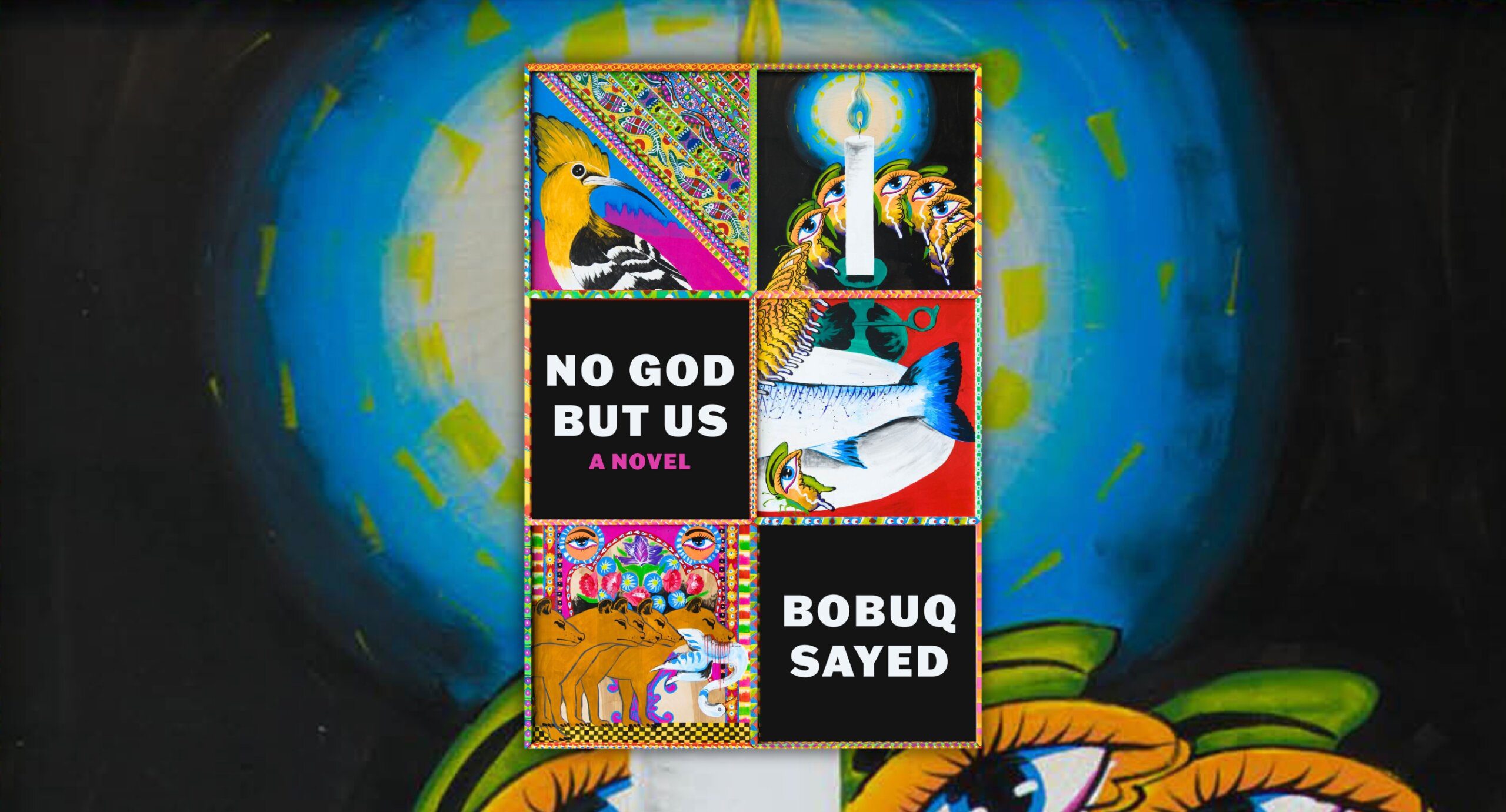
When the two queer Afghan protagonists of Bobuq Sayed’s No God but Us meet for the first time, a scene that is teased for chapters before it happens, the emotional and erotic connection between them is undeniable. Or at least it’s undeniable to Delbar, the younger and more naive half of the pairing. Having spent most of his life in the United States, dodging the prying eyes of his family, he is deeply critical of American imperialism and white supremacy, and of Western hegemony in general, but still an optimist when it comes to love. When he first lays eyes on Mansur, a refugee living temporarily in Istanbul, he is certain that they are destined to be together. After introducing himself, Delbar feels seized by “an uncanny and inevitable closeness … this sudden conviction that he and I were stuck on an elevator forged by circumstances beyond our control.” Neither man has met another gay Afghan before. Mansur is also drawn to Delbar, but, due to his more pressing concerns about survival, Mansur is much more wary of the forces that may limit their connection.
Sayed is a writer and theatre-maker of the Afghan diaspora, who has lived in both Australia and the United States. No God but Us is their first novel, a passionate and politically grounded work. Somewhat atypically for diaspora fiction written in English, the majority of its narrative takes place in Turkey, rather than somewhere in the Global North. Delbar leaves Washington, D.C., for Istanbul, hoping for more personal freedom, rather than the other way around. Delbar’s aunt Yosra has also left the U.S. to live and teach in Istanbul, where she prefers the Asian side of the city to the European side because it reminds her of Afghanistan, of how life could have been there without the war. The book complicates the idea that the U.S. and Europe are always the safest and most desirable places in the world for everyone. The emotional and political relations in the book are also surprising and refreshing, in that many of the values and tenets of diasporic queer and trans communities in the U.S. are criticized and recontextualized, thanks to Mansur’s narration.
In a 2022 interview with the Brooklyn-based Center for Fiction, Egyptian Canadian writer Noor Naga discusses the complex ethics of her award-winning novel, If an Egyptian Cannot Speak English, which features dual narration by an Egyptian American woman visiting Cairo and an Egyptian man originally from a rural village north of the city. The two characters engage in an intense and increasingly fraught romance that dramatically destabilizes their own self-concepts. In the interview, Naga discusses some of the book’s major questions, especially “how untranslatable ethics are across borders.” She underlines the limitations of exporting concepts like privilege, marginalization and allyship “from a North American space to the third world [sic].” Much of her project involves an attempt to move outside of her own Egyptian-North American point of view, which she notes she will always ultimately fail at doing. This failure, however, doesn’t mean the project is not worthwhile. If anything, it seems clear that her writing has widened a space in English-language fiction for other diasporic writers to contend with similar questions.
With No God but Us, Sayed writes queer and trans lives into that space. Like If an Egyptian Cannot Speak English, Sayed’s is an incisive and canny novel that asks big questions about borders and ethics, via the parallel perspectives of two lovers whose identity markers overlap, but whose life experiences and freedom of movement are vastly different. Mansur has fled a constrained existence with his family in Tehran, where they settled as refugees after fleeing the war in Afghanistan, for a somewhat less unstable existence waiting for European asylum in Istanbul. His queerness increases his precariousness as a refugee. He has had to rely on the resources of romantic and sexual partners, some consensual and some less so (he accepts the advances of a man he dislikes because he doesn’t have anywhere else to sleep), in order to cross borders and to secure jobs, housing and papers. He is used to being “the powerless one with my palm outstretched, begging the fortunate for meager assistance.” When it comes to love, he can’t allow himself to simply follow his heart.
Delbar is a young aspiring drag queen who was raised in a strict family in the suburbs of Washington, D.C. He hides his sexuality, his gender fluidity and his desire to become a drag performer from his family; when he is outed and shamed at a gathering hosted by his imperious mother—who then has a breakdown—he jumps at the chance to stay with his rebellious aunt Yosra in Istanbul. There, he begins volunteering at PeaceMeals, a weekly free meal program for queer and trans refugees, where his and Mansur’s orbits collide. Smitten with Mansur, Delbar is certain that they are meant to be together, despite the fact that Mansur is in a complicated relationship with white German Leif, who runs the weekly dinners and is crucial in helping Mansur with his asylum claim. Delbar and Mansur sneak moments of intimacy together, but they have very different expectations of what these passionate encounters can lead to.
In No God but Us, the tenets of queer community in places like the U.S. and Canada, such as knowing one’s privilege, owning one’s identity, vying for acceptance from family and public institutions and being an ally to those more marginalized than oneself can only go so far. Queer love between two people from the same diaspora is not a magical cure for the violence and limitations of global capitalism and colonialism. Mansur and Delbar do change each other’s lives, but not necessarily in the ways they or the reader might expect. The novel is interested in more than star-crossed romance; it features an array of intimate relationships, and is deeply romantic in how it portrays the emotional bonds between its characters.
Though Delbar grew up in the U.S., Sayed successfully decentres American politics and concerns in the novel. Setting the majority of the action in Istanbul in 2015 allows them to place their characters and their personal intrigues against the tumultuous backdrop of the Turkish political upheaval of the 2010s. They bring the buzzing streets and maze-like neighbourhoods of Istanbul to life, from parks and palaces and queer bars to cramped refugee dormitories and public spaces subject to brutal police crackdowns. Istanbul is beautiful and brimming with energy; it is also sometimes dangerous for queer and trans people, and politically unpredictable. The characters’ lives and goals are frequently interrupted by much larger events outside of their control. In Turkey, the act of marching in the streets, whether against the ruling party or for Pride, is a risky activity, unlike the parades that Delbar is used to in the U.S.
When Yosra describes the nostalgia for Afghanistan that comes with living on the Asian side of Istanbul, she says it’s like “a parallel universe,” one in which so many Afghans, including her family, were not displaced by war. Parallel universes are a narrative theme in No God but Us. The close-knit ragtag crew of queer and trans refugees who hang out at the weekly meals support and love one another, through friendships and romantic relationships. However, they know that if one of them gets asylum elsewhere, they will need to leave Istanbul almost immediately, and can’t bring anyone from the group with them, which means that all of these intimate relationships can be severed at any time. Delbar and Mansur’s relationship also suffers from the problem of parallel realities. Delbar, with his American passport and his kind aunt, is committed to their romance; he struggles to accept that Mansur can’t afford to leave Leif, his ticket to getting residency in Germany, even if he is more drawn to Delbar.
No God but Us can’t promise a romantic happy ending for its two queer leads, but this doesn’t reduce its richness, or the emotional impact of the relationships that form between its characters, despite the risks of misunderstanding, sudden departure and violence. The immediacy of Sayed’s writing allows us briefly into the shifting realities of 2015 Istanbul, into the warmth that exists among this queer and trans crew—and the pain as well. As Anahita, a friend from PeaceMeals, tells Delbar while coaching him on his drag act: “You have to hold on to what hurts, bring her to the forefront, you see?” In a world shaped by war, repressive immigration laws and migrant exploitation, fairy-tale romances might not be possible; nevertheless, Sayed’s characters keep their dignity and their humour, and learn things from one another that no government or border can strip from them.
 Why you can trust Xtra