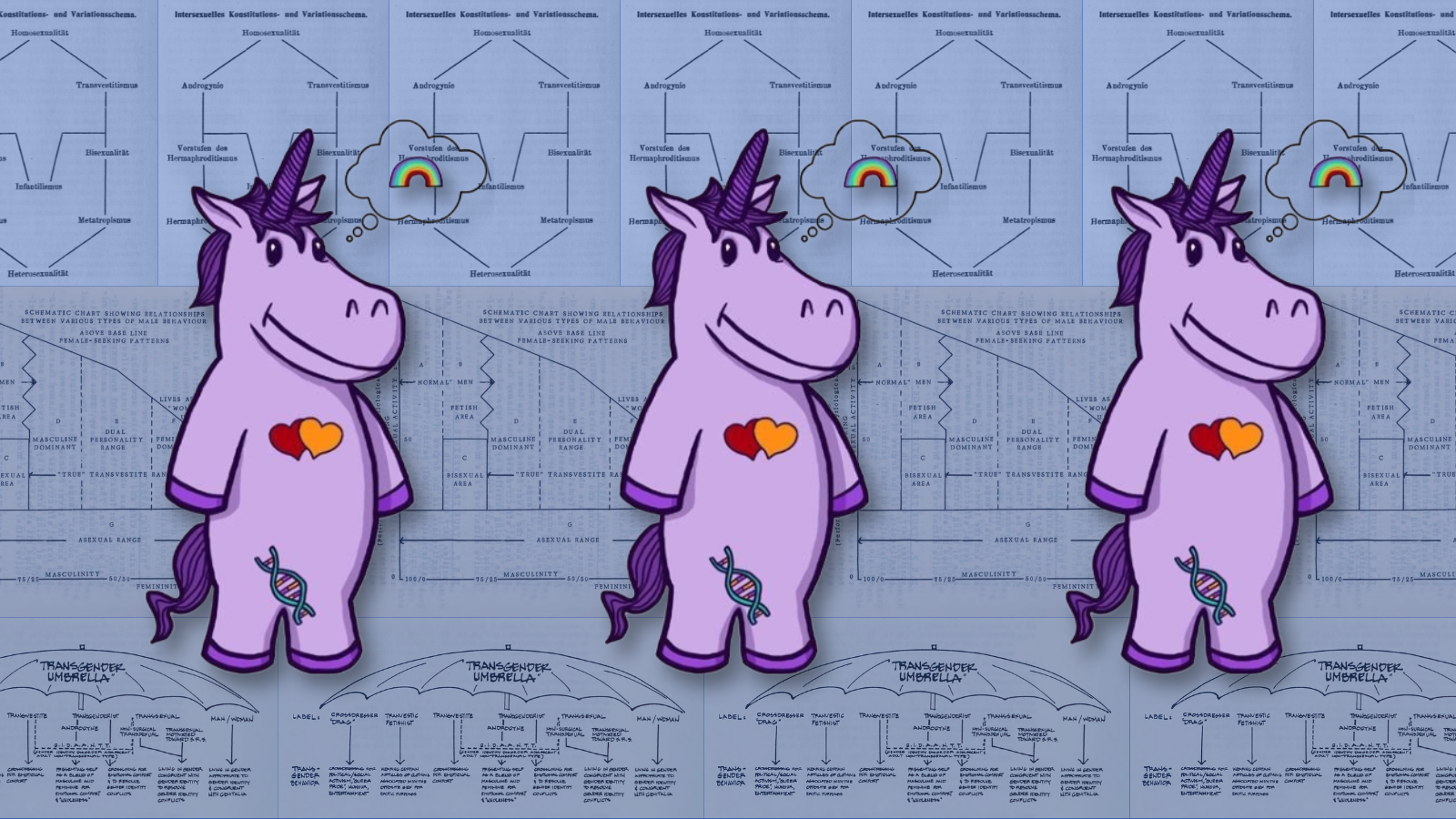
A Texas lecturer who was fired for using the Gender Unicorn—a teaching tool illustrating the differences between sex, gender and sexuality—in September is now suing her university. When Texas A&M first dismissed English lecturer Melissa McCoul, university officials claimed it was for teaching a curriculum not included in her syllabus. Later, Texas governor Greg Abbott admitted he pressured the administration to fire McCoul for discussing the Gender Unicorn because it is “contrary to Texas law.” He then pressured the university president to fire McCoul’s department head before forcing the university president to resign.
I helped create the Gender Unicorn in 2014 while directing Trans Student Educational Resources, an organization that works to improve the educational environment for trans students. More than a dozen other queer and trans youth helped design the diagram causing so much debate today. We believed it would be a useful resource for trans 101 workshops, and never expected it to lead to Fox News debates, anti-trans picketing or mass firings and resignations. Despite these extreme responses, the Gender Unicorn is an innocuous model, meant to provide a basic teaching tool for all ages. After the infographic was first banned by a North Carolina school district in 2016, I became curious about the longer history of “gender mapping”—graphic representations of gender and sexuality. Like the Texas government, North Carolinian protesters claimed the Gender Unicorn represented a new “transgender indoctrination” mechanism. But are diagrams of gender and sexuality actually that novel? I investigated the surprisingly long history of gender mapping to find out.
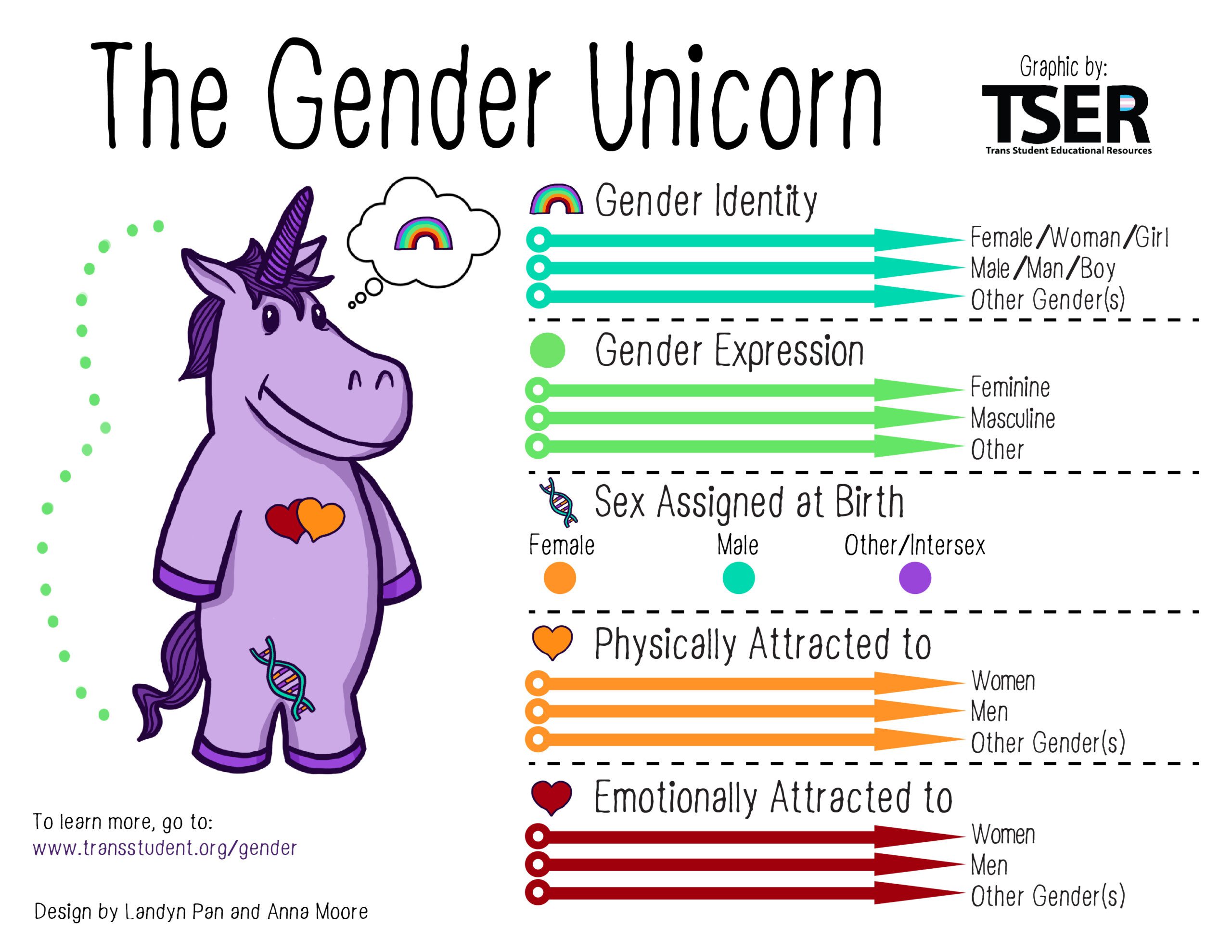
The Gender Unicorn Credit: Courtesy of Trans Student Educational Resources
Gender mapping graphics are visual metaphors for gender and sexuality. They are simple illustrations intended to educate about the LGBTQ2S+ community. There is nothing new about these tools, nor are they meant to be provocative. However, the graphics now exist within a political background that has “summoned the ghost of Joe McCarthy” against professors who just want to support their queer and trans students.
Many of the attacks on LGBTQ2S+ education rely on the idea that trans people are new. Politicians like JD Vance claim that trans identity is a recent “cultural trend” that will go away. Right-wing pundits argue that the rise in people identifying as trans is due to investments by the pharmaceutical industry. A certain British billionaire author has poured millions into promoting the myth that there is an ominous “explosion” of trans youth that must be stopped. One recent Southern Poverty Law Center survey even found 63 percent of Republicans believed trans people “are trying to indoctrinate children into their lifestyle.” These beliefs have decayed into conspiracy theories accusing teachers of forcing students to transition against their will with LGBTQ2S+ teaching tools. But queer and trans people are nothing new, and we always need more educational resources to build understanding about our communities.
While researching for my first book, Before Gender: Lost Stories from Trans History, 1850-1950 (2025), I came across the diagram below by Magnus Hirschfeld. Interestingly, it appears in the same 1923 article in which the term transsexualism (transsexualismus) first appeared in print. A renowned Jewish-German sexologist, Hirschfeld was known for opening the earliest trans medical clinic in his Institute for Sexual Science in 1919. His early diagram represents trans identity (transvestitismus) as a form of transition toward complete homosexuality.
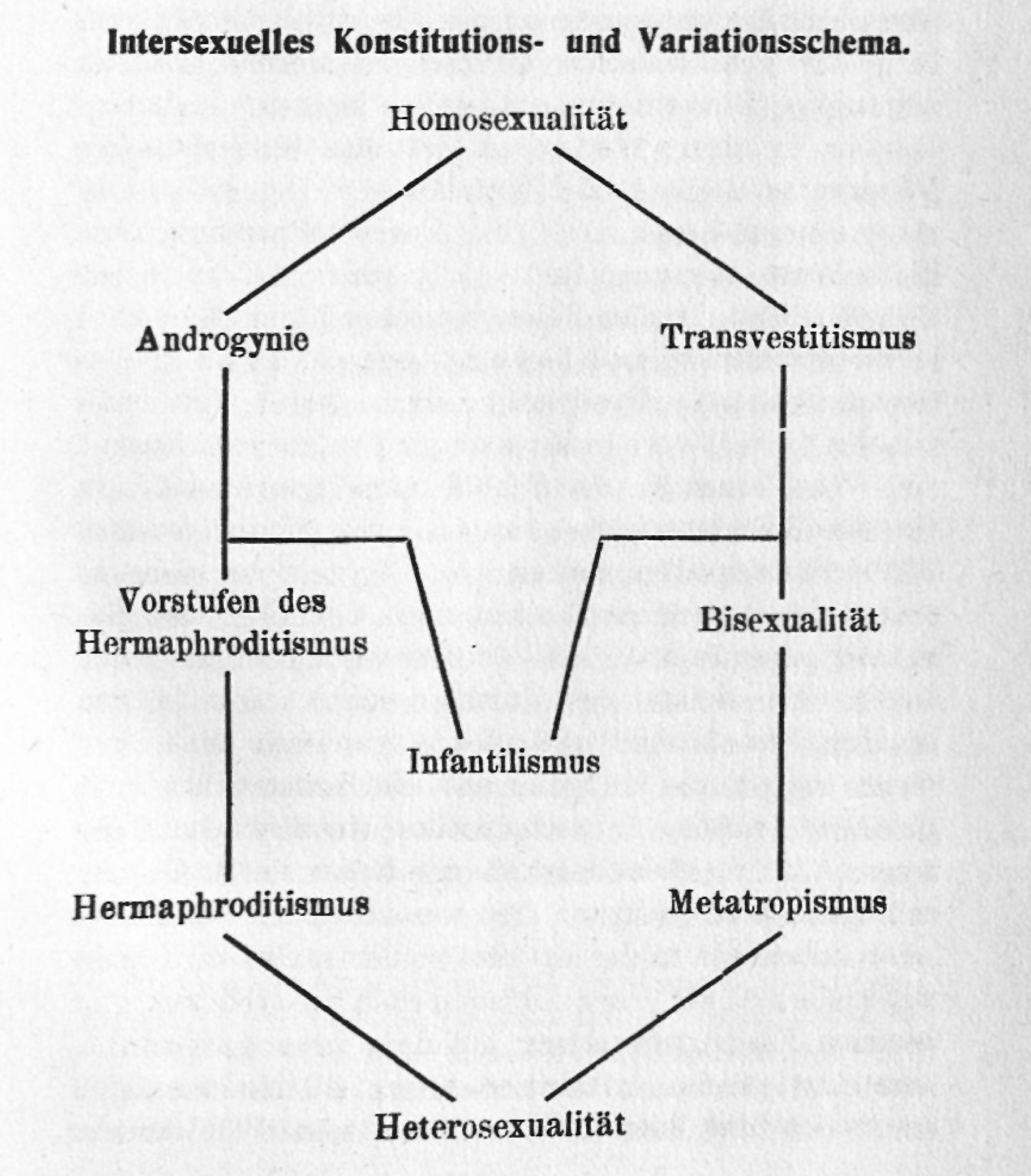
Magnus Hirschfeld’s chart in “Die intersexuelle Konstitution” (“The Intersexual Constitution”), 1923. Credit: transreads.org/
The diagram is laid out like the Etz Ḥayim (the Jewish mystic Tree of Life). The Tree of Life represents the relationship among mind, body and God, making it an apt metaphor for gender and sexuality at the time. The left side represents physical differences of the body, while the right side represents psychological differences. The diagram allegedly shows how one might become gay when read from bottom to top. Hirschfeld witnessed many of his community members change their gender and sexuality over the years and saw queer existence more as a path than a concrete identity. “Man is not man or woman, but man and woman,” he explained.
Although the graphic may seem bizarre to contemporary readers, it reflects how sexologists understood gender and sexuality in the 1920s. Gender, sexuality and what Hirschfeld called “hermaphroditismus” (today known as intersex) were considered steps along a biological scale. Hirschfeld knew that these were not the only forms of gender and sexuality. “Anyone who is familiar with the nature of gender transitions will immediately understand that such a grouping of types is only a makeshift, albeit an indispensable one in my opinion, which can never stand as something complete or even nearly complete,” he wrote.
Not unlike the Republicans of today, Nazis eagerly censored Hirschfeld’s writings. German Student Union members raided the Institute of Sexual Science shortly after Hitler seized power in 1933. Thankfully, there are archived copies of almost all of Hirschfeld’s published writings. However, thousands of notes, manuscripts and patient files are still missing, and are likely never to be seen again.
In 1966, famed sexologist Harry Benjamin released another map of gender and sexuality, the Sex Orientation Scale (SOS). The graphic influenced a generation of gender-affirming care providers. Benjamin collaborated with Magnus Hirschfeld during his frequent visits to Germany and was inspired by his typology. The SOS was based on Alfred Kinsey’s better-known Kinsey Scale, along with Hirschfeld’s distinction between what was then called “transvestite” and “transsexual.” The scale suggests that straight and asexual trans people were more legitimate than non-straight ones.
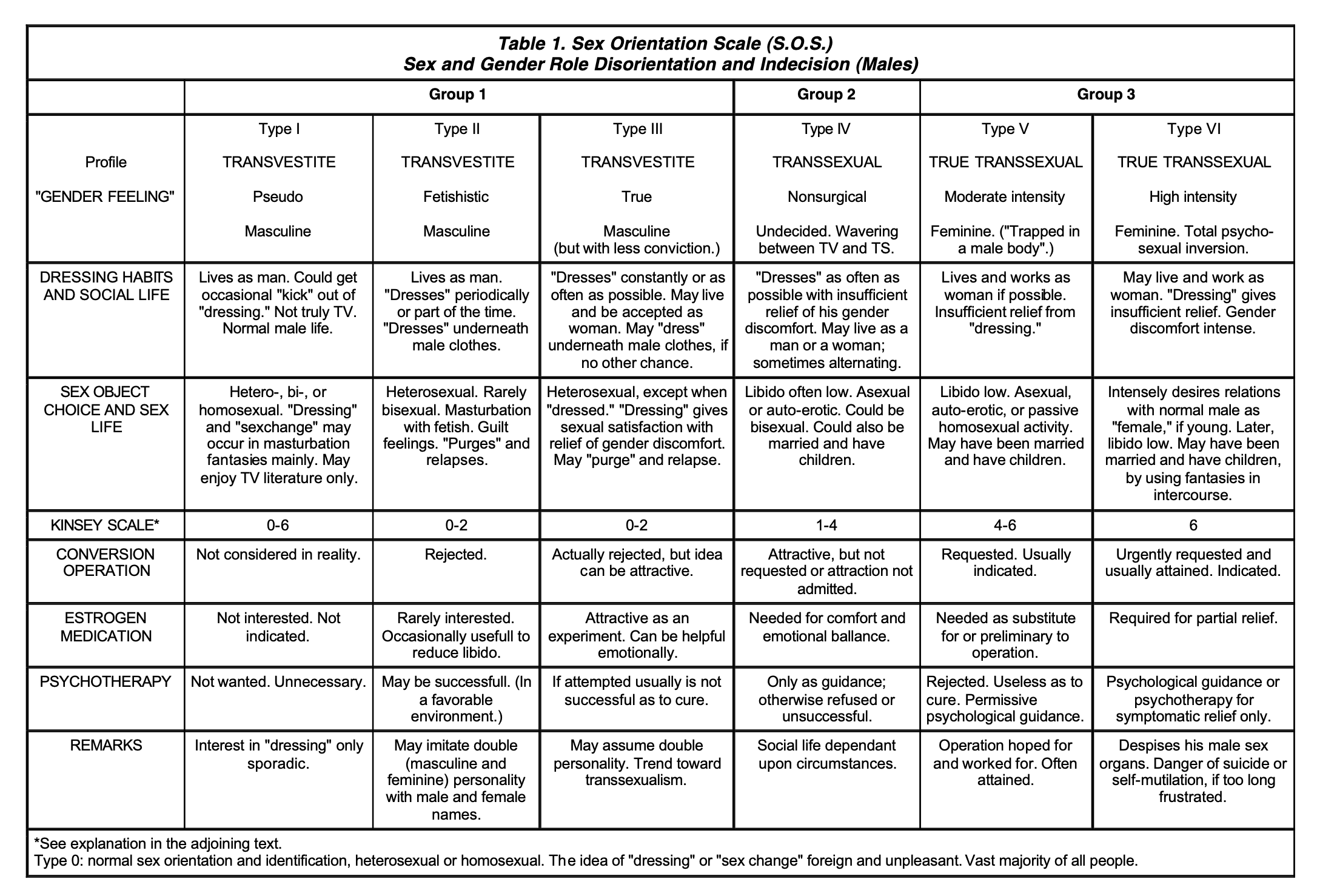
Harry Benjamin’s infamous scale from his 1966 book, The Transsexual Phenomenon. Credit: Courtesy of Eli Erlick
These scales can create hierarchies of trans people and erase large sections of our community. Unfortunately, this was characteristic of the time. While searching through UCLA’s archives, I found a similar scale by one of Harry Benjamin’s most prolific patients, activist Virginia Prince. Prince was the editor of Transvestia magazine, where she helped popularize the term “transgender” in the 1960s. Like Benjamin, Prince proposed that trans people were more legitimate if they were straight and less sexually active. She first published her graphic in the April 1965 issue of Transvestia. It was never widely circulated, but still represents a common understanding of gender and sexuality at the time among trans people. She encouraged readers to find themselves on her chart.
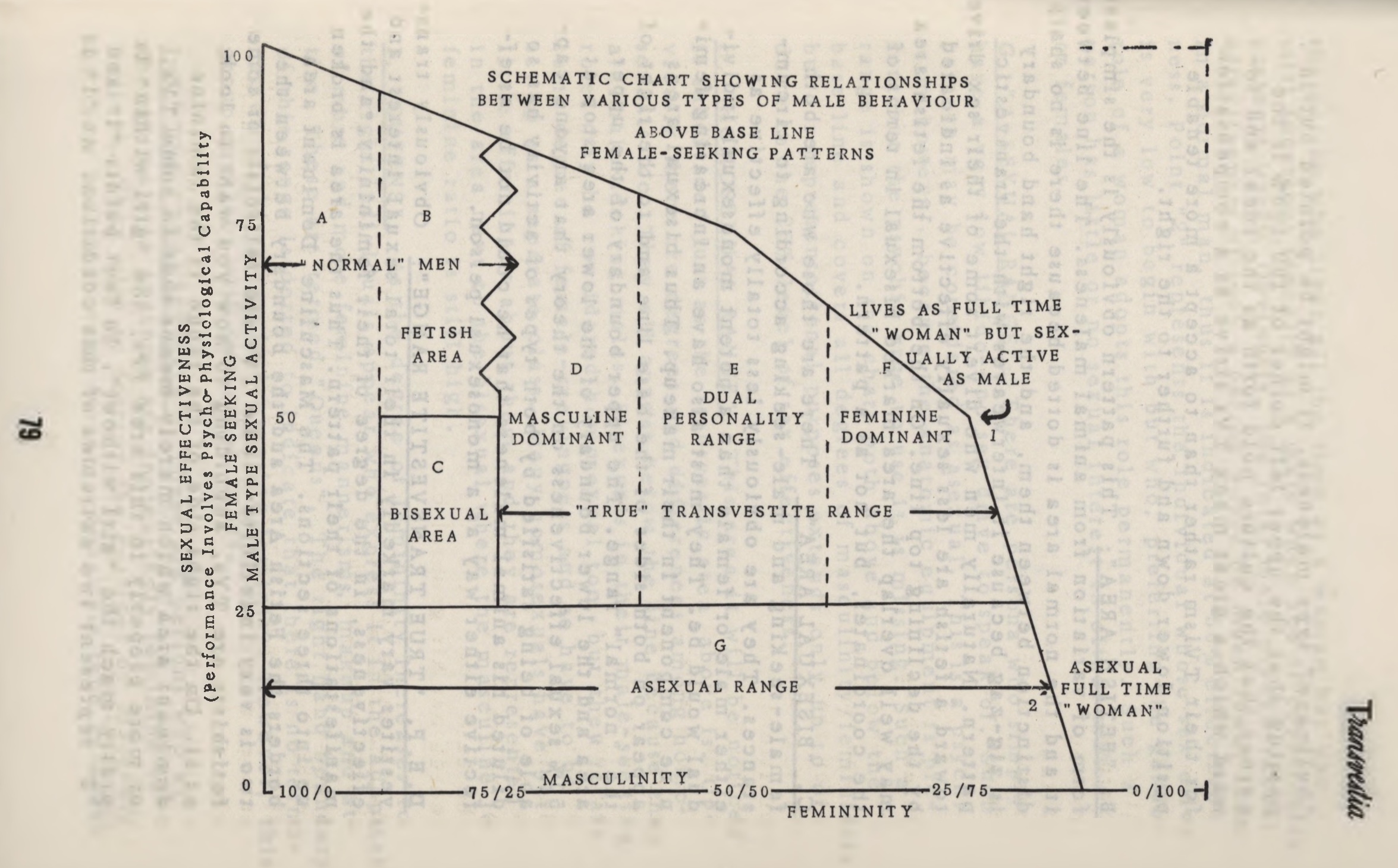
Credit: Courtesy of Vault/UVic Libraries
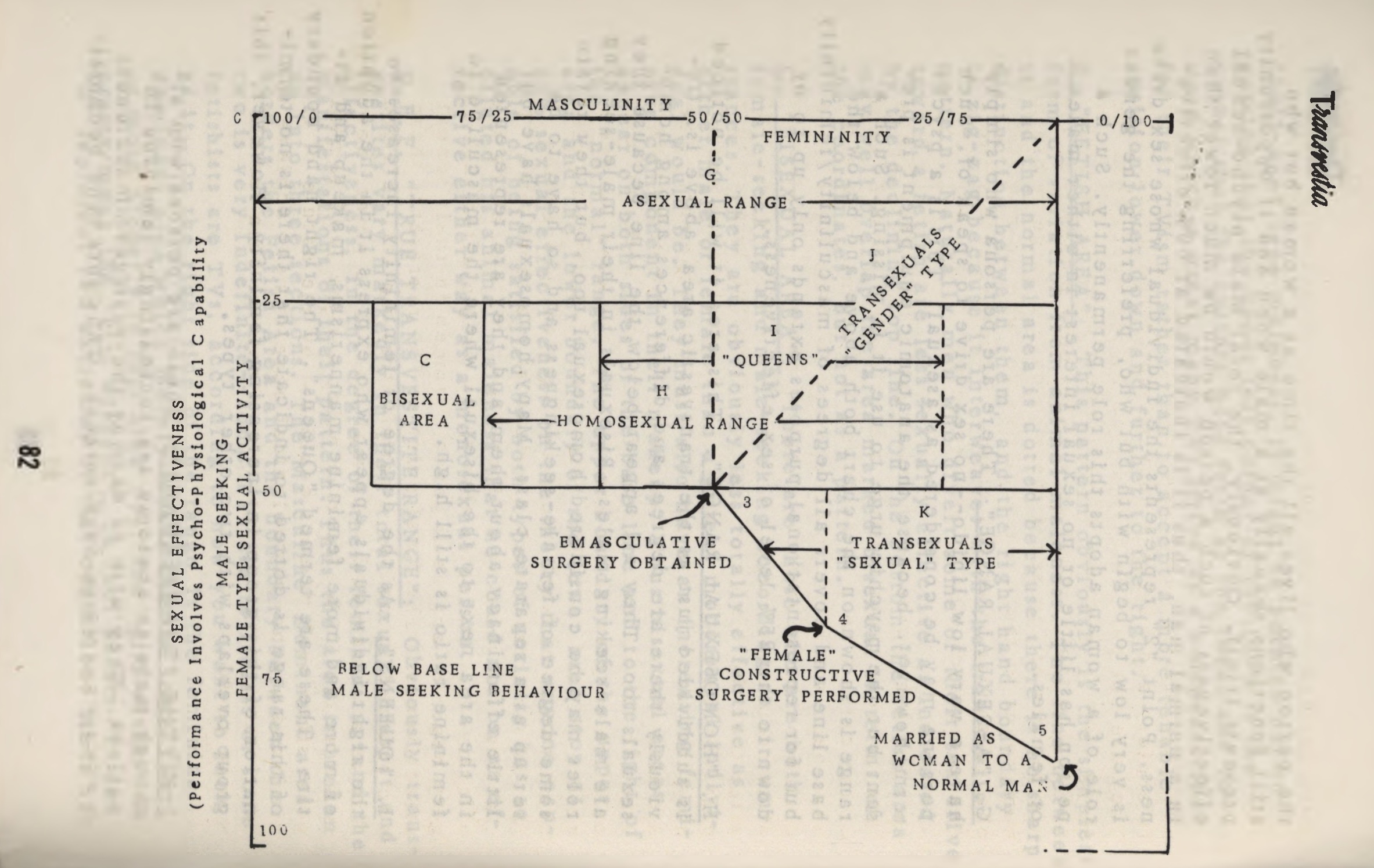
Prince’s diagram of gender and sexuality suggested hierarchies in the LGBTQ+ community. Credit: Transvestia, Vol. 06, No. 32 (April 1965); Courtesy of Vault/UVic Libraries
Following 70 years of scales, trans community members began to create more inclusive and welcoming gender-mapping graphics. The trans umbrella, which is still used today, first gained popularity in the early 1990s. There are multiple, contradictory origin stories for the umbrella. Regardless, it was a commonplace teaching tool by the middle of the decade.
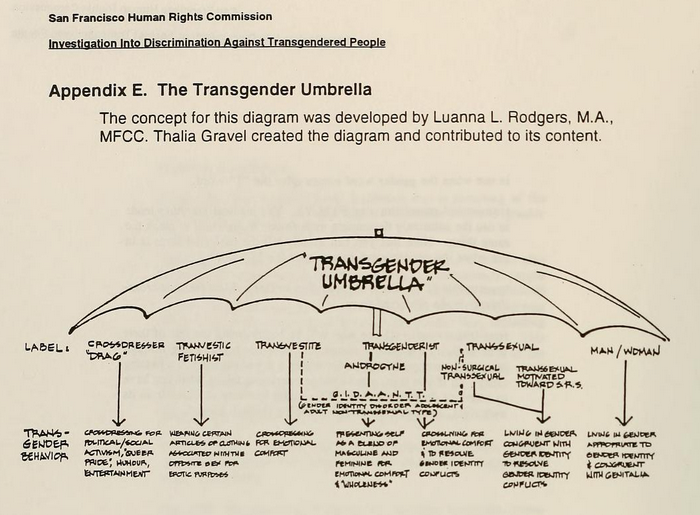
A 1994 print of the transgender umbrella from the San Francisco Human Rights Commission featured in the Oxford English Dictionary Credit: oed.com
Illustrations of gender and sexuality proliferated in the 2010s. The Gender Wheel (2010), Gender Galaxy (early 2010s) and “gender cloud” (2013) were each created early in the decade. Some of these graphics were still relatively binary, like the Genderbread Person (2012). Others were more fluid and abstract, like The Gender Planet (2013). Trans Student Educational Resources created the Gender Unicorn in 2014 to bring these abstractions and social constructs together with sliding scales and fill-in-the-blank responses.
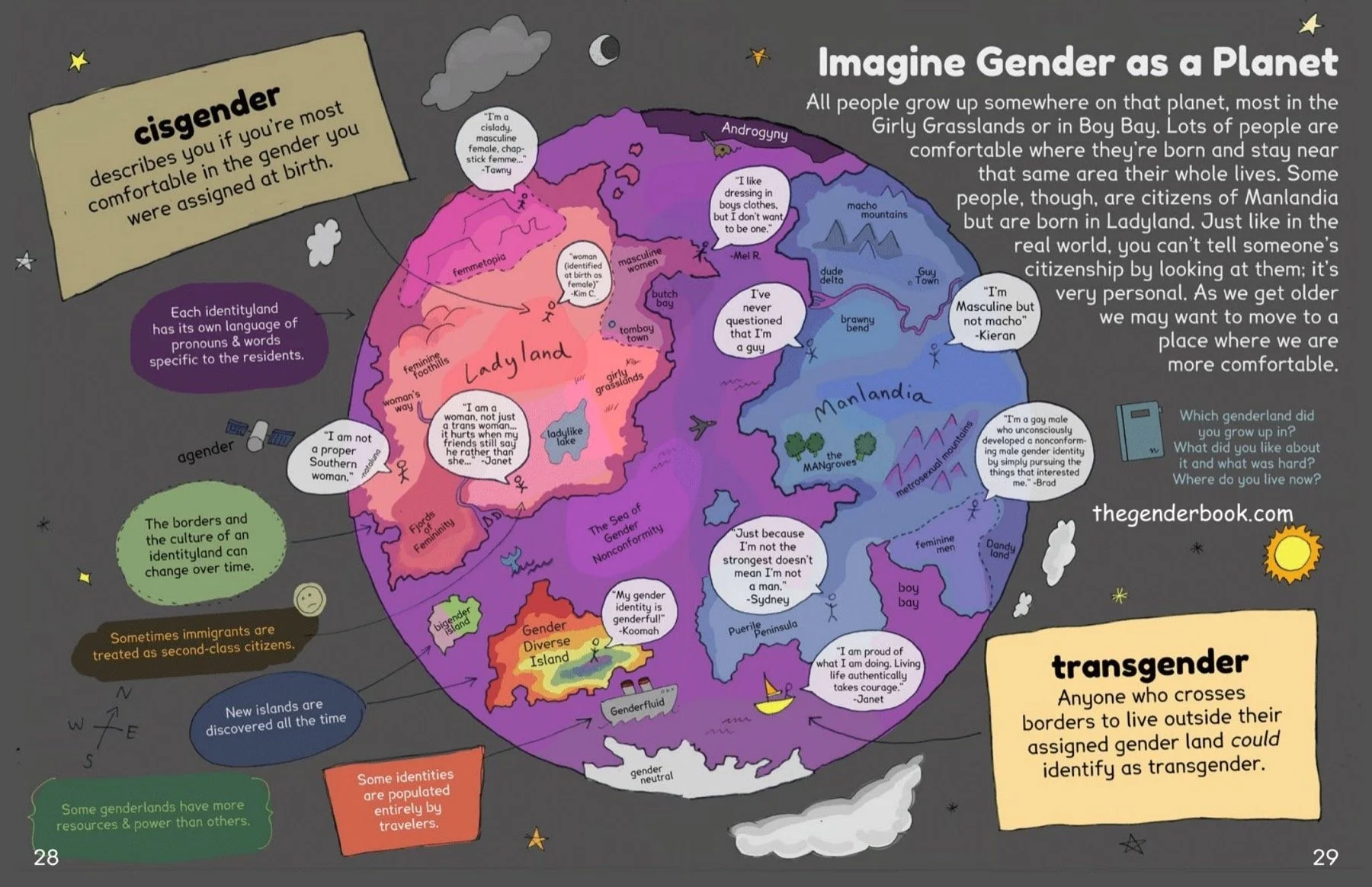
The Gender Planet in the GENDER book (2013) Credit: thegenderbook.com
There are plenty of reasonable critiques of the Unicorn. “Indoctrination” isn’t one of them. Contrary to the “growing ‘gender ideology propaganda’” accusations, graphics like the Gender Unicorn encourage critical-thinking skills. The teaching tool is now over 12 years old, and has yet to turn a single person trans.
Lecturer Melissa McCoul’s firing should be a wake-up call to anyone concerned about free speech or LGBTQ2S+ people. A new wave of censorship is here, and politicians are using the Gender Unicorn as a pretext to attack everyone’s freedoms. Yet trans people, past and present, have never stopped finding creative ways to express ourselves. No matter how intense the backlash, no matter how many book bans are enacted, we will continue to deepen our understanding of gender and sexuality.

 Why you can trust Xtra