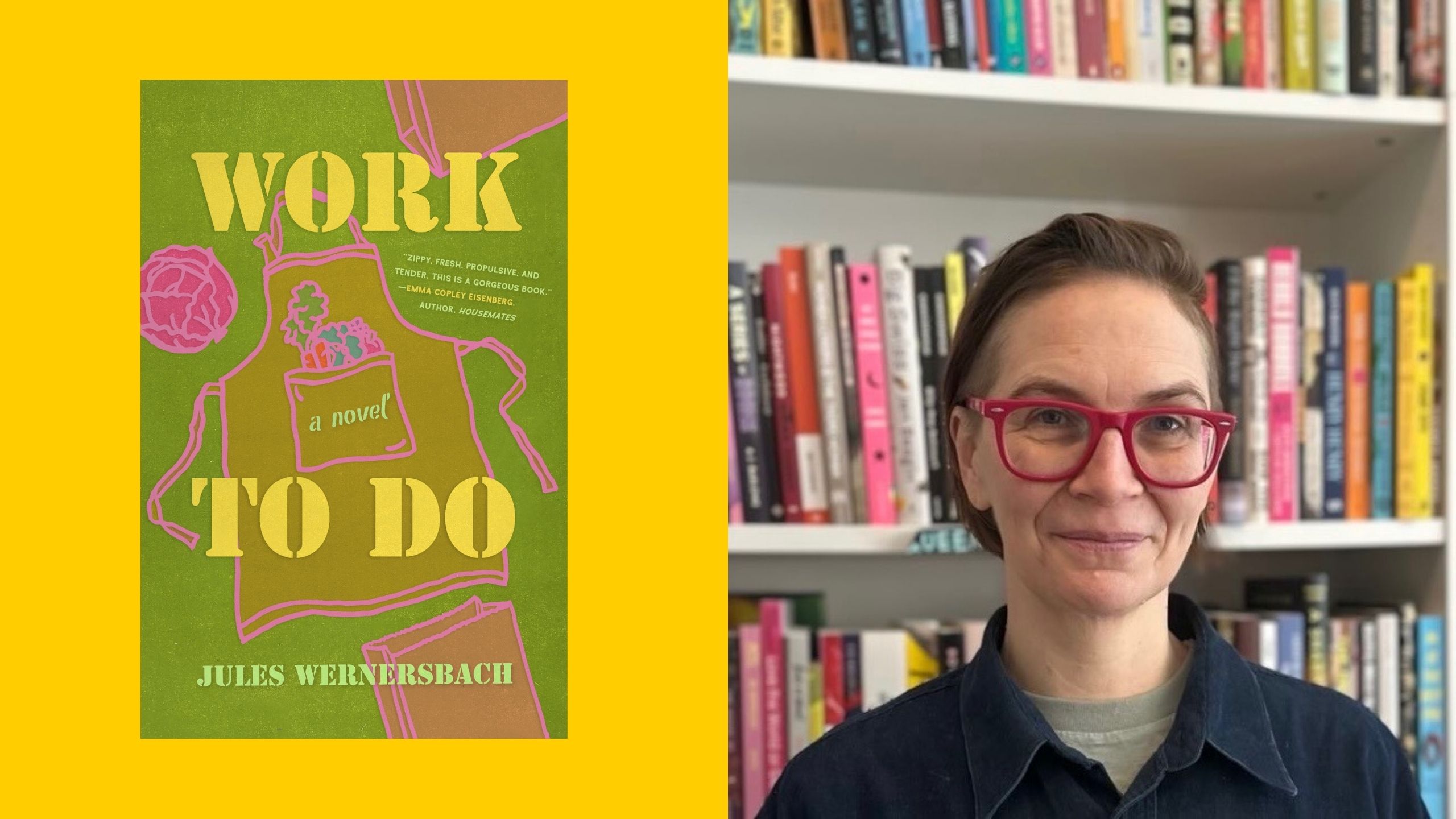
“This isn’t us,” a character tells her co-worker/girlfriend in one of the many scenes of interpersonal conflict in Jules Wernersbach’s Work to Do. “It’s just the store. It’s just work.” Yet, as Wernersbach illustrates over the course of this smart, expansive and funny novel, it can be nearly impossible to separate work lives and personal lives, especially when social and dating circles overlap dramatically with workplace hierarchies and their attendant class tensions.
Work to Do unspools over the course of one week in Austin, Texas, in 2019, in the midst of a destructive hurricane season. Narrated by three main characters among a cast of dozens, it closely follows the lead-up to and fallout of a staff bid to unionize at the Guadalupe Street Co-op, a 40-year-old independent grocery store. Meanwhile, the store itself is threatened by flooding and tornadoes, as well as everyday pressures from disgruntled investors, rising costs and corporate competitors.
Work to Do, which is Wernersbach’s first novel, brims with energy and astuteness as it delves into the intricacies of retail wage labour, queer entrepreneurship and relational dynamics, climate change and class revolt. Like the co-op itself, the text is in constant motion; it is light on its feet, never letting the reader become too comfortable in one perspective before shifting into another register, portraying the escalating series of events from yet another angle.
While a novel like this might have turned weighty and didactic in another writer’s hands, Wernersbach makes the clever choice to narrate the story from three different vantage points in the store’s hierarchy. They approach each character’s perspective with a balanced helping of empathy and class-informed realism, never losing sight of the inequitable distribution of power between them.
Randy, the dairy manager, is a longtime member of the general staff, middle-aged and dedicated to the work, but suffering from back and knee pain, as well as increasing financial and housing precarity. They have formed the clunkily named Guadalupe Street Co-op Employee Collective for Fair and Sustainable Working Conditions, a faction of store employees working behind the scenes to unionize the staff. However, even within this tightly allied group, Randy often clashes with Zoey, a much younger and more militant co-worker whose organizing tactics are too bold and chaotic for Randy’s comfort.
Roz is a longtime floor manager, who longs to be named general manager. Inhabiting a classic middle-management role, she is seen as the boss’s puppet by the general staff, and yearns for the boss’s approval without ever really getting it—or any real say over how things are run. She is both dedicated to the co-op and prone to taking out her frustrations on the employees she supervises, including her girlfriend, Molly. For her part, Molly resents the unequal power dynamics involved in their relationship and seeks solace, behind Roz’s back, with Randy.
Eleanor is the boss. One of the original founders of the co-op, she is, like Roz, a hard-working lesbian who is estranged from her more conservative family, and whose single-minded dedication to the store pushes away her romantic partners and everyone else. Eleanor’s dismissive Boomer attitude toward the younger staff’s demands for better pay and working conditions could make her into a one-dimensional villain; however, Wernersbach soon shows us her more vulnerable sides. She has been hiding a cancer diagnosis and fears that, despite the store’s longevity and relative success, she won’t be able to afford treatment. She is also desperately lonely, still pining after her long-ago ex-girlfriend Meg, whose only contact with Eleanor is from her position as majority investor in the co-op.
The novel is rooted in the mundane details of grocery-store work and workplace organizing, but Wernersbach makes these scenes anything but dull. They write about the frenetic choreography of a chaotic retail shift with loving precision. The opening chapter, which features Roz dashing around the store as a storm rolls in and customers pack the place, has the urgency of an emergency-room drama. There are crises to be dealt with in every aisle, a torrent of urgent demands and complaints, a riot of competing personalities and workplace hierarchies and the increasing threat of flooding and destruction. The staff sometimes find a kind of meditative calm in these overwhelming circumstances. “The work was bottomless,” Randy notes during one hectic shift. “It carried them. [They] gave themselves to it.”
The work of the grocery store staff team, especially on storm days, is portrayed as skilled labour, with periods of elation and exhaustion, rather than as dismissible “work for college students,” as one investor puts it. At the same time, the trouble of worker exploitation and low wages is never far out of frame. Once the unionization bid goes public, Randy tells a reporter that it is important “to resist the language that confuses employment here [at the co-op] with any kind of family dynamic. We are not children. We are workers. Management does not love us like family. They use us for our labor and that’s it.” Herein lies the impossibility of a caring capitalist enterprise. Though all the members of the co-op’s staff, including Eleanor, care deeply about the store and the business of feeding people, the power structure within the company means that the bosses, the management and employees all have competing interests. Wernersbach shows us unconditional love and support between them all is a fantasy, or at least extremely compromised.
There is no easy solution to the power dynamics and exploitation inherent to capitalism, other than to abolish it entirely, which is beyond the scope of the novel. Work to Do is, however, a staunchly political book, grounded in a working-class solidarity that is evidenced by Wernersbach’s attention to the details of work shifts, produce stocking, bathroom cleaning, customer demands, wage scales, seniority, union meetings, investor pressures and different characters’ class-informed attitudes toward money and labour. It’s exciting to read a queer novel that takes the realities of retail work and union-organizing just as seriously as it does the highs and lows of sex and dating.
The inevitability of change undergirds the fast-paced action of Work to Do. Just as the co-op’s produce is bought and restocked, just as its employees come and go, the weather itself, made even more unpredictable by climate change, cycles through town, forcing humans to abandon their best-laid plans. “Weather was Earth,” Roz thinks, “pushing toward, and past, its equilibrium, over and over. There was no such thing as stability.”
Over years of struggle and success, Eleanor has become increasingly unable to separate herself from the business, which has made her brittle and embittered. By the novel’s close, Roz, who is almost as entwined with the store as Eleanor, finally manages to unload some of the emotional baggage of the workplace. In the wake of various professional and personal upheavals, she is able to see the store as it is: “just a building, an indifferent space that could be pushed around and set up any way they [the staff team] wanted.” It’s just the store, it’s just work, after all—and yet we are left with the sense that this new period of grace will inevitably give way to another storm season, as it always does.

 Why you can trust Xtra