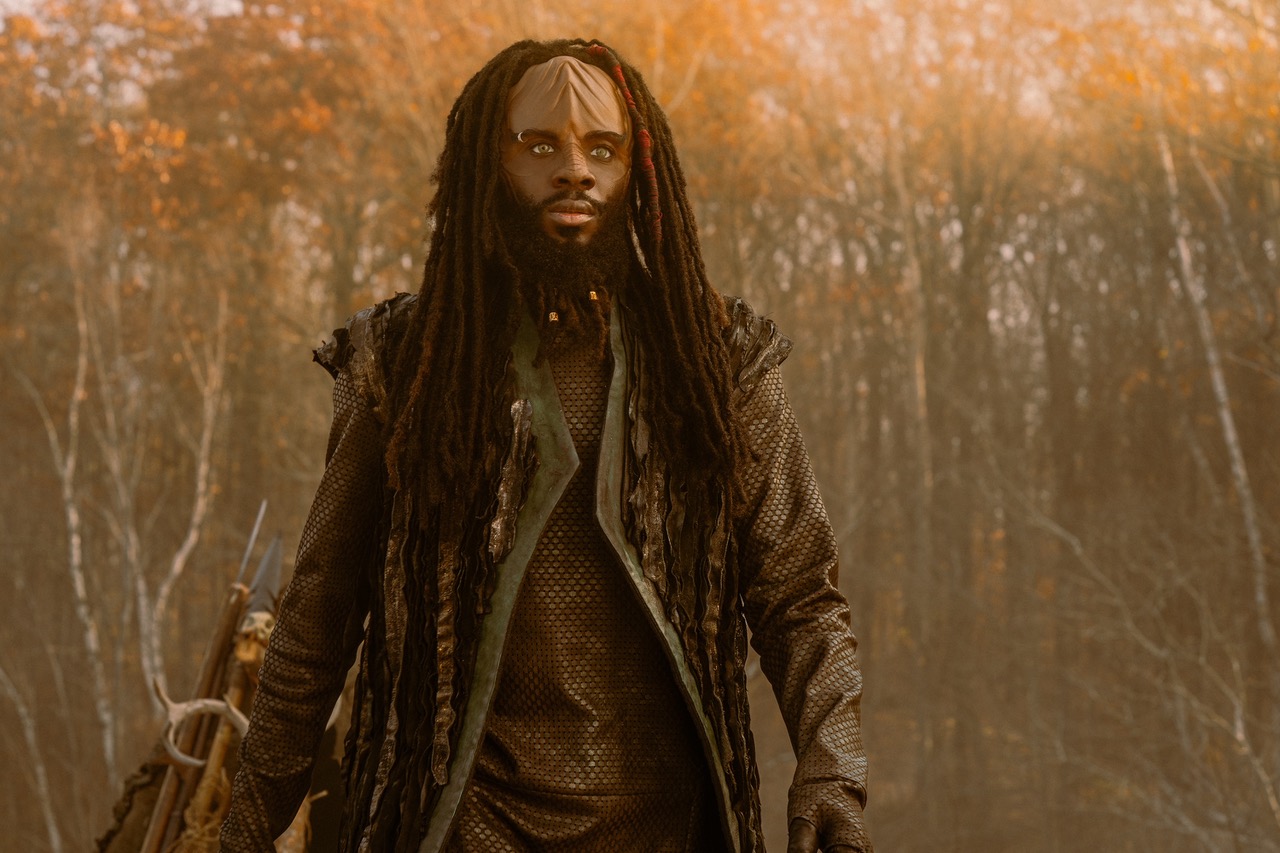
When he learned he’d been cast as the first gay Klingon in the long-running Star Trek franchise, Karim Diané knew he’d be making history. The 23-year-old actor plays Jay-Den Kraag, a first-year cadet in the live-action series Star Trek: Starfleet Academy, which comes six decades after the original show debuted in 1966. Set in the 32nd century, over 900 years after the adventures of Captain Kirk and the U.S.S. Enterprise, the show follows a group of first-year cadets as they tackle the challenges of young adulthood on their way to becoming Starfleet officers. But this is not yesterday’s Enterprise. In 3195, the Federation and Starfleet are rebuilding 150 years after “The Burn,” a galactic calamity that wiped out interstellar travel and forced member worlds back into isolation. In focusing on recovery after societal collapse, Starfleet Academy paints a hopeful picture, with the older generation acknowledging its mistakes and passing the baton to fresh new faces.
Like the original Star Trek, which aired amid the Civil Rights Movement and the anti-Vietnam War protests of the 1960s, Starfleet Academy arrives at a turbulent time. Queer and trans rights are under assault, DEI initiatives are being scaled back and the wars in the Middle East continue to escalate. Like its progenitor, the show presents a future in which the inclusion of groups that are marginalized today is taken for granted. But whereas the first series quietly championed and represented ethnic and racial diversity, Starfleet Academy gives us a world where gender and sexual expression are fluid and free, quietly introducing same-sex couples, polycules and queer characters matter-of-factly, without fanfare, taking their existence and acceptance as a given.
Diané’s Jay-Den further shatters the mould. In the show’s post–Burn reality, the Klingon home world has been destroyed, the Klingon Empire has collapsed and the displaced nomadic survivors are scattered across the galaxy as refugees. Jay-Den dares to imagine a better future than the hardscrabble existence of his people and joins Starfleet Academy to study medicine, embracing both science and pacifism.
The actor’s sensitive portrayal of the young outsider exploring his potential, grappling with his sexuality and masculinity, and contextualizing his Klingon heritage in an unfamiliar environment is a refreshing take on Star Trek’s honour-bound warrior race. While some fans have welcomed this portrayal, others have attacked Diané and his character for deviating from established tropes about Klingons and throwing queerness and gender nonconformity into the equation. Diané has responded to the online backlash with grace, humour and sass, relying on wit to outplay the haters.
The actor spoke to Xtra ahead of tonight’s Starfleet Academy season finale.
How did you land the part of Jay-Den in Starfleet Academy?
I was born in Washington D.C., and I’ve been a singer since I was a young kid. I was in the choir. I enjoyed doing theatre in high school. And so as soon as I graduated, I moved to Los Angeles to pursue music. I stumbled into acting, and I feel like acting chose me instead of the other way around.
My first acting audition was by virtue of my being a singer. My music manager tipped me [off] to that audition. I did not get the role, but the agent who facilitated that audition ended up signing me. Fairly soon after that, I booked One of Us Is Lying, my first big-boy significant role on a TV show as a recurring character for two seasons.
After that, I booked a pilot called 1266 [a workplace comedy starring Gabourey Sidibe from Precious, based on her time as a phone-sex worker in the early 2000s], but it didn’t get picked up. When that ended, another audition landed in my inbox, and they tried to conceal it. They called it something else, but my agent tipped me off, “This is Star Trek, dude. Take it serious.”
I was like, “I’m probably not going to book this.” You get a ton of auditions.
I sent in [my self-tape], forgot about it and moved about my life in New York City. Maybe two and a half weeks later, I got an email saying I had a callback, and I was like, “Holy crap.”
Before my callback, the casting directors FaceTimed me to break down the role and explain what the director and producers were looking for in my audition, which had never happened to me before. Casting directors do not regularly call actors to give them the cheat codes. I went into a callback with our showrunners and the producers. As soon as I got off that callback, I called my manager, and I told him, “I think I’m going to book Star Trek. I think I’m going to get this role.” It went so well. They were so responsive. And now here I am.
Were you a fan of Star Trek growing up?
I’ve always been a fan of sci-fi at large, but I never explored Star Trek until I booked this role.
As soon as I got cast, I watched so much, and I’ve been converted into a Trekkie. I immediately started watching all the episodes that have [the Klingon] Worf in them just so that I could understand what the standard is. I focused on episodes that feature [his son] Alexander to understand Klingons from a slightly different perspective.
Then I did a lot of exploring on my own. I watched all of Strange New Worlds that was available at the time. I watched Lower Decks. I loved that first J.J. Abrams movie: that’s probably my favourite of them all.
Tell us about meeting George Takei, the queer icon who played Sulu in the original Star Trek.
I initially met George at a Broadway show. The lights came on, and he was sitting next to me. I introduced myself and told him that I was a new castmate on Starfleet Academy. We didn’t have much time to talk because everybody was being rushed out, but his lovely husband, Brad, gave me his business card, and I held on to it for a couple of months.
One of the Starfleet Academy producers had called me, prepping me for what was to come, playing this queer Klingon on the show. They knew that I would be met with a lot of heat. I decided to send George an email and just tell him about the character. The show wasn’t out yet, but I told him, “By the way, my Klingon Jay-Den is gay.”
Ten minutes later, he and Brad wrote back this lovely, lovely email, expressing that they had tried in the ’60s to get a queer character on the show. But [Star Trek creator Gene] Roddenberry had feared that, because they had already featured that interracial kiss between Uhura and Kirk, a gay character back then would have risked the series’ total cancellation.
To go from George’s experience to Jay-Den existing feels like the manifestation of all the work that he had put in. It’s cool and touching to be stepping into that. I feel a sense of responsibility knowing how much work went into my getting the chance to play this character. I just feel humbled to know the history behind all of this.
How do you feel about the way Starfleet Academy handles Jay-Den’s sexuality and the same-sex love triangle he is part of?
There is never a huge “coming out” moment in Jay-Den, Kyle and Darem’s relationship. There is no big discussion about it. I believe in a future where none of this matters as much. It is so confusing to me why people care so much about what others do in the privacy of their homes, especially regarding sexuality, as long as it is not harming anybody else.
I love the way the story unfolds on the show. I don’t believe that there needs to be this big announcement. If the show had a whole “Jay-Den is gay” episode, it would have made it a big deal, but it is not—it is normal. People are gay. It is a fact of life in humans and in animals. I feel like we need to move forward and focus on other things.
How do you feel about the way Starfleet Academy addresses masculinity?
Society expects men and masculinity to look one way, and it’s so rigid that almost nobody fits that standard. Men are expected not to be emotional, not to need friendship or not to like other men. They’re expected to do it on their own, pull up their pants and dive into battle.
We’re turning all of that on its head with this show. Some men are gay, some are straight and some are not necessarily the best captains, but they’re great co-captains or team members. Not every man has to be the head of the ship. Some women are better at that.
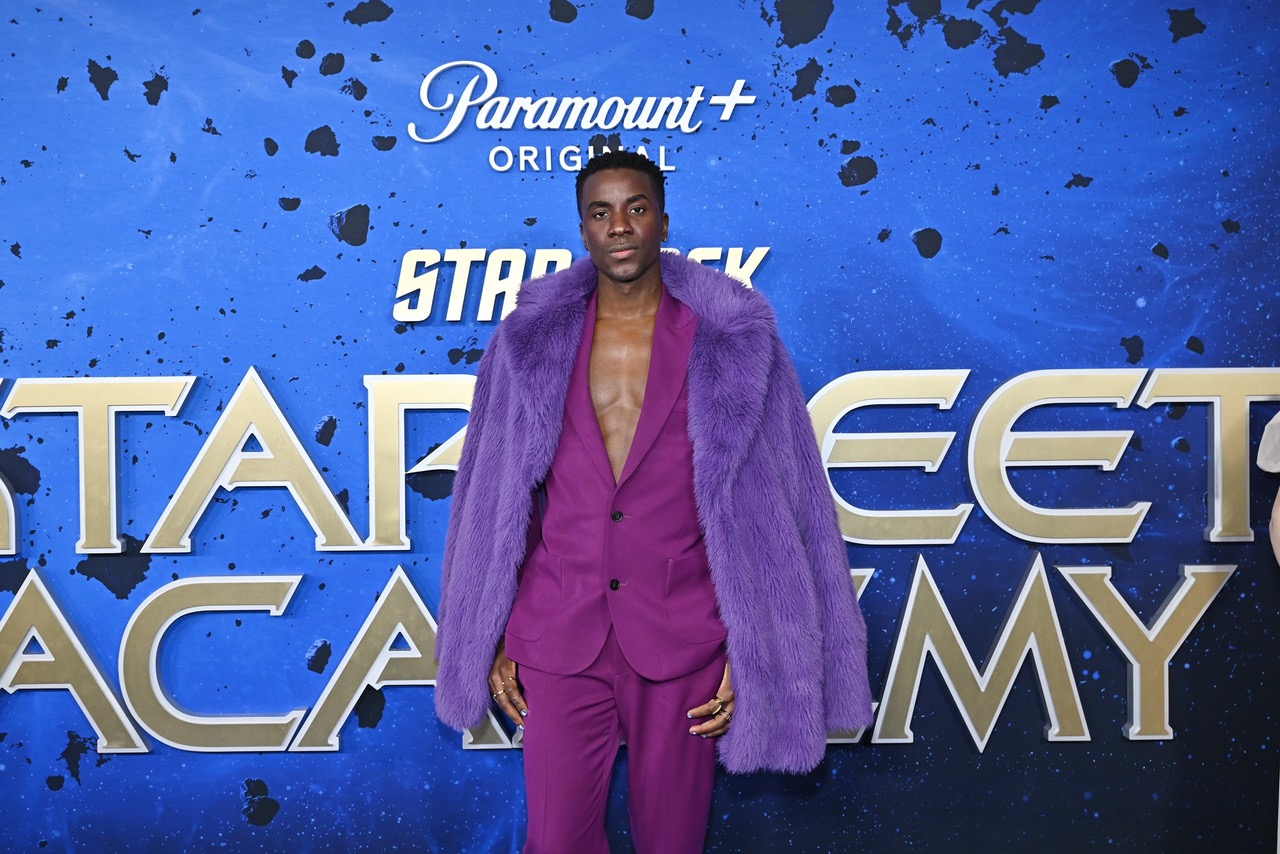
Credit: Courtesy of Paramount/CBS
Men can be emotional. They can hug other men and seek friendship from other men. Men are so layered, and it’s important to move away from stereotypes and allow men to be themselves, whoever or whatever that is. It’s okay for men to cry sometimes.
People expect Black men, especially in America, to be a certain way. My whole life, I have been expected to be a basketball player because I’m tall, to be rough and tough and to have a certain machismo to me, but that’s not who I am. I’m a soft person. I enjoy theatre. I enjoy dance. I enjoy fashion.
Jay-Den and I share that quality. We are expected to be a certain way, but we are so different. We are soft, and kind and warm once you get to know us.
What was it like working with queer comedians and cast mates Tig Notaro and Gina Yashere?
I think the world and society at large are very skilled at making young people feel crazy and insane just for being themselves. We live in an age of social media where the personalities who win online are not the contrived ones, not the ones that are dressing up and putting on a show. If you log on to TikTok, you’ll see that the videos getting the most views are the ones of waking up with a bonnet on, with no makeup and morning breath. There’s this authenticity that wins.
Sometimes, that authenticity clashes with what society wants you to be. People are choosing their own path, and it diverts from what we’re told to be and do: “You’re crazy. You’re weird. What are you doing? Get back in line!”
So, it’s so important to have someone like [onscreen lesbian couple] Lura Thok and Jett Reno—in real life, Gina and Tig—reach out and be, like, “Hey. No. You’re not crazy. Please forgive these other aunties and these other uncles. They’re stuck in their ways. You’re doing great. You’re doing amazing, and keep on that path.” That is so important.
I have my elder brothers and my elder cousins, who looked at me like I was fucking crazy for pursuing the life of an actor because it’s unstable and nobody ever makes it in that industry. I needed people in my life who are older than me to be like, “Yeah, it’s kind of crazy. It’s out there, but go for your dreams, and we’ll be here to support you.” That is invaluable as a young person.
@xtramagazine It’s hard to deny that @Heated Rivalry, the new queer hockey drama about two rival pro hockey players that fall in love is having a moment. From thinkpieces to social media discourse, the show is everywhere. Even the interview with creator Jacob Tierney and stars Hudson Williams and Connor Storrie that we published here on Xtra quickly shot up into our most read stories of the year when it dropped. But what makes it so good? We break down some of the key ingredients to the show’s recipe for success. 🏒🏳️🌈 #heatedrivalry #lgbtqnews #booktok #mlmromance #canada ♬ original sound – Xtra Magazine
How do you respond to the online hate?
When haters or angry people attack me on the internet for something that they don’t know the truth about—because it has never come out of my mouth—I realize that it has nothing to do with me. It is rooted in racism, homophobia and sexism. These negative things have nothing to do with me.
Yesterday, I did an interview with [showrunner] Alex Kurtzman. He brought up a great point. On YouTube, there is an overabundance of negativity when it comes to not just me but the show in general. Creators make money off it because negative taglines on YouTube get more clicks than positive ones. A lot of times it is just a way to make money, which is so evil.
Now, I understand that people have different opinions creatively about the show, and that is fine. I welcome, read and respond to some of the critiques. But the majority of it really is hate for the sake of hate. What I am truly focused on is the positivity. There is so much love.

 Why you can trust Xtra