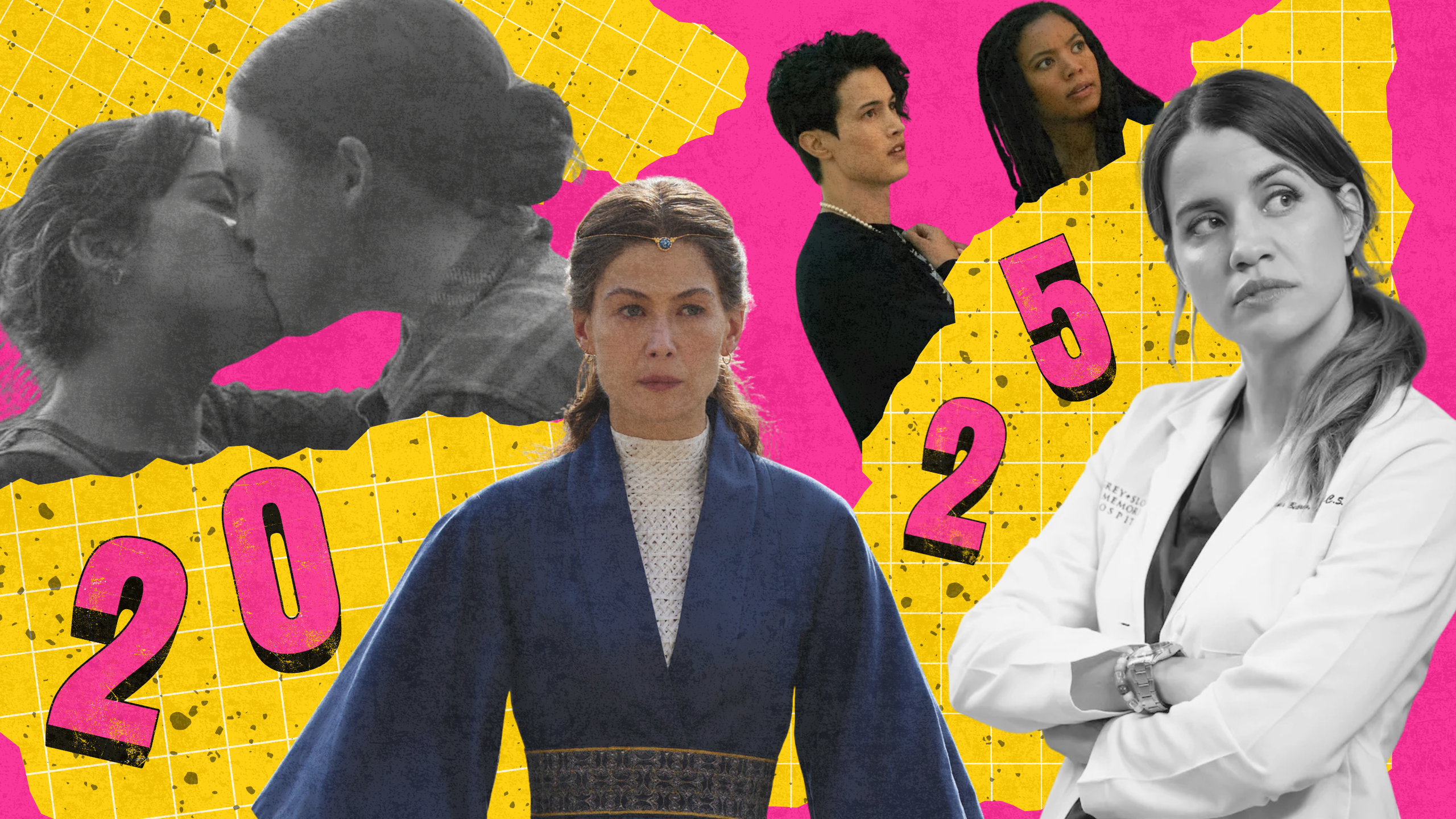
This has been a stressful and downright depressing year for culture. From the ongoing circus of the Trump administration’s attack on any media that isn’t explicitly conservative to the continued consolidation of Hollywood and the onslaught of AI slop permeating every facet of our daily lives, this year has left both creators and audiences feeling uncertain about the future of diversity in entertainment. This representation squeeze has resulted in Sapphic representation that feels like a pointed regression from last year’s tour de force of toxic lesbian catharsis provided by series like Agatha All Along, House of the Dragon, Pretty Little Liars: Summer School and so many others. While there have certainly been series to deliver well-written Sapphic characters (looking at you, Pluribus), the boringly safe execution of shows like The Last of Us and Gen V alongside the shockingly brutal deaths to hit queer characters on The Wheel of Time, Grey’s Anatomy and beyond highlight the troubling backward trajectory of LGBTQ2S+ characters on the small screen.
In my year-end retrospective from last year, praising both television and film’s embrace of toxicity and complexity across specifically Sapphic representation, I kicked it off by bringing up the GLAAD Where We Are on TV Report, a yearly study conducted by the media watchdog group to assess how many queer characters are on TV, the amount of representation for each sector of the community exists and, perhaps most importantly, how many characters will not be returning for next year’s study. While this year’s GLAAD report begins with the positive news that queer representation on TV is up for the 2024-2025 season in comparison to the previous two years’ declining numbers, there continues to be troubling trends across the representation of specifically queer women. Forty percent of all queer characters will not be returning for the 2025-2026 season, either due to cancellation, planned ending or character exit/death. And of those not-returning characters, 52 percent of them are queer women. Despite seeing an increase in the sheer amount of queer women across the small screen, they are still more likely to be affected by cancellations and exits than their male counterparts, and that trend bleeds into the overall shadow that was cast across queer female representation throughout the year.
In the wildly popular video game The Last of Us Part II, Ellie develops a romantic relationship with Dina, a woman she meets within the safe walls of the Jackson, Wyoming, infected-proof community. Dina’s feelings for Ellie overlap with her breakup with her on-again-off-again boyfriend, Jesse, leaving her pregnant with his baby but romantically committed to her female best friend. This results in Ellie calling her a “burden” as Dina presses Ellie to give up her unhinged revenge fantasy and ultimate mission to avenge her fallen father figure, Joel. The progression of Ellie’s story in the game allows her to become twisted by grief and revenge, driving away those closest to her in favour of prioritizing a mission that is eating her alive from the inside. It’s truly one of the most compelling and heart-wrenching portrayals of a Sapphic relationship in a video game, and remains a fan favourite by many within the queer community.
However, when this storyline was brought to HBO’s second season of the Emmy Award-winning adaptation of The Last of Us, the execution was much different—to the detriment of the series. Season 2’s Ellie (Bella Ramsey) is meek and lacks the destructive drive showcased in the game, stumbling through her half-baked revenge plot with little character devolution. It’s the show’s version of Dina (Isabela Merced) who ultimately convinces Ellie to maintain her path of revenge, vowing to stay by her side, despite her pregnancy, to see their mission through. They stay soft and sweet throughout the entire season, and when Ellie’s actions ultimately catch up to them (in the form of Kaitlyn Dever’s Abby bursting into their safe haven in the middle of an unfamiliar, militarized city), the gut-wrenching guilt and terrifying danger they’re in doesn’t pack the same punch as it did in the game.
The smoothing of Ellie and Dina’s tumultuous relationship into something more palatable reeks of an overt fear from the creators of the show and HBO itself to ensure Ellie stays likable, a fear that was never a factor in Joel’s (Pedro Pascal) portrayal throughout the first season. Joel was able to doom the entire human race without a sharp pull-back or overcorrection, while Ellie, in an effort to ensure the lesbian lead of one of their biggest series remains likable, is watered down and rounded over, never allowed to be truly angry or warped by her actions.
This is such a stark contrast to the representation showcased last year, even on one of HBO’s own shows. While House of the Dragon’s Rhaenyra Targaryen (Emma D’Arcy) was allowed to be fearsome and level-headed by turns, all while exploring her queerness, Ellie is reduced to a softer portrayal just one year later. Similarly, Prime Video’s Gen V doubled down on its boring, placid presentation of Marie’s (Jaz Sinclair) on-again-off-again relationship with the bi-gender Jordan (London Thor/Derek Luh). While the series attempts to reconcile with Jordan’s own internal misogyny and the pressures present within the relationship between them and Marie, Gen V falls flat when attempting to insert any amount of angst between the couple, falling back on quick reconciliations and near-insignificant breakups between the series’ higher-priority, plot-progression scenes. The representation on the show is good enough—especially as it features a rare bisexual woman of colour as the lead of the series, alongside a bigender supporting character—but it’s never truly great because Gen V is so tangibly afraid of making Marie, Jordan or their relationship unlikable. This robs them of any complexity in their connection.
But even beyond the ways TV has failed to showcase that same satisfying toxicity that defined Sapphic representation in 2024, queer women just seem to be disappearing more rapidly on TV than in previous years. Fantasy triumph The Wheel of Time is unfortunately not returning for a fourth season at Prime Video (meaning Rosamund Pike’s lesbian lead Moiraine is one of those 40 percent affected by cancellation), but even before the news of the entire show’s demise, the Season 3 finale featured the brutal and shocking death of Siuan (Sophie Okonedo), Moiraine’s wife and the leader of the famed White Tower. In a massive sidestep from the novels’ storyline, Siuan is overthrown in the Tower, but instead of simply being ousted from her position, she is brutally battered and eventually beheaded, her body left lying in a heap next to her decapitated head. This stomach-turning deviation from the books left fans of the series reeling, questioning why such a powerful, Black queer character had to meet her end in such a horrifying way. Similarly, fans of Grey’s Anatomy were shocked when the Season 22 premiere included the unexpected death of Dr. Monica Beltran, played by queer actress Natalie Morales. Monica, who had just begun a flirty, sweet relationship with Amelia Shepherd (Caterina Scorsone), was crushed to death by a pillar following an explosion at the death trap that is Grey Sloan Memorial Hospital.
And even when Sapphic characters aren’t brutally killed off, they’re simply disappearing from shows altogether. In the second season of Netflix’s massively successful Wednesday, the mysterious vampire Yoko (Naomi J. Ogawa) was entirely absent, robbing the series of its only Sapphic representation; she seemed to be moving toward a relationship with siren Divina (Johnna Dias-Watson), who was also cut from the second season. With how all-popular and all-consuming the series is, the removal of the show’s only queer characters is both a heartbreaking loss for those looking forward to the representation within their favourite teen drama and a loss for simply putting queerness into every living room possible.
While there were, of course, some bright spots throughout the year—like Netflix’s salacious The Hunting Wives and uber-popular Stranger Things, Apple TV+’s knockout hit Pluribus and Prime Video’s consistent Hazbin Hotel, the sensitized, uninspired standouts from this year hang heavy over the wins. It’s demoralizing to swing so wildly from last year’s showcase of Sapphic amorality to this year’s sharp shift backward, but it is unfortunately emblematic of the trajectory of the entire Hollywood system—and ultimately bodes poorly for the future of queer and trans representation on TV. David Ellison’s acquisition of Paramount has already come with a pointed effort to forge ties with the Trump administration, and if his plan to purchase Warner Bros. Discovery succeeds, two of the largest legacy studios in Hollywood will be under the thumb of a regime eager to please the sitting president and his censorship efforts. This could put a slew of the series mentioned above in danger of further censorship or, at worst, straight-up cancellation.
While the whims and wiles of over-wealthy media executives are not likely to change, the only way to ensure queer representation stays as bountiful and satisfying as it has been across the past decade is to keep showing up for these shows with our viewership and our voices. From The Last of Us to Gen V, Grey’s Anatomy to Hazbin Hotel, each of these series contributes so much for queer representation, and the LGBTQ2S+ community deserves the very best they have to offer—without concessions or regressions.

 Why you can trust Xtra