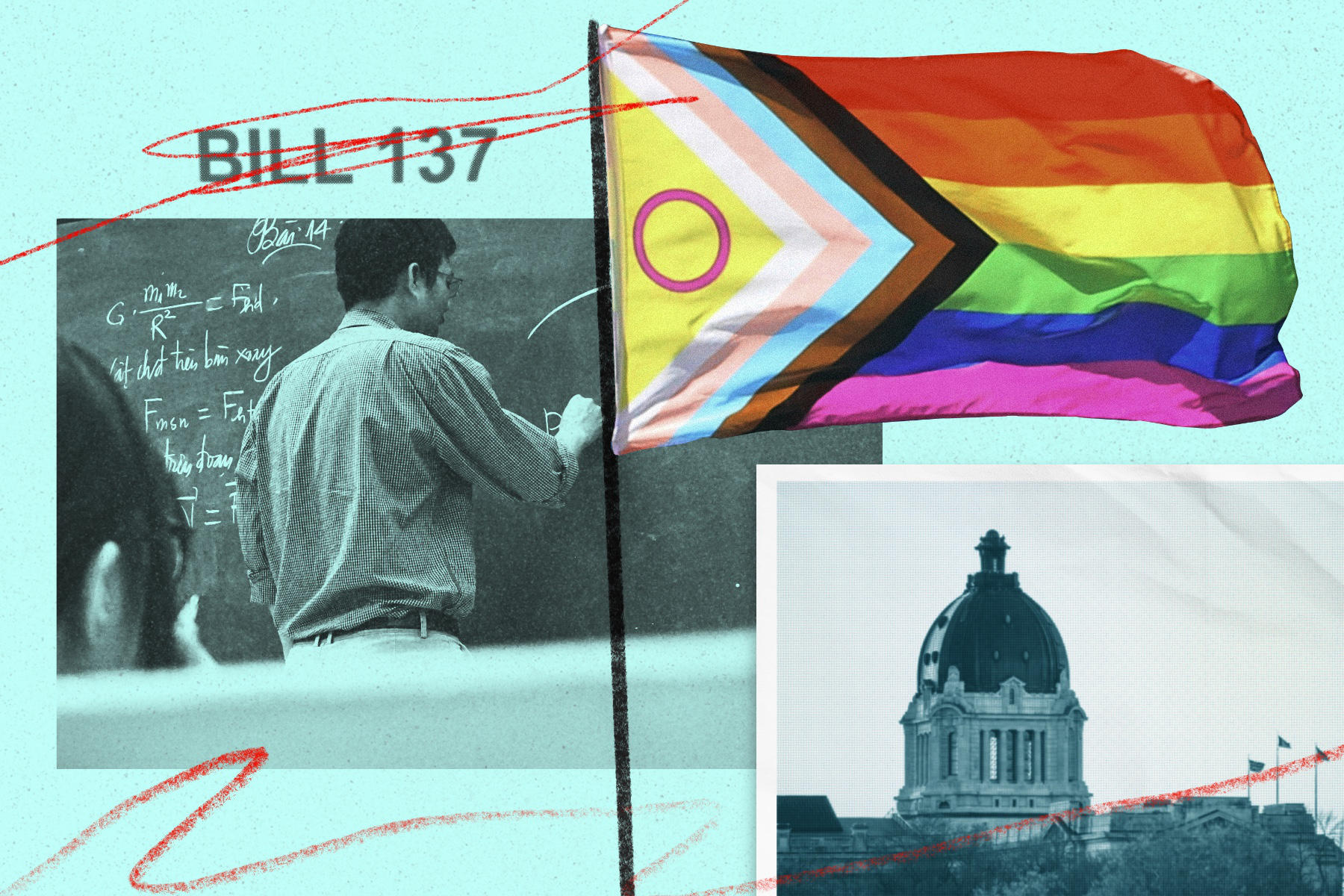
Jake had just started teachers’ college in October 2023 when Saskatchewan passed Bill 137, suddenly casting a chill over classroom discussions of sexuality and gender. As a visibly trans man training to become a teacher in Regina, he quickly felt uncomfortable in his education classes. “I felt like an elephant in the room,” he says.
For his internship, mandatory for all students pursuing an education degree in the province, Jake (whose name has been changed to protect his privacy) was placed in a Catholic elementary school. Before he began his internship, he was told by school administrators that he was welcome to bring his queer identity into the classroom. But that attitude quickly changed when another intern at the same school disclosed to students that she was bisexual, and parent complaints started rolling in. Jake was never explicitly barred from talking about his gender and sexuality, but it was clear to him that he was expected to keep quiet on these topics.
Pushed through in October 2023, Bill 137, or the “Parents’ Bill of Rights,” forces teachers in Saskatchewan to tell parents if a student under 16 asks to go by a new name or pronoun. It also allows parents to withdraw their children from sex-ed classes in school. Its passage resulted in a cooling effect in schools across Saskatchewan, where teachers are hesitant to speak about any LGBTQ2S+ topics in the classroom, or explicitly show support for queer and trans colleagues and students. Facing worsening work conditions and a rise in harassment, queer and trans teachers and educators who oppose the bill are starting to leave the profession.
Jake’s discomfort grew throughout his internship. The teacher he was placed with taught sex-ed out of a textbook called Fully Alive, which Pearson Canada stopped publishing in January 2023 because it contained homophobic and transphobic content. “I was basically in a class, sitting through lessons that were teaching the children that I don’t exist or I’m unnatural,” he says.
Worried for his well-being, Jake’s education faculty pulled him from the Catholic school, and he finished out his internship term teaching in the public school system. Though he had a far better experience, Jake noticed that teachers were still hesitant to discuss queer topics or the fallout from Bill 137 in the classroom.
“The chilling effect was very real within the classroom in both systems,” he says. “I think people were just kind of afraid to stick their necks out in any real way to say ‘This is wrong,’ or ‘I’m not going to follow this.’”
An increasingly hostile school environment
The “chilling effect” Jake described, where teachers are hesitant to speak about LGBTQ2S+ topics out of fear of risking their jobs, is far-reaching. Deb (whose name has also been changed to protect her job), a teacher in Regina, remembers how suddenly her school division changed their attitude on supporting LGBTQ2S+ students in the classroom. Before Bill 137 passed, Deb’s division had recently gone through training on how to support gender-diverse people in school, including respecting people’s pronouns and privacy. “When Bill 137 was pushed through, all of a sudden, we were being asked to do the exact opposite,” she says.
Moravia de la O is a spokesperson for the Saskatchewan Coalition to Repeal Bill 137, a grassroots organization of teachers and community members who are working to repeal Bill 137 and urging unions and school administrations to take a stand against the law. She says that the coalition has heard accounts of teachers being told by school administrators not to read books about gender-diverse characters in schools and not to run Gender & Sexuality Alliance (GSA) clubs, as a result of overcompliance with Bill 137.
Jake says some of his queer and trans colleagues and professors have noticed that the bill has emboldened people both within education and at large to be more vocal about their transphobic views—for example, raising hot-button topics such as trans women in sports in a bad-faith manner—when they otherwise might have been silent.
De la O says the coalition has found an increase in homophobia and transphobia aimed at teachers and students. An event held by the coalition in November 2025 collected anonymous testimonies from gender-diverse teachers, students and parents of queer and gender-diverse children to highlight the impact of the bill. Many testimonies spoke of a rise in bullying. “It’s given carte blanche for bigots to say ‘Bigotry is okay here,’” she says.
Jake experienced the impacts of the bill not only as a teacher candidate but as a parent. When his trans child experienced an increase in bullying at school, Jake noticed that teachers had become less willing to intervene.
To Deb, enforcing Bill 137 would mean breaking her professional code of ethics as a teacher to not cause harm to students. She believes the bill is regulatory overreach from the provincial government.
“I don’t think we’re being treated as professionals,” she says. She adds that, in the past, when parents have complained about their kids being taught about treaties and cultural diversity, teachers were not expected to change their teaching based on those parents’ complaints. “Now it feels like we’re expected to change our teaching based on parent complaints, even when we have other parents that desperately want us to support their gender-diverse kids,” she says.
The Saskatchewan education minister did not respond to Xtra’s request for comment.
Uneven admin and union support
Deb, Jake and de la O all think that the response from the teachers’ union has been tepid.
The Saskatchewan Teachers’ Federation (STF) released a statement opposing the bill, highlighting the “difficult position” that Bill 137 puts teachers in: choosing between obeying the law and placing a child in potential danger, or breaking the law and facing legal consequences. But the STF does not explicitly say it will defend teachers who defy the law.
Samantha Becotte, president of the STF, says that while the union does not support Bill 137, it cannot advise teachers to defy it.
“We have an obligation to advise our teachers in a manner that protects them from disciplinary action, therefore, we can’t advise teachers to disobey this law because they could face disciplinary action,” she says. “We support teachers through various processes if they do find themselves in those disciplinary meetings, but we have an obligation to advise them in a manner that protects them.”
Becotte says that the STF is continuing to advocate for the government to repeal the bill. But—despite striking over poor working conditions in 2024—it hasn’t threatened job action to pressure the government to repeal the law. Deb believes that collective action from teachers could be the deciding factor in whether the bill stands or falls.
Deb also thinks the stance the STF has taken signals that the union is willing to comply with the bill, despite being unhappy with it. She is frustrated by the union’s lack of willingness to direct teachers to defy a bill that she sees as dangerous and unethical. And she says it sends a message to teachers who want to defy Bill 137 that the union might not strongly show up in their defence.
Not only has the STF been hesitant to tell teachers to defy Bill 137, there has been inconsistent support from school administrations.
At his Catholic school placement, Jake felt that the admin was outright unsupportive. “I very much felt like they did not want me there,” he says, while he felt the admin at his public school placement was ambivalent.
And in his education program, he felt the placement coordinator brushed off his concerns about transphobia during his Catholic school internship. A trans faculty member had to speak to the internship director on Jake’s behalf before he started to feel like his situation was being taken seriously.
Jake knows a number of queer and trans teacher candidates and graduates from his program who have chosen not to enter teaching due to these factors—weak support from school admin and caution from the teachers’ union, paired with a hostile work and school environment. He thinks admin and unions need to be vocally supportive of teachers impacted by or taking a stand against Bill 137—and that silence only strengthens the bill’s impact.
So far, it seems no teacher has been punished for breaking Bill 137. Deb knew that she would need to stop teaching if school divisions were to enforce the bill. “I would not follow it,” she says. She is one of over 100 teachers who signed a petition calling for Saskatchewan school divisions to refuse to implement Bill 137.
Both Deb and Jake are involved with the Saskatchewan Coalition to Repeal Bill 137. De la O says that the coalition is currently pushing to have school trustees in Regina denounce Bill 137. They’re also asking the STF to be more vocal in their support for teachers who choose to denounce or defy the bill, an issue that coalition members who are also part of the STF have been repeatedly raising in internal union meetings.
The coalition is gaining momentum. The event in November had a packed venue, and de la O says that an open letter to Regina’s school board trustees calling for them to remove anti-trans administrative procedures now has over 500 signatures.
Right now, Jake is not teaching. He is considering moving to another province to teach, in part because trans rights are being rolled back in the education system. But he feels torn over the decision to leave Saskatchewan.
“I want to be the grown-up I needed in the school system,” he says.
This story is published with support from the 2025-26 Ken Popert Media Fellowship program.

 Why you can trust Xtra