This story is a collaboration between Xtra and the Investigative Journalism Foundation
In an era of political party leaders boosting their images on TikTok and Instagram, Alberta’s Murray Ruhl is something of an anomaly.
He’s the leader of Alberta’s third-wealthiest political party, a fundraising powerhouse that counts members of the provincial government among its friends and supporters. The party’s single-minded focus is on opposing abortion rights, and it claims big success.
Over the last decade, Prolife Alberta has rebuilt a dormant party into a unique political entity focused on influencing legislators rather than getting its own candidates elected. As a registered party, Prolife Alberta isn’t bound by restrictions placed on charities or political advocacy groups, making it the “only political pro-life organization that can issue tax receipts and engage in politics—including during provincial elections,” according to its website.
But you won’t find Ruhl taking credit for the party’s successes. In fact, you won’t find much information about Ruhl at all.
He doesn’t talk to the media. His own party’s website includes no photo or bio or even a single mention of him. Aside from a name signed on Elections Alberta documents, there’s virtually no trace of Ruhl to be found online.
Allan Ruhl, however, has a comparatively large public presence as a traditionalist Catholic commentator and podcast host. Writing for online magazines like OnePeterFive and on AllanRuhl.com, he blends conservative apologetics with conspiratorial themes in his critique of the anti-Christian “abominations” he says are undermining Western civilization—democracy, freedom of speech and freedom of religion.
The Investigative Journalism Foundation and Xtra have found that the Prolife Alberta party head and anti-democracy blogger are one and the same.
Ruhl has taken care to keep his two worlds separate. Though he shares stories about his life on his blog and podcast, he avoids ever naming Prolife Alberta or his role in the party. The IJF and Xtra were able to use several documents to verify Ruhl’s identity, as well as using social media and blog posts to connect accounts belonging to Murray and Allan Ruhl.
The University of Alberta Spring 2009 convocation program lists Murray Allan Ruhl as graduating with a bachelor of science in petroleum engineering. The same education history is listed on Allan Ruhl’s LinkedIn page. Public records show that Ruhl used the same name, address and phone number to register his website and to register himself with Elections Alberta as the official agent of a nominated candidate during a general election.
Allan Ruhl also posted pictures to his X account that appear to show him at the same address used by Murray Ruhl to register with Elections Alberta.
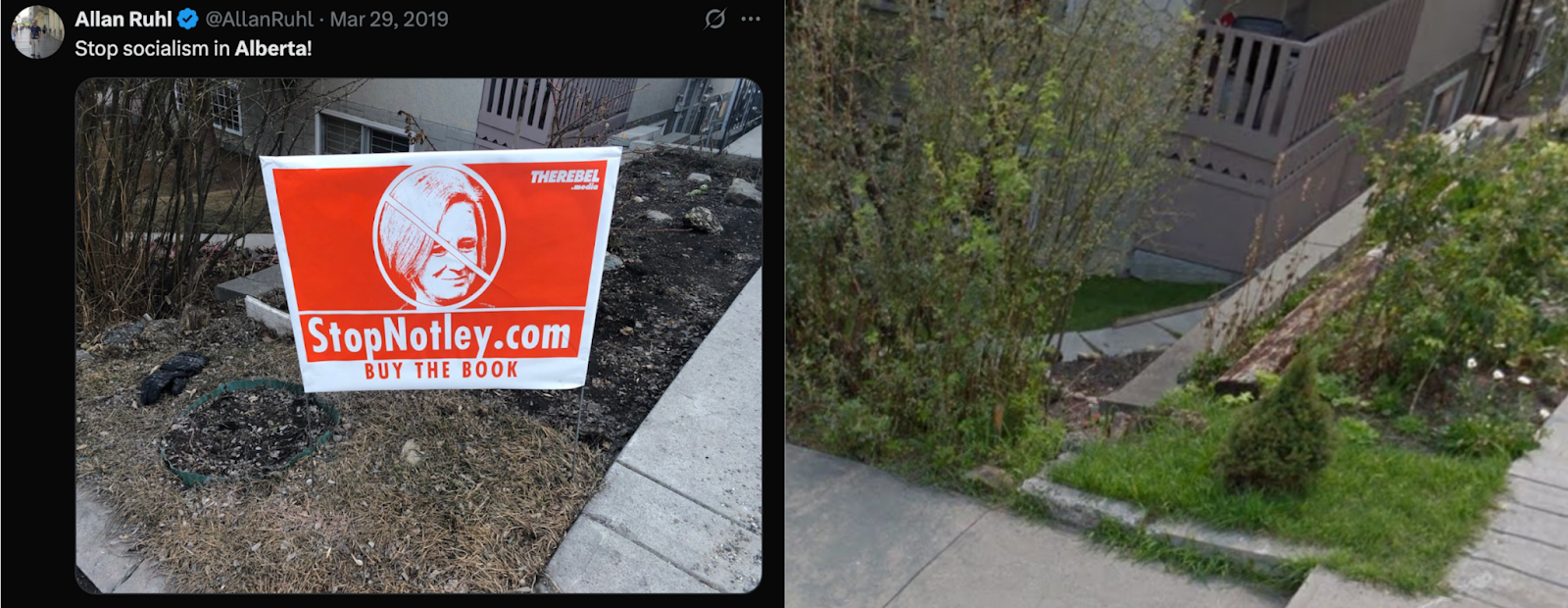
Left: a picture posted to Allan Ruhl’s X account. Right: a screenshot from Google Street View of the address used by Murray Ruhl to register with Elections Alberta as the official agent of a nominated candidate during a general election. Credit: X/Google
A review of hundreds of articles authored by Ruhl and hours of interview footage from his podcast provides a window into the authoritarian thought within Alberta’s anti-abortion movement, and gives insight into its strategy to shape United Conservative Party government policy and roll back rights for women and LGBTQ2S+ people.
Citizenship in the Republic of Sodom: A political biography
On his podcast, Ruhl shared that he grew up in a very politically active family, and it wasn’t unusual to have members of Parliament visit their home. By the time Ruhl was a student at the University of Alberta, what he wanted more than anything was to start a political career, he wrote in a 2017 blog post.
Ruhl volunteered for election campaigns, attended political events and introduced himself to any politician he could, “hoping that these men would remember [his] name for some time in the future when [he] wanted to run for office.”
But as the rights of LGBTQ2S+ Canadians gained social recognition and legal protection, Ruhl wrote that he lost faith first in the offices he’d aspired to, and eventually in the democratic system that guarantees those rights.
Seeing the majority of elected officials voting in favour of same-sex marriage, the increased attention given to trans rights, and the Trudeau government’s apology for the LGBT Purge of thousands of government employees between the 1950s and 1990s, Ruhl wrote he “realized how fake politicians are” and that he was horrified by the prospect of having to support similar policies himself if elected.
The final straw that marked the end of Ruhl’s involvement with mainstream conservatism came in 2018, when after being denied permission to march in the Edmonton Pride parade, the United Conservative Party organized its own Pride breakfast.
“I will no longer campaign for the UCP or the CPC (Conservative Party of Canada). The most I will do is vote for them and I may not even do that. Democracy is an extremely flawed anti-Christian system anyway,” he wrote on his blog in response to a social media post by then party leader Jason Kenney, whose own political career began as an anti-abortion activist who campaigned against LGBTQ2S+ rights while he was a student at the University of San Francisco.
“I also won’t be applying for citizenship in the Republic of Sodom like the traitor Jason Kenney,” Ruhl wrote.
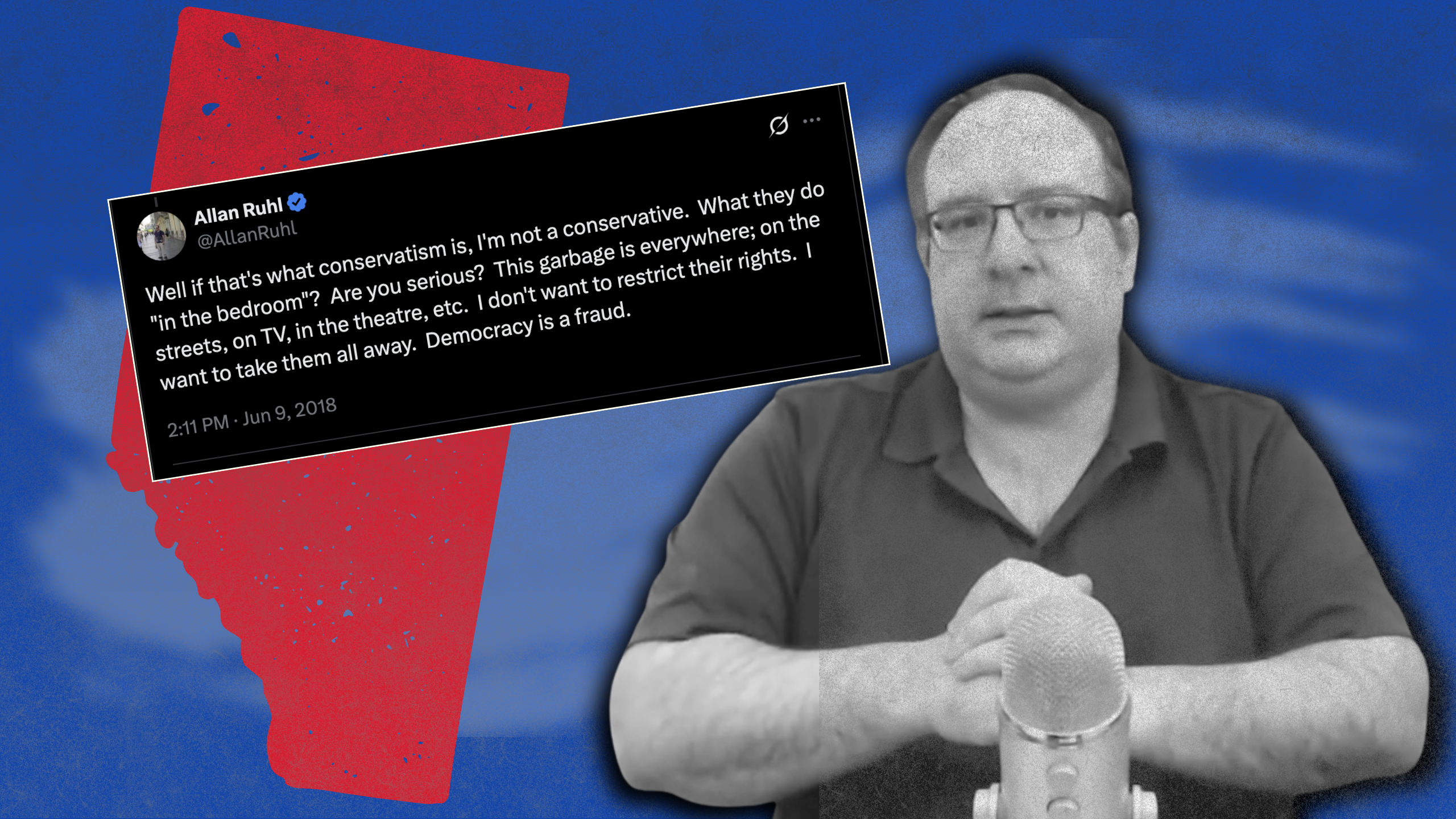
Writing on X at that time, Ruhl argued there should be no compromise when it comes to LGBTQ2S+ rights: “I don’t want to restrict their rights. I want to take them all away. Democracy is a fraud.”
A biblically accurate autocracy
On his blog and throughout hours of recorded podcasts, Ruhl describes values like democratic pluralism not only as ideas contrary to traditional Catholic teachings but as part of the liberal agenda of the “anti-Christian West.”
The rise of feminism, abortion, gay marriage and other “demons in the West,” he told readers, has been enabled by freedom of speech and freedom of religion, the “two biggest errors of democracy that have ruined our civilization.”
“Christianity isn’t democracy,” Ruhl wrote. “Democracy was invented by Greek polytheists who practiced pederasty and in recent history it has been used as a tool of Freemasonry to undermine Christ’s Church.”
Ruhl wrote that there is no verse supporting freedom of speech in the Bible and made the case that a biblically accurate, and autocratic, system of government has a duty to suppress non-Christians and non-Christian ideas.
“A righteous Christian government has the obligation to protect its citizens from people promoting evil in the public square. The Church and the state need to work together for the suppression of speech promoting evil,” he wrote in a blog post titled “Freedom of Speech is Demonic.”
Vladimir Putin’s use of increasingly repressive legislation targeting the LGBTQ2S+ community in Russia is one example Ruhl gave of how the denial of free expression permits governments to enforce religious values:
“Putin is suppressing homosexual propaganda and restricting freedom of speech not to punish his people but to protect them.”
In 2013, Russia passed a law banning what officials called “propaganda of nontraditional sexual relations,” which allows authorities to issue steep fines to people for providing information about the LGBTQ2S+ community to minors or organizing a Pride parade.
In the same entry, Ruhl said that in conversations with people in the pro-life movement, he had found these views are increasingly common: “Both Catholics and Protestants who take their faith seriously are starting to realize that Democracy is dead. In fact, it was dead on arrival and one of the reasons why was the idea of religious freedom.”
Prolife Alberta positions itself as a defender of free speech in the province, particularly in its opposition to “bubble zones” that restrict protesting near abortion clinics. “Free speech cannot be a privilege reserved for the powerful; it must be a right protected for every Albertan,” reads a page on the party’s website about bubble zones.
Ruhl and Prolife Alberta did not respond to repeated attempts to contact them by email. The IJF also sent questions related to the contents of this story via registered mail, which was delivered on Dec. 18, 2025, and signed for by Prolife Alberta executive director Richard Dur.
How to take over a party
Taking a leading role in a political party may seem to be at odds with Ruhl’s opposition to democracy, but Prolife Alberta isn’t a conventional party. Rather than focusing resources on electing candidates, Prolife Alberta organizers have adopted a strategy from the prolife movement of backing sympathetic candidates in a bid to influence the makeup of major political parties and the policies they support.
The party’s own origin story exemplifies its strategy.
From 1935 to 1971, the Social Credit party governed Alberta. Its membership declined with the rise of the Progressive Conservatives to a state of inactivity and irrelevance, enabling a group of young, prolife activists to purchase memberships and vote to replace Social Credit leadership at the party’s 2016 annual meeting.
After that meeting, Murray Ruhl became the final Social Credit party president. The next year, the party changed its name to the Prolife Alberta Political Association (Prolife Alberta).
Ruhl was elected party leader in 2018 and has held both positions since.
In the two provincial elections since rebranding, Prolife Alberta has run only one candidate, the minimum required to maintain official party status.
“We will change how politicians view pro-lifers by forcing the debate on abortion in the political arena,” reads a section of Prolife Alberta’s website. For the party, this means rallying voters to elect MLAs who will take prolife positions.
On a podcast episode with guest Cameron Wilson, director of the anti-abortion group the Wilberforce Project, Ruhl explained why buying memberships gives activists greater influence over the direction of the party.
“This is how we can get a vote. And really, it’s not that hard work,” Ruhl said. “You just have to purchase a membership—that’s 10 bucks—and you have to take probably 30 minutes, an hour of your time one day every few years to go out and cast a vote for the prolife candidate. Like we did that in my riding,” with Jeremy Wong, the UCP’s Calgary-Mountain View candidate in 2019.
“Pro-lifers actually get the biggest bang for their buck” by voting in party nomination contests, Wilson said. “It’s about 100 times more powerful than it is in the general election.”
Anti-abortion organizations took credit for the makeup of the UCP’s first caucus, with one group saying it helped candidates win 42 percent of riding contests in 2019, ushering in what Wilson called “the most pro-life legislature in decades, and maybe ever.”
Friends in the legislature
Exactly how many UCP MLAs and constituency association board members have received a boost from Prolife Alberta or Wilberforce is unknown. But their members, and platforms, appear to have a strong support within the province’s governing party.
When the Fall 2025 session of the Alberta legislature opened, Red Deer MLA Jason Stephan welcomed two friends as invited guests to watch the throne speech: Wilson and Prolife Alberta executive director Richard Dur.

Left: UCP MLA Jason Stephan in the Alberta legislature with Cam Wilson and Richard Dur. Right: UCP MLAs at a 2025 Wilberforce Project fundraiser banquet in Edmonton. (X/Facebook) Credit: X/Google
Two weeks later, Stephan attended the Wilberforce Project’s fundraiser banquet in Edmonton alongside fellow UCP MLAs Glenn van Dijken, Chantelle de Jonge, Jennifer Johnson, Grant Hunter and Dan Williams.
Prolife Alberta’s messaging has emphasized areas where the province has power to limit access to reproductive healthcare without provoking federal court challenges. “Whether abortion is legal or not is a national issue but the province can choose to cut funding,” Ruhl explained in a post from 2019.
A 2024 campaign encouraged Albertans to write to the premier and demand an end to public funding for “elective, medically unnecessary abortions,” among other action items. Later that summer, Prolife Alberta received media attention for circulating misleading claims about late-term abortions. The term is commonly used by anti-choice activists and recently got a boost in circulation after the U.S. Republican Party included opposing “late term abortion” in its 2024 policy platform.
At the UCP AGM on Nov. 29, party members passed a resolution calling for the end to “public funding for third-trimester abortions” except for “medically necessary cases.” The resolution also says the province should adopt a “values-based funding policy” for abortion.
The week of the AGM, Stephan read a member statement in the legislature, saying it would be good for the citizen initiative process to be used to hold a referendum on “late-term abortion.”
Stephan did not respond to questions about his relationship with Ruhl, Dur and Prolife Alberta, or whether he received support from members of Prolife Alberta in his election campaigns.

 Why you can trust Xtra