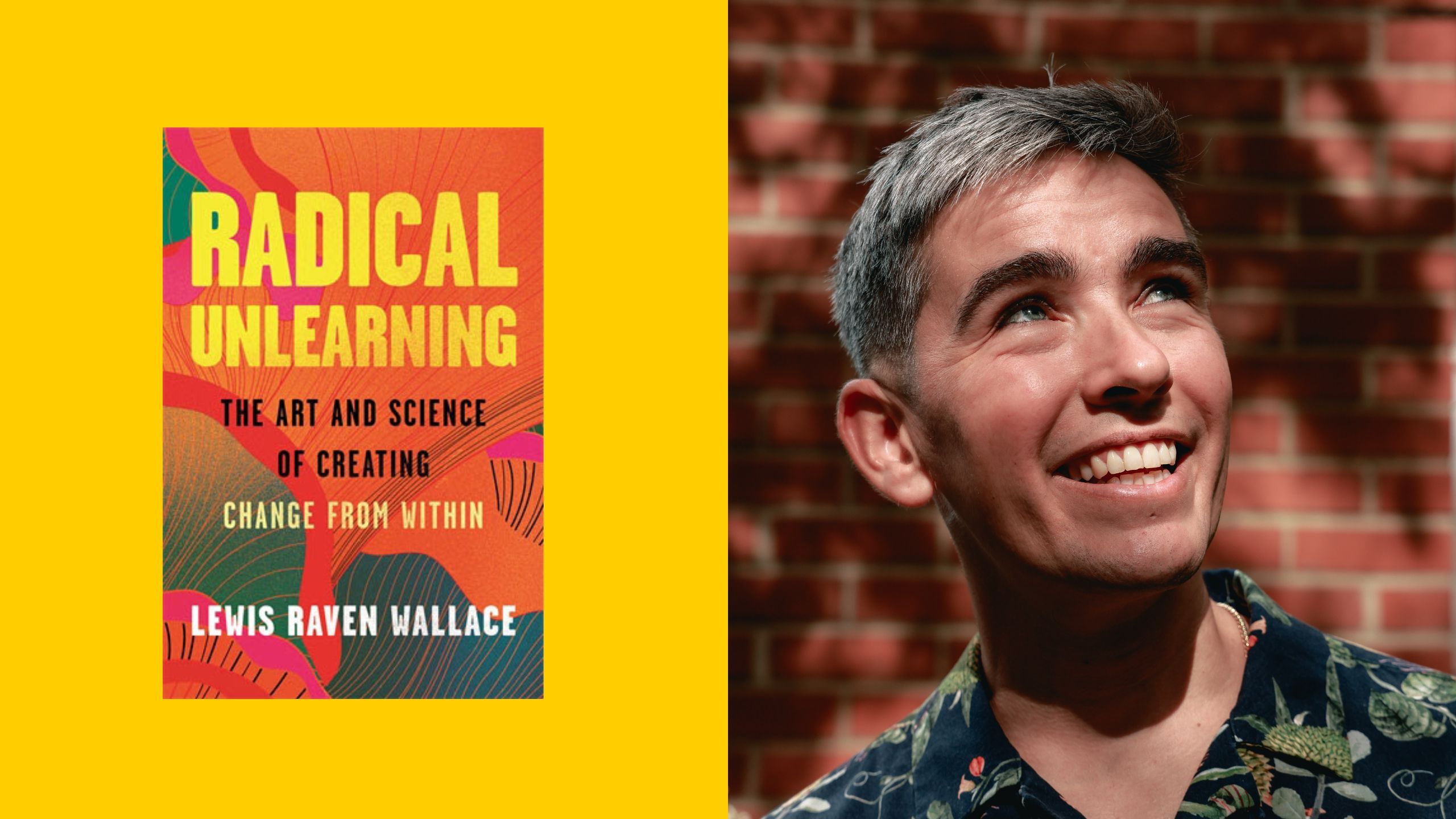
After years of working as an abolitionist toward a freer future, one thing has come into sharp relief for me: that with the right conditions, people can change. In order to build different futures wherein we respond in new ways to conflict, crisis and harm, we need to learn how to trust each other and how to practise repair when problems arise. Repair seems impossible if we can’t believe that people have the capacity to change. Change may seem elusive in families where white supremacy leads the way, or in a group whose beliefs are rooted in transphobia or colonial practices, but it’s exactly this kind of complex context that proves the ideal and fruitful grounds for personal transformation in Lewis Raven Wallace’s new book, Radical Unlearning: The Art and Science of Creating Change from Within.
Rooted in the science of neuroplasticity, decades of community-organizing experience and community stories from the front lines of movements for trans and racial justice, Radical Unlearning helps us understand the motivating factors for personal transformation. Wallace chronicles stories ranging from a trans anti-racist activist who was once a white nationalist, a former IDF soldier who is committed to anti-Zionist organizing and from Wallace’s own grandmother, who embraced trans and racial justice later in life. “I interview[ed people] who not only had undergone the kind of deep personal change in unlearning but who had done some reflection on it so that they could share the how … I would ask everybody, ‘What do you think created the condition for you to unlearn? What made it possible?’” Wallace tells Xtra. Personal unlearning is core to radical change. “I think in an interdependent sense, we are all responsible for one another, but in an individual sense, I can’t make you change. That’s not how it works. And it doesn’t matter how generous I am, or open I am. There’s not a simple cause and effect there.”
Wallace helps us better understand our own relationships to change. “I really dislike the mindset that I encounter a lot: ‘Well, how do we convince people? How do we win people over? How do we change people’s minds?’ The question is being framed [as if] there’s a stable us who have things right and understand things, and then a faulty them, who don’t have things right and don’t understand things. I wanted to reframe that question, and instead of asking, ‘How do I bring someone else over to my world view,’ find people who could self-reflectively talk about their own process of change.”
So what does it take to change people? Being personally impacted by systems of oppression was a key factor to radical unlearning for the book’s subjects. “What can we all learn from people who are most directly impacted by systems?” Wallace asks. “When I interviewed my friend, Tashiena Combs-Holbrook, who’s incarcerated, she was the most excited about and willing to do unlearning of anybody that I talked to. Being personally impacted by systems, harmed by them, and then having a desire to think outside of the things that have harmed you, I think that is kind of a golden ticket to unlearning.”
@xtramagazine Stonewall veteran Miss Major Griffin-Gracy passed away this week at the age of 78. Miss Major was a pivotal activist and organizer for LGBTQ2S+ liberation for decades—from the Stonewall riots, to AIDS activism and abolition work. She founded the House of GG, served as the director of the Transgender Gender-Variant & Intersex Justice Project and fiercely advocated for trans rights throughout her life. In 2023, Miss Major told her story in Miss Major Speaks. We honour her legacy, and lessons, in her own words. 🏳️⚧️✊ #lgbtqnews #missmajor #stonewall #transhistory #lgbtqhistory ♬ original sound – Xtra Magazine
As we move into an era that is increasingly overt with its injustice and fascism, we need to have conversations about radical unlearning in our everyday lives even more urgently. Many have plans for conversations that matter with our loved ones over the holiday dinner table by starting discussions about challenging transphobia and white supremacy, and supporting migrant justice and disability justice. Wallace’s book offers hope and strategies for anyone preparing to engage with their conservative uncle about Black Lives Matter with insights backed by science.
Radical Unlearning reminds us that boundary-setting is an important part of the process. “It wasn’t always the constructive conversations that I had with people that might’ve spurred them to unlearn around transphobia or around gender identity. Sometimes it has been the setting of boundaries: “‘I’m not going to talk with you about this anymore,’ or ‘I’m not going to participate in certain spaces.’ And feeling those consequences, feeling the stakes is another thing that can open those kinds of doors,” they say. “In some ways, I think the boundaries can be the teacher.”
Radical Unlearning read like a how-to for me to better understand what makes people do what they do, and gave me hope through a tool kit of stories and reflections about the possibilities for growth and change. Wallace is excited about the ways that love motivates change through biochemical changes, explaining that radical unlearning] “emerges in relationships, emerges in feelings and connections of love, not just romantic love, but community love, familial love, parent-child love or caregiver love, but love as a neurological and embodied experience really does loosen the synapses and helps us unlearn.
“That was the coolest thing in the science side of it,” they say. “To me, the coolest thing was learning about how love works in the mind and body, to actually make us more open-minded.”
I was curious about Wallace’s learnings about accountability and the ways that we can show up for each other to address past harms. “We’ve had a lot of conversation in transformative justice and abolition circles about this idea of accountability. Can you ever hold someone else accountable, or does accountability have to come from within? I am from the school of thought that you can’t really hold someone else accountable. You can create consequences for them, but true accountability, I think, has to come from within.”
Radical Unlearning teaches readers that accountability, change and personal transformation are processes that are deeply individual, yet also interdependent. We are all connected and together we are co-creating the future worlds we will live in. Radical unlearning is part of how we will get freer, together. We can do our own unlearning in radical ways, and meet people in a space of growth and transformation. Wallace reminds us that no matter our path or life’s history, people can change. “A lot of my work is helping people to see that there is a possibility that change is even on the table.”

 Why you can trust Xtra