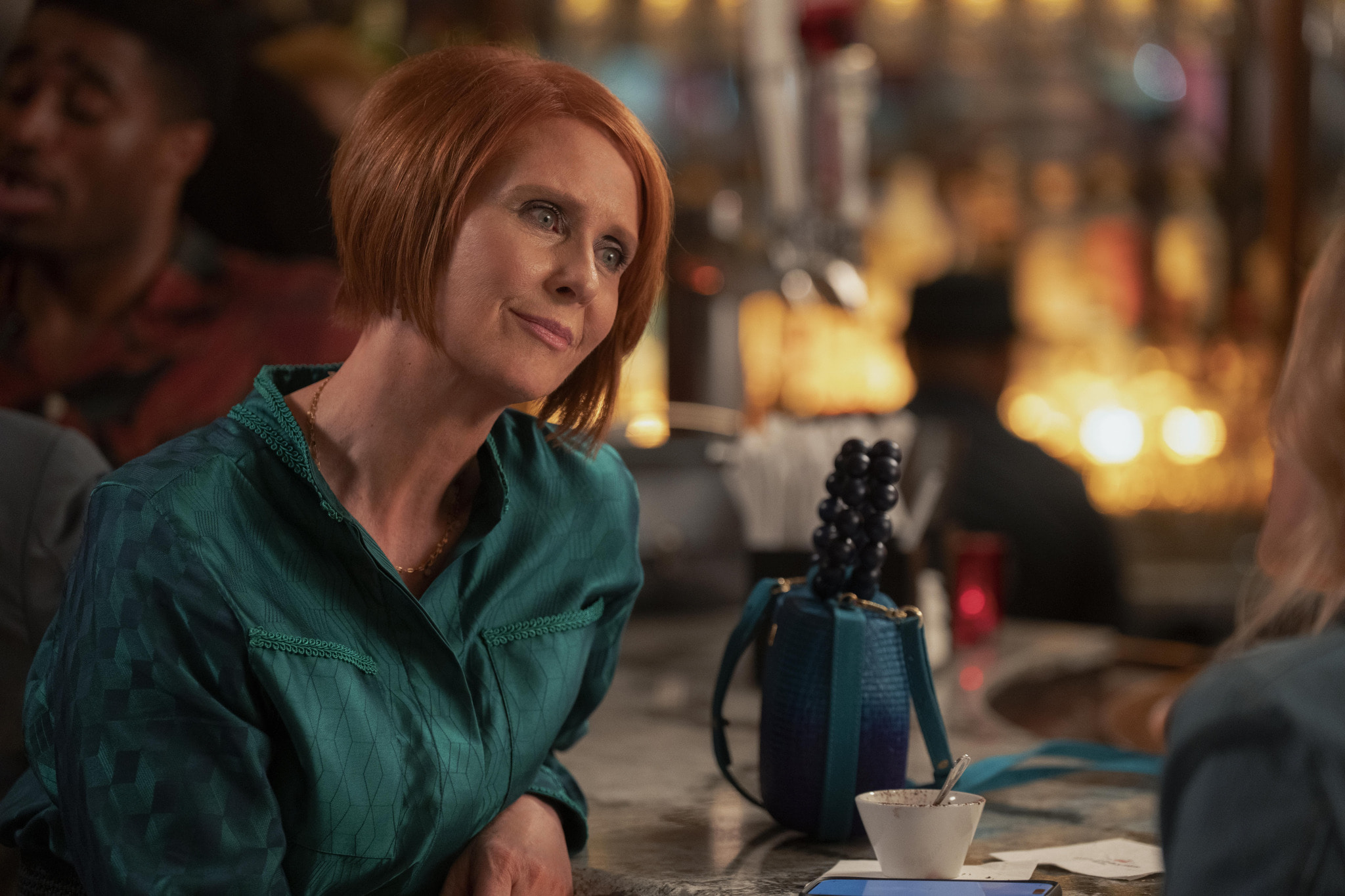
My fixation on queerness in the Sex and the City universe is not a new thing. A couple of years ago, in advance of the Season 2 premiere of And Just Like That …, I wrote an opus on the surprising queer timeline of the original SATC series. I was remiss in not writing my “We have all dated Che Diaz” hot take (we have, I have). And now, in Season 3 of AJLT…, a favourite hate-watch for women of a certain age, I would like the PR gods to bring me Cynthia Nixon, because I have some questions.
Namely: How did Nixon let the writers represent Miranda’s sexuality the way they have? Nixon is a queer woman herself. Not only a queer woman, but a queer woman living in New York City. And a queer woman living in New York City with a butch partner. According to DIVA Magazine, Nixon started dating her partner Christine Marinoni in 2004; the pair got married in 2012 and have a child together. Nixon is a known activist for many causes (and even ran for New York governor in 2018), and she and Marinoni have together advocated around LGBTQ2S+ rights and around education issues.
Now, let’s return to Miranda, Nixon’s member of the “core four” of the original SATC series. Early on, Miranda, a successful lawyer with strong convictions, is presumed to be gay in her workplace. She is set up on a date, flabbergasted that said date is a lesbian, tries kissing said lesbian regardless of her own heterosexual designation, and decides that she is definitely not into women. Sure! And then she continues to be an outspoken woman who sports a short hairstyle and suits and ties around town, at one point saying, “I’m never going to be a girly girl” (though I should not have to point out that “girly girls” can be queer). This is not to mention her iconic overalls + puffer ensemble—and, yet, she is never presumed to be gay again. All right!
Fast forward to And Just Like That…: Miranda is married to her long-time on-again, off-again beau, Steve (David Eigenberg); we learn the pair is not having sex. Their son is grown (and sex-crazed—awkward, we knew him as a tiny child) and they’re living in Brooklyn. Carrie (Sarah Jessica Parker) is working on a podcast with non-binary bisexual comedian Che Diaz (Sara Ramirez), whom Miranda meets at one of their (awful) stand-up gigs. Che has been written about excessively. But let’s pause here: Che is not a woman; Che is (in my gender-policing opinion) somewhere on the androgynous- to masculine-presenting spectrum. Miranda is smitten, falls hard for Che, loses all self-respect, kind of becomes self-interested and screws over her friends. This is realistic! Based on what we’ve seen on both SATC and AJLT, Che has a gender presentation that Miranda has never considered, never mind dated, before and they ignite something in her that is unexpected. Pearl-clutching Charlotte (Kristin Davis) exclaims, “You’re suddenly having non-binary sex!” It’s super cringey but actually pretty realistic too.
Eventually (Season 2) Miranda and Che break up, and now (Season 3), Miranda is boasting that she is … a lesbian. Now, I am not here to open the can of worms that is “Can you be a lesbian if you’re attracted to someone who is not a woman?” I am here to ask how the writers of this show decided that having one messy non-binary partner is the pipeline from aggressively heterosexual to lesbian. And how having one relatively masc-presenting queer lover creates a situation where Miranda is now attracted exclusively to straight-passing women—a designation I use intentionally—which is what seems to be the case. There’s Miriam Shor’s Amelia in Season 2, Dolly Wells’s Joy in Season 3 and a server at a Mexican restaurant whom we’ll come back to later. She also has a one-night stand with a virgin nun tourist (you read that right) played by Rosie O’Donnell—who is, as we know, queer, and often butch-presenting these days—who’s styled to be as mousey and unmemorable as one can make Rosie O’Donnell. (To date, I don’t think the word “femme” has been uttered on the show; I do not see anything inherently “femme, the gender,” as opposed to styled-femininely, about these characters. And a recent listen to a podcast I am too old for tells me that feminine lesbians are using “girly girl” language, and not “femme” specifically.) I’m not saying that attraction between feminine-presenting women doesn’t exist, or even doesn’t coexist with other attractions, but I can’t help but wonder why queer masculinity is erased from the show after Miranda’s first foray into queerness.
Bring me the butches! While I am not going to diagnose Nixon’s own queer journey adequately and I have no idea when her queer awakening happened (there are many takes written on calling her queer vs. bi vs. gay; assuming this info is not dated, Nixon prefers “queer” herself), I do know that the actor herself was in a long-term relationship with a man before beginning her current relationship.
TIME magazine suggests that after being diluted and off from her usual strong character, Miranda is back, particularly in the workplace—but, arguably, her sexual orientation journey has been her central plotline, and currently that plotline makes no sense! Was the idea with AJLT… to bring in a new audience (one would think so with their aggressive woke-ifying of the show), or to keep their legacy audience comfortable (which Miranda’s current love interests would do, by being what they would expect women to look like, if she has to be attracted to women). When Variety nudged Nixon about being an executive producer and the possibility that the writers pulled from her personal experience, Nixon was kind but vague, saying, “The writers may choose to add elements of all of our experiences.” I.e.,. not saying much at all!
In addition to “where are the butches?,” I am left wondering why Miranda couldn’t have been made to be bi or pan or a more expansive orientation. Why dismiss her decades-long relationship with Steve and all the men who came before him?
Where is the sexual fluidity in this show? Only Che Diaz themself seemed to embrace any! In Episode 2 of Season 3 of the show, Miranda is rejected by a “guacamole waitress” who lets her down by telling her that she’s straight and married with kids. And Miranda is like “Sheesh, well, this is so embarrassing, I thought we were flirting” (paraphrasing), making absolutely no connection to the fact that she, herself, Miranda Hobbes, was married to a man and is a mom and that she is still queer!
In a less than fine moment of the original SATC, Samantha (Kim Cattrall) dates a woman, much to the dismay of her friends. Carrie responds to this by asking, “How does that work? You go to bed one night, wake up the next morning and poof, you’re a lesbian?” to which Miranda (ugh) replies, “Oh, I forgot to tell you, I’m a fire hydrant!” (This just gets my back up because it is so “the kids are using litter boxes” ahead of its time.) Internalized homophobia is a thing, people are allowed to evolve, but I’m not buying this pantsuit-for-pencil-skirt-only lesbian as a natural evolution. As Ariana DiValentino wrote in a 2022 Cosmopolitan article, “ultimately, as Cynthia has tried to communicate to the press for years, pinning someone down to a single, inflexible term sort of misses the point.
“Being queer now doesn’t mean she was a lesbian all along, and it also doesn’t mean she magically transformed into one during menopause,” DiValentino writes, but in this new iteration, the writers are saying both of these things are true. It’s unknown to me if Cynthia Nixon herself considers herself to have been queer “all along” or a “late bloomer” of sorts, but I’m left wondering why Nixon did not use her position and lived experience to advocate for more nuance and scope into Miranda’s evolution.

 Why you can trust Xtra