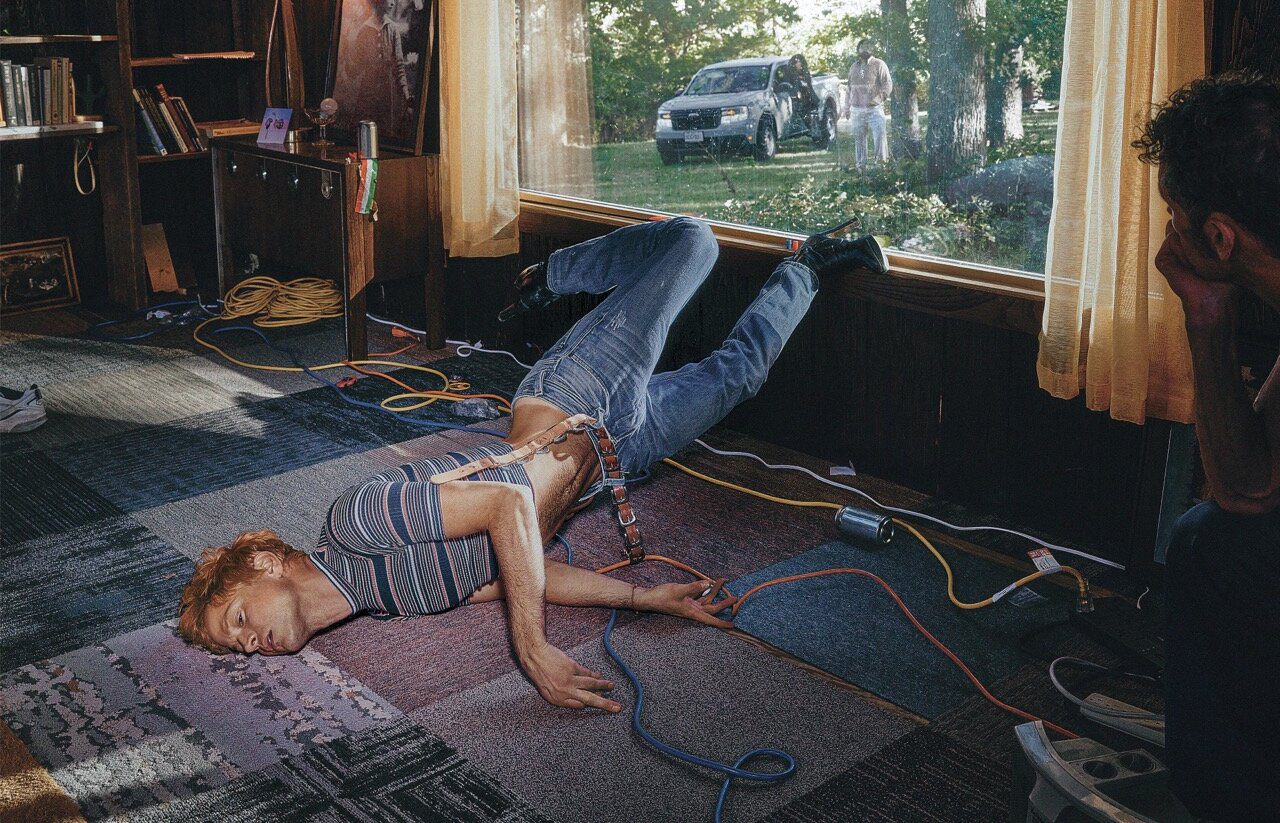
Perfume Genius has said he has an innate impulse toward isolation. But rather than shutting the listener out, his latest album, Glory—which he’s called his “most directly confessional” album yet in press materials—opens the door and invites us to peer into the darker parts of his imagination.
Over the 15 or so years since his first album, Learning, Perfume Genius—aka Mike Hadreas—has proven himself to be one of the most routinely good indie artists out there. A rare out gay guy in the indie rock world, his albums have received consistently high ratings and have ranked on a number of “best of the year” or “best of the decade” lists. It would be pretty easy for an artist of his calibre to coast on their laurels and release more of the same.
But Hadreas isn’t content to do more of the same, which accounts for much of his success. The album preceding Glory, 2022’s Ugly Season, saw him travelling in more experimental and instrumental territory—the music was written specifically for an immersive dance piece produced in collaboration with choreographer Kate Wallich and commissioned by the Seattle Theatre Group and the Massachusetts Museum of Contemporary Art. And while Glory returns to a more straightforward indie rock album format, Hadreas’s approach to writing music has continued to mutate. Though much of his previous work was written solo, he co-wrote many of the tracks on Glory with his partner, Alan Wyffels, and longtime producer Blake Mills.
What emerges is a new perspective—one that is as informed by collaboration as it is by Hadreas’s own shifting point of view. While recurring themes in his discography, like desire, the body and its failings and the pain of memory return, we see them with new eyes on Glory. As he strips down, Hadreas confronts emotions that have been building in him his whole life—but with the vantage point afforded by age and distance.
With this shift comes a reckoning. “What do I get out of being established? I still run and hide when a man’s at the door,” he sings over a country-adjacent twanging guitar on lead single “It’s a Mirror.” In the press materials accompanying “It’s a Mirror,” Hadreas explains that he wrote the songs while stuck in an exhausting cycle of depression and self-isolation. “I wrote ‘It’s a Mirror’ while stuck in one of these isolating loops, seeing that something different and maybe even beautiful is out there but not quite knowing how to venture out. I have a lot more practice keeping the door closed.”
With age comes the privilege of knowing yourself better—but that knowledge doesn’t mean you’ve escaped the problems themselves. Most of the time it just means that you’re better at reading yourself.
What’s always struck me about Perfume Genius is the intensity of his gaze, and on Glory it’s clear that intensity hasn’t dulled with time. The “ugly” versions of the emotions that recur throughout his work—of desire, of loneliness, of fear—crop up again and again throughout the album. On “Hanging Out,” he’s “four on the floor in the dirt,” “chewing his face like a hog.” On “Capezio,” the figure of Jason, who appears in both Ugly Season and 2020’s Set My Heart on Fire Immediately, returns, in yet another tense sexual situation, sitting next to an unnamed third (“She let me sit/ On the other side of Jason/ Pooling his spit in a jar”). But again, there’s a sense of distance, the kind of insight that comes with age: “How long until we come to understand/ What is happening here?” he sings. In other moments, Hadreas finds humour in the darkness—on “In a Row,” someone locked in the trunk of a moving car thinks of “all the poems I’ll get out” of the experience.
Our past lives and past traumas are bound to haunt us forever. But the idea of breaking free is always on the horizon, just out of reach enough to keep us going. In the chorus of “Valley,” a song on 2017’s No Shape, Hadreas asks: “How long must we live right/ Until we don’t even have to try?” On Glory, I see an answer: it takes forever—but we have no choice but to keep trying.

 Why you can trust Xtra