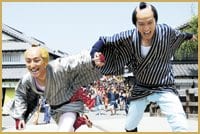
While the gay-samurai-road-movie-musical premise of Yaji & Kita: The Midnight Pilgrims seems to have been drawn from the same random post-modern genre hybrid machine that created the mafia-romance-suspense-gross-out-comedy disaster Gigli, the good news is that Yaji & Kita delivers a fun movie that’s worth a watch if for no other reason than to revel in its sheer lunacy.
The story follows gay samurai lovers Yaji and Kita, whose relationship has hit the rocks over Yaji’s demand that Kita give up his addiction to drugs. Yaji proposes that the pair make a pilgrimage from their home in medieval Edo to the holy city of Ise, where Kita may be able to find his “true reality” and finally become clean.
After a short musical number, the pair hop on their motorcycle and take off. Just before they arrive at Ise, a police officer stops them. He informs them that their motorcycle is anachronistic, so they have to return to Edo and start again on foot.
Don’t be misled by the tagline. This is a gay movie without any gay sex, a samurai movie with almost no sword fighting, a road movie on foot, and a musical with only a couple of songs. And it’s all the better for it.
The genre trappings in Yaji & Kita serve as more of a springboard for hundreds of crazy ideas that director Kankuro Kudo throws at the audience. Beginning with a nightmarish opening sequence that can best be described as a game of zombie Tetris, Kudo exhibits a visual imagination matched only by the zaniness of the plot.
Admittedly, this is not a perfect film. While the sheer oddity of the plot and the storytelling maintain the film’s momentum through its first hour, the pace feels much slacker in its second half, when a subplot involving the murder of Yaji’s wife comes to prominence. Clocking in at just over two hours, it does try the audience’s patience toward the end.
Also, an over-reliance on metafilmic devices distracts somewhat from the character arcs. While the frequent use of anachronism effectively conveys the gay lovers’ sense of dislocation from their greater society, scenes where Yaji and Kita tear open and repair a backdrop of Mount Fuji, and one of Kita in an empty theatre criticizing the very film we are watching, serve as little more than plot devices to cover up the traps into which Kudo’s story falls.
Still, the sheer audacity of a film where a bleached-blonde gay samurai is tempted from his quest by a flock of teenaged schoolgirls who proclaim themselves to be the “pleasure team” of a local mafia boss has to be rewarded. And that’s just one of a dozen great little bumps along these heroes’ journey.
But all the wacky ideas that Kudo throws at the audience would fall flat if it weren’t for characters as rounded and entertaining as Yaji and Kita. These gay samurai genuinely care for each other and exhibit a loving relationship that is comfortable and real, unlike the superficial pining and moaning seen in many other gay films. They aren’t your typical gay heroes, any more than they’re typical samurai heroes.

 Why you can trust Xtra