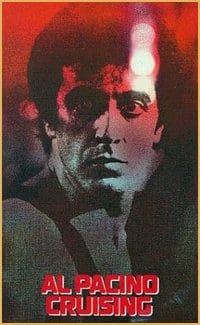
As one of the first mainstream Hollywood gay films to explicitly examine gay sex — albeit in a less than satisfactory way to many gay groups — the 1980 detective film Cruising holds an interesting place in queer cinema history.
Its recent re-release on DVD gives a new generation of queers an opportunity to catch this largely forgotten film.
To catch a serial killer who’s stalking New York’s underground gay leather scene, Det Steve Burns (Al Pacino) is sent deep undercover to find out what he can from the gay community and ferret out the killer. Over the course of the investigation, Pacino is shocked by the decadence of the leather crowd, and finds himself alienated from his wife, whom he only sees on rare nights off from assignment.
You can probably imagine that this is not a glowingly positive view of the gay community. It’s the story of a man being thrown into a strange, alien environment that just happens to be the gay world.
As an anthropological document of what the gay scene looked like to an outsider in the ’80s, it’s fascinating, even if it does sometimes feel like the gays are being treated like zoo animals.
But it’s hard to be too offended by a movie that’s as outrageously silly as this one is in parts.
In a testament to the dialogue that will follow, the film opens on a police officer demanding a tranny hooker come look at his “night stick.” The same hooker later boasts to police that one of her johns “gives the best beatings six ways to Sunday.” There’s not even a good reason for Pacino to be sent into “deep cover” — the leather community isn’t the mob; no one’s going to follow him home.
And in the finest bit of unintentional hilarity in the film, police turn out a muscular, black guy wearing only a jockstrap and cowboy hat to rough up an uncooperative suspect.
But the shocking insensitivity to the gay subject matter actually makes this film about grizzly violence in the gay community much less offensive than it would have been otherwise. Because it locates violence as much among straights as it does in the cruising grounds it’s much more complex than early gay critics gave it credit for.

 Why you can trust Xtra