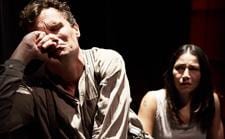
The stage version of Wild Dogs presents lovely, wild gestures infused with sharp poetic language that simultaneously engages and repels. Nightwood Theatre’s adaptation of lesbian writer Helen Humphrey’s novel of the same name is both captivating and frustrating. Marked by the reiteration of a lone central metaphor — the wild dog as the human heart — there are moments when the poetic language becomes so dense and repetitive that one wonders where this 100-minute elegy for lost love will ever end. Nevertheless, throughout this seven-member ensemble piece currently running at the Berkeley Street Theatre, there is enough power and sheer thespian bravado to make what should have been an hour — or two short acts pruned of needless repetition — a relatively satisfying theatrical venture.
Led by Tamara Podemski as Alice, the central narrative voice, the cast achieves a delicate balance between prolonged monologues that tell the audience what the action is rather than enacting it, interspersed with brief, at times chilling scenes of actual dialogue. There are too many moments where the tendency to transcribe large sections of the novel into the script becomes cumbersome and superfluous. A classic case of telling rather than showing burdens the stage with static, tiresome images made worse by set designer Teresa Przybylski’s beautiful but bulky stand of trees that get in the way of the (non-)action. Shadowy, three-dimensional lighting effects aided by projections of a forest might have liberated director Kelly Thornton’s cast from what tends to be declamatory, downstage activity that leaves the background silent and somewhat puzzling.
Podemski’s strong presence balances nicely with the self- conscious, emotional fragility of her character, Alice. A highlight occurs when she lists, straight from Humphreys’ 185-page novel, a list of jobs she has had and the frequently comical reasons she left them. Steve Cumyn’s Malcolm, as a poodle-owning, Psycho-inflected, Norman Bates character whose sexual identity seems as shrouded as his past, gives a fine, ghoulishly comic performance as the deranged painter. Les Carlson adds charming characterization to his elderly befuddled portrayal of Walter. Tony Nappo’s Spencer, although proficient and compelling in his final violent declaration, suffers at the hands of a script that allows him to wallow in shallow — albeit chilling — metaphoric declarations, giving him little to no opportunity to interact with the other performers.
Raven Dauda as Alice’s remote love interest provides an appropriately cool, lovelorn lesbian who seems to be more interested in wolves than women. Taylor Trowbridge as Lily and Stephen Joffe as Jamie are both brilliant as they consistently rise above the static nature of the script and enliven the stage with vibrant vocal and physical presence. Jennifer Gillmor’s music and sound design is beautifully wrought but there simply is not enough of it.
With some radical editing and the addition of a more consistent underlying score, this original piece, adapted by Anne Hardcastle for the stage, could become a powerful mixture of sound, movement and lighting, moving it further from the realm of playwriting and closer to a kind of poetic performance art. As it stands the repetition and fragmented nature of the script do not mark an easy or entirely effective transition from page to stage, rendering it too static to be wild.
 Why you can trust Xtra