What do Bette Davis, Helen Mirren, Cate Blanchett, Glenda Jackson, Judi Dench, Quentin Crisp, Flora Robson and Anne-Marie Duff have in common?
There are several answers to that question, but one is a real challenge. Correct, they’re all actors. And, yes, each actor played Elizabeth I in a film. The difficult answer is that opulent larger-than-life portraits of the actors dressed as that most iconic of English queens are currently hanging in the austere, white-walled space of the Grunt Gallery.
The next reasonable question might be, “Why?” After all, formal portraits of a notable historical figure —as painted by Montreal’s Claude Perreault —seem an unlikely choice for a forward-thinking gallery that showcases contemporary art.
The sceptical gallery visitor would be wise to suspect a trick.
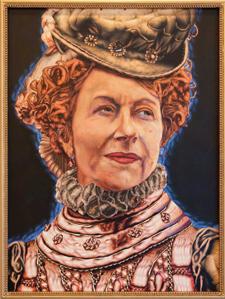
Stepping nearer to one of the gold-framed portraits, and then nearer still, the coherence of the depiction begins to dissolve. Bette-as-Elizabeth and Cate-as-Elizabeth are not simply canny masquerades. If old portraits ordinarily offer viewers a chance to examine the fashions, personalities and artistic traditions of bygone eras, then Perreault’s regal takes on Elizabeth give us that, but with a queer twist.
Upon close inspection, the iconic face reveals itself to be composed of thin layers of paper —not paint —and the opulent clothing and elaborate jewelry likewise show themselves to be manufactured from magazine paper. The source material is similarly unexpected: gay men’s porn magazines.
Elizabeth’s face is in fact a collage of porn actor skin, and her accessories are miniature vignettes of hardcore man-on-man sexual gymnastics.
“Why men’s hardcore?” is likely to be any viewer’s follow-up question, but eye-to-eye with Perreault’s Elizabeth series, it’s the intricate craft that’s immediately astonishing. Considering that their surface is nothing but an assemblage of clippings from porn magazines, their from-a-distance realism is amazing.
Perreault says his portraits are labour-intensive creations.
“My process is really complicated to explain, but basically it involves a lot of research in order to find, through porn cut-outs, the lights, the shadows and forms that will be as compatible as possible for the subject I have chosen.”
In addition to being complicated, Perreault says the process is time consuming. “When everything is set, the actual collage can begin and takes more or less four months to realize.”
If all that effort seems like hard work, for Perreault collage is nonetheless as comfortable as it is expressive. And from the start, he notes, it’s an ideal material for forging his vision.
“I started making collages by pure accident during the Christmas holidays when I was studying set design in Paris in 1989. I was doing a portrait of the Mona Lisa [and] realized I did not have enough paint to do the skin part,” he recalls. “Then I had the idea to use cut-outs from porno magazines which I had handy. I found the result very surprising and it gave me the interest to do more work in that direction.
“I used gay porn because it was something from around my apartment that could serve as skin tones in the portraits,” Perreault explains. “In all my earlier work there are other kinds of images I used for hair, clothing, etc. It became an artistic challenge for me to use only porn for almost the whole portrait.”
While the choice of porn was originally a happy accident, it’s also a provocative challenge because the layers of each portrait —a long dead but venerated monarch is interpreted by a film actor (whose image is actually comprised of other images: buff gay male porno performers) —undermine our certainty. Who is it that we can be sure we’re seeing?
Perreault concedes that this playing with perspective is integral to his work. “At first glance, the portraits seem to be paintings, but as the viewer approaches, the intricate collage work is revealed and the illusion fades,” he says. “The initial reading confused, a tension is created between superficial and profound readings of the portraits.
“But even this surface reading is troubled by the texture of her clothes,” Perreault adds. “For the first time in my work, almost the entire portrait is made of ‘skin.’ At once strength and vulnerability are suggested, though neither really hitting the mark.
“These elements are offered up to the viewer’s inquiring gaze but even after a rigorous reading of the surface, it remains hard to be certain what’s underneath,” he points out.
Needless to say, viewers can’t help but take note of the conflict between the intact flesh of the historical Virgin Queen and the unapologetic promiscuity of the sexual performers whose skins now depict her.
Perreault’s artistic pursuit remains a singular one. Asked if he sees his work as reflecting a gay aesthetic or being in conversation with other gay artists and their interests, he is matter-of-fact. “No, not really. Let’s say that collage is rather marginalized as a medium by the art world, gay or straight.
“I see my work as kind of a curiosity within contemporary art, as I am still as fascinated with the image as I am with the conceptual component,” he concludes.
CLAUDE PERREAULT’S ELIZABETH.
Runs until Feb 14.
grunt gallery, 116-350 E 2nd Ave.
604.875.9516.
 Why you can trust Xtra