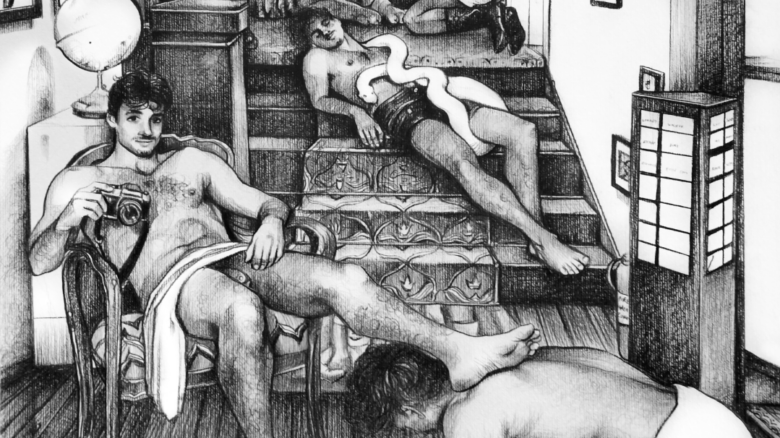
Canadian artist Steve Walker, who died at his home in Costa Rica on Jan 4 at age 50, was best known for his haunting and poignant acrylic portraits of beautiful young men (solo and in pairs), often done in muted shades.
“Some colours are very exciting to me,” he once told James Lyman, a Massachusetts gallery owner and Walker’s art executor and trustee. “While others are quite offensive. Painting flesh is very exciting to me because of the huge variations possible within a very small colour range.”
Longtime friend John Alan Lee says Walker was strongly influenced by Renaissance Italian artist Caravaggio – especially in his use of shadow to show the contours of the young male form.
For his subjects, he chose to paint gay men, depicting the struggles and joys the gay community lived through in his lifetime, from the ongoing fight for sexual liberation to the devastation wrought by HIV and AIDS. But he believed his subjects were universal, touching on themes of love, hate, pain, joy, beauty, loneliness, attraction, hope, despair, life and death.
“As a homosexual, I have been moved, educated and inspired by works that deal with a heterosexual context. Why would I assume that a heterosexual would be incapable of appreciating work that speaks to common themes in life, as seen through my eyes as a gay man? If the heterosexual population is unable to do this, then the loss is theirs, not mine,” Walker once said.
Before he found painting, Walker worked as an actor, often appearing at Buddies in Bad Times productions in Toronto in the early ‘90s.
He was entirely self-taught as an artist and sold his first painting, Blue Boy, to Lee in 1990. He painted a second for Lee in 1991, called Morning, of two young men in bed after sex.
Walker’s paintings were mostly large. “He painted large paintings,” says Lyman, because “he believed that a large image was more appealing and has more impact than a smaller one.”
Lee says Walker was “painting the sadness that was in his life.”
Two of Walker’s partners had died over the years, and his close friend Marlene Anderson says he was lonely.
Lyman says, “His paintings are about gay life, and the focus of them often depicted sadness and loneliness to reflect the reality that much of anyone’s life is sad and lonely.”
Lyman says Walker told him that it is rare to find success as an artist. He was happy his work would be his lasting legacy.
“I strive to make people stop, if only a moment, think and actually feel something,” Walker wrote in an autobiographical note. “My paintings contain as many questions as answers. I hope that in its silence, the body of my work has given a voice to my life, the lives of others, and in doing so, the dignity of all people.”
In recent years, his work has been exhibited In Toronto, Montreal, Los Angeles, Fort Lauderdale, Provincetown and Pasadena.
Lyman says the North American gay community always loved Walker’s work and many pieces were sold for several thousand dollars.
Walker’s art also graced the covers of gay novels, such as American writer Felice Picano’s 1995 epic Like People in History, and the late Gordon Anderson’s novel of 1970s Toronto, The Toronto You Are Leaving.
A funeral will be held at Our Lady of the Visitation Parish (5338 Bank St) in Ottawa on Feb 25 at 11am. It is anticipated that a memorial celebrating Walker’s life will be held in Toronto at a date still to be determined.
 Why you can trust Xtra