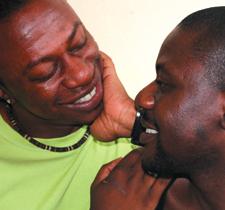
In playwright Kwame Stephens’ bold new play, Man 2 Man, two black men meet and fall in love in an unlikely place: church. Brash, sexually confident 20-year-old Damien is initially a handful for older, recently divorced Emmanuel, who is still figuring out his sexuality. As their relationship emerges, they navigate through obstacles of family, identity and their church’s repressed gay pastor.
“There’s more church than you’ll see in most gay plays,” Stephens says. “The show is a blend of sexuality, race and religion in a strong way. It’s honest; it has adult language and scenarios.”
Harbourfront’s annual Kuumba festival celebrates black performing arts as part of Black History Month. And while Stephens is happy that Man 2 Man is being showcased for a wider black audience after being presented for one night last year at Buddies, he’s quick to insist that the show in no way is meant to represent the entirety of the black experience.
“I can’t speak in broad strokes,” Stephens says. “When I stand up as an African poet, people ask me about Africa; I say there are 900 million people in 54 countries speaking 1,000 languages. North Americans love little boxes and cookie cutters. I’m strongly careful about that. The play is Damien and Emmanuel’s love story.”
Still, Stephens is proud that the show incorporates his African roots into its design.
“My African-Ghanaian origins are woven into the play. One of the costumes worn is a traditional Ghanaian outfit. Pastor Everton wears African outfits,” he says.
“My primary audience is the black gay man, bisexual or questioning man. We accomplished that at Buddies. Moving the play to Harbourfront, we are grateful and thankful to move it to a larger audience, the black community at large,” he says.
For Stephens, an openly gay man who grew up Catholic in Ghana and has lived in Canada for 22 years, religion is a basic part of life.
“I read my Bible every morning,” he says. “I was raised in a culture where God was just part of who we are. When I came to terms with my sexuality, I struggled with masturbation and sex and sin.
“I credit the Metropolitan Community Church of Toronto that I learned it’s okay. God loves us all, even if we’re gay. A deacon there mentioned John 3:16 — most Christians know it. ‘For God so loved the world that he gave his one and only Son, that whosoever believes in him shall not perish but have eternal life.’ “‘Whosoever’ includes me and every gay man. That was my personal revelation. God loves me, too. That was my own personal journey, where I came to terms with it. I’m of the view that walking with God is a very personal thing.”
Stephens first performed at Kuumba as a poet in 1999. He’s actually much better known for his published poetry and only recently made the transition into theatre, after being invited to join Canadian Stage’s BASH program for emerging artists. He went on to write and produce short sketches for youth groups and African theatre ensembles. Man 2 Man is his first feature-length play. But Stephens says the new medium plays to his personal strengths.
“The beauty of theatre is that it’s a continuous process. It’s such a collaboration,” he says.
The deep networks he’s built in the gay, black and arts communities — he’s a long-serving volunteer with Black CAP and ACT — have also come in handy, Stephens says.
“That’s really helped me putting on the play,” he says. “I’ve had lots of help from people I’ve met over the years.”

 Why you can trust Xtra