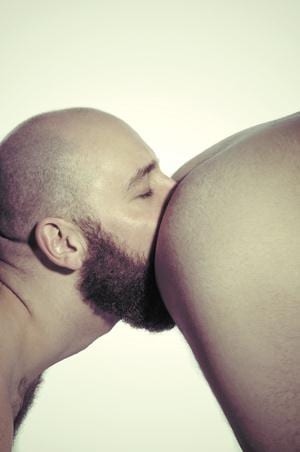
Photographer Drasko Bogdanovic’s Submission (part of the Contact Festival) is going to be unlike any art show you’ve ever attended.
“We’re turning the gallery opening upside down,” Bogdanovic says. “When you walk in a gallery space, it’s always white walls, it’s always brightly lit, there’s always that kind of chichi cocktail music going on. We’re turning that upside down. We’re having a dark room. The walls are going to be painted black, and people are going to walk in with flashlights.”
And what will visitors discover under their flashlights’ beams? Given Bogdanovic’s previous work, it seems safe to assume it will have something to do with naked men. “It’s going to be a whole range of nudity, full-frontal, sexual acts,” he laughs. “The good stuff!”
What gallery would agree to such an unconventional exhibit? Actually, no gallery did. Instead, Submission is going to be presented at Buddies in Bad Times Theatre, a rather untraditional space for an art show. “Buddies in Bad Times is not a gallery space, so it was a challenge,” Bogdanovic says. “They are not designed to exhibit art . . . But on the other hand, it’s a theatre, and we can create whatever we want in there.”
It wasn’t just a willingness to turn out the lights and paint the walls black that Buddies brought to the table — it was also a willingness to “submit” to whatever Bogdanovic wanted to show. “It’s going to be very explicit,” he promises. “Lots of the stuff that I do is very raunchy. But Buddies has said that they won’t censor anything. Whatever I decide to exhibit, they’re gonna show it. So for me, it was very liberating. Because I don’t know when I’m going to get a chance like that again.”
Over the past several years, Bogdanovic’s photography has become ubiquitous in gay Toronto. He’s a regular contributor to fab, and his homoerotic photos are frequently used in event promotion and advertising.
Bogdanovic insists that while it’s great getting attractive guys to drop trou in his studio, he also has something more political in mind. “We’re so used to seeing the female body naked,” he tells us. “But male nudity — there is still a fear of penis. People are just not ready to see it. They are literally afraid to look at it. Even in advertising, in fashion, in the media, we don’t get to see the same amount of male nudity that we do of female nudity.”
While Bogdanovic hasn’t absolutely determined all the photos he’s going to exhibit, it’s clear he won’t shy away from depicting, well, anything. “I think showing explicit work is very important in our queer history,” he says. “For a long time, the only images of ourselves we could see were in pornography. You couldn’t see a gay kiss on TV or a gay couple in a movie. The only thing you could see in the media were these very sexual images that you had to buy in the back of the bookstore or whatever.”
Just how scandalized should those of us with a prudish streak be prepared to be? “With gay people, I don’t think they will be that surprised with what’s in the photographs,” Bogdanovic says. “Because it is our lives. It’s what we do on the weekends — or what we wish we did on the weekends. But considering the exhibit is part of the Contact Festival, I’d like to see more straight people in there and their reaction to it. And then, maybe, their discomfort.”
 Why you can trust Xtra