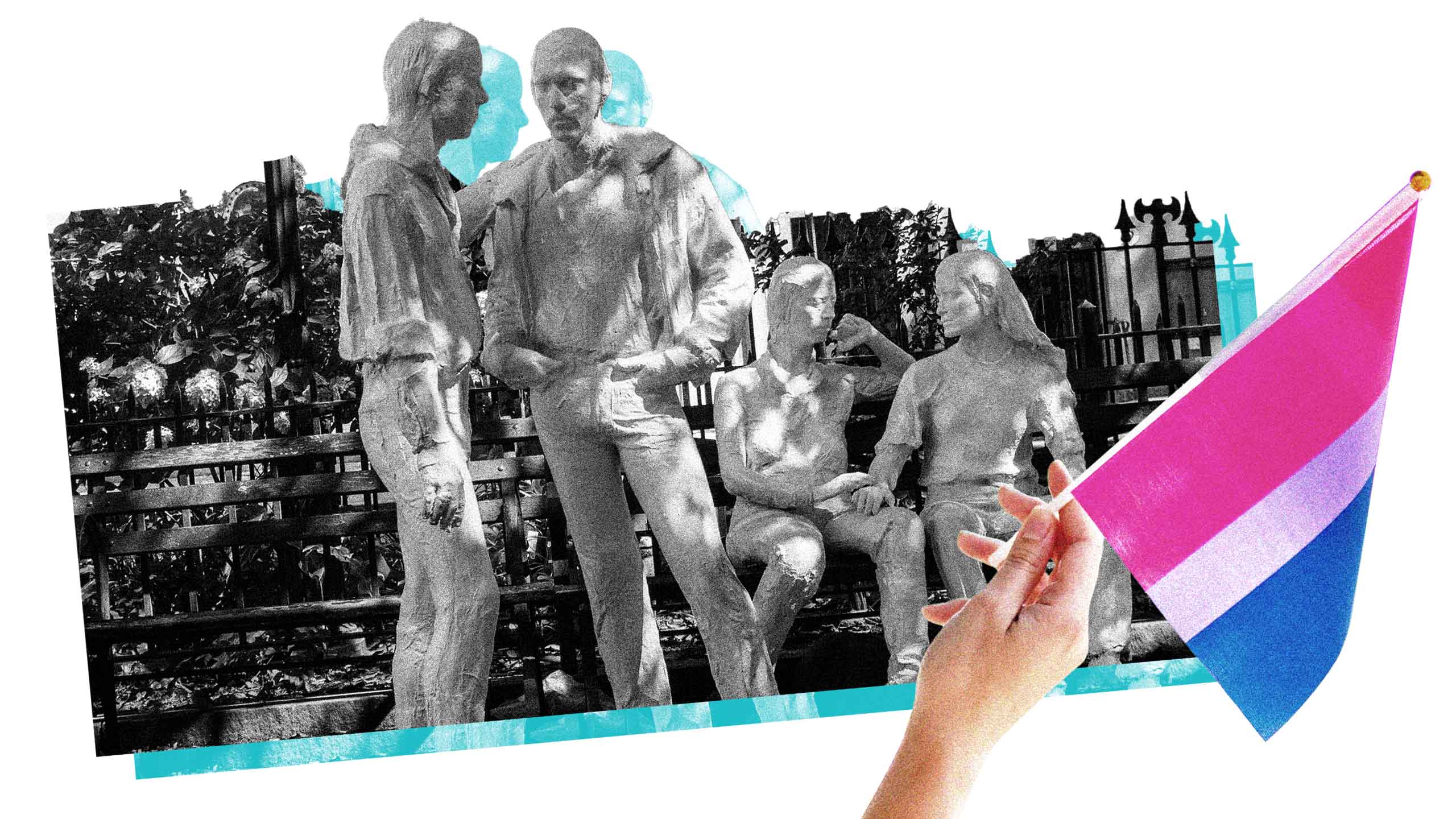
In June 2025, journalist Erin Reed noticed that the word “bisexual” had been removed from the Stonewall National Monument’s website. According to the .gov’s own website, the changes had been made on May 27, but had gone unnoticed for several days.
The updates came after the word “transgender” was removed from the site in February. After that, and until May 27, the home page of the site read: “Before the 1960s, almost everything about living authentically as a gay or lesbian person was illegal. The Stonewall Uprising on June 28, 1969, is a milestone in the quest for civil rights and provided momentum for a movement.” Archives from the Wayback Machine show that before May 27, the statement read: “Before the 1960s, almost everything about living openly as a lesbian, gay, bisexual (LGB) person was illegal. The Stonewall Uprising on June 28, 1969, is a milestone in the quest for LGB civil rights and provided momentum for a movement.”
“Bi+ people have been involved in LGBTQ2S+ activism throughout history, but our role is often underrepresented or erased,” says Mel Reeve, an archivist and founder of the Bi History Project. “Not only is removing the role of bi+ people in LGBTQ2S+ history and activism inaccurate, doing so also has a real impact on bi+ people today—who may experience marginalization both from within the LGBTQ2S+ community and the wider world.”
References to bisexuality were re-added to the home page after news of its removal broke, however mentions of bisexuality on the “history and culture” page remained absent for at least a month. However, the page now includes a reference to bisexuality once again. Currently, there is still no mention of trans people or identities on the Stonewall Monument website, and the acronym used on the site is “LGB.”
“Under a government controlled by the far-right, bi+ people can expect discrimination in marriage, housing, employment, medical services and even the tacit approval of violence against us,” says Eric Von Beck, secretary and former president of Los Angeles Bi+ Task Force, a grassroots 501(c)3 that promotes education, advocacy and cultural enrichment for non-monosexual people.
While there is a common misconception that the far-right don’t believe bisexuality is real—and therefore wouldn’t trouble themselves with attacking or erasing it—as an author whose work focuses on both bisexuality and the far-right, I knew this wasn’t the case, and wasn’t surprised to learn that “bisexual” had been erased from the Stonewall Monument website. When I spent 18 months infiltrating far-right digital communities for my book Pink-Pilled: Women and the Far Right, I noticed specific ways in which bisexuality was conceptualized and discussed.
In the imagination of the far-right, bisexuality is a symptom of the so-called sexual degeneracy of Western women, and functions as a gateway into other “progressive” or “anti-family” beliefs. On forums, in Telegram or Signal channels, private Facebook groups and on Instagram pages, bisexuality is discussed far less frequently than trans people (discussions about trans people are almost incessant in far-right spaces, given the current culture war around trans identity. These discussions feed both into and off of the Trump administration’s attacks on trans rights), but mentions were still present enough to surprise me during my research.
The most common way that bisexuality is mentioned or discussed is as a misogynistic shorthand to indicate that a woman is promiscuous, untrustworthy or degenerate. Bisexual men do not exist in the far-right imagination, and most mentions of bisexuality are bi-misogynistic.
To further this, bisexuality is associated with instability, impermanence and frivolity, which, to the far-right, are weak characteristics that are associated with women. In contrast, men and masculinity are characterized as being stable, strong and unchanging. Bisexuality simply does not fit into this.
A common meme format in online far-right spaces compares “modern/progressive” women to “traditional” women. The modern woman is often depicted as being in a bigger body, with tight-fitting and revealing clothes, brightly coloured dyed hair and body modifications. Around her, there are descriptions of who she is as a person, which usually include things like “owns multiple cats,” “on her fifth abortion,” “thinks casual sex is empowering” and, invariably, she is described as either bisexual or pansexual. Often, there is often mention of this archetype having sex with Black men or having biracial children. Sometimes her sexuality isn’t mentioned at all, but I never saw the progressive archetype being described as straight or a lesbian. She is only ever bi, pan or unlabelled. In contrast, the “traditional” woman is depicted as slender, with long, natural-coloured hair, wearing modest clothing. She is usually described as “loving God,” “being submissive,” “recognizing the sanctity of life” and having white babies. She’s also either described as straight (or sometimes “understanding God’s design for men and women”), or her sexuality is not mentioned, which is intended to suggest that she is “normal” (i.e., straight).
The “progressive” women’s bisexuality is also often coupled with mentions of her having had abortions. In this way, her sexual orientation is used to hammer home how dangerously promiscuous modern women have become. It is implied that without male oversight, women are inherently so sexual that they will not limit themselves to proper sexual propriety—like sleeping with one gender—and will engage in race-mixing and abortion. Her sexual fluidity is used to suggest that women’s sexuality and bodily autonomy need to be controlled by men. The “traditional” woman is not just straight, she is submissive to men— as conservatives think she should be.
In these meme formats, as well as several other types of memes shared in far-right Telegrams or forums, there are also references to women claiming to be bi, even though they only date or have sex with men. One example uses screenshots from the Barbie movie, Barbie tells Ken that she’s bi even though she only sleeps with men, to which he smugly replies, “So you’re straight but want attention.” In these memes, bisexuality is being used to suggest women are much more easily led by social trends or a desire to fit in than men. The underlying assumption in these circles is that queer people and other minorities actually have more liberties and social capital than straight men.
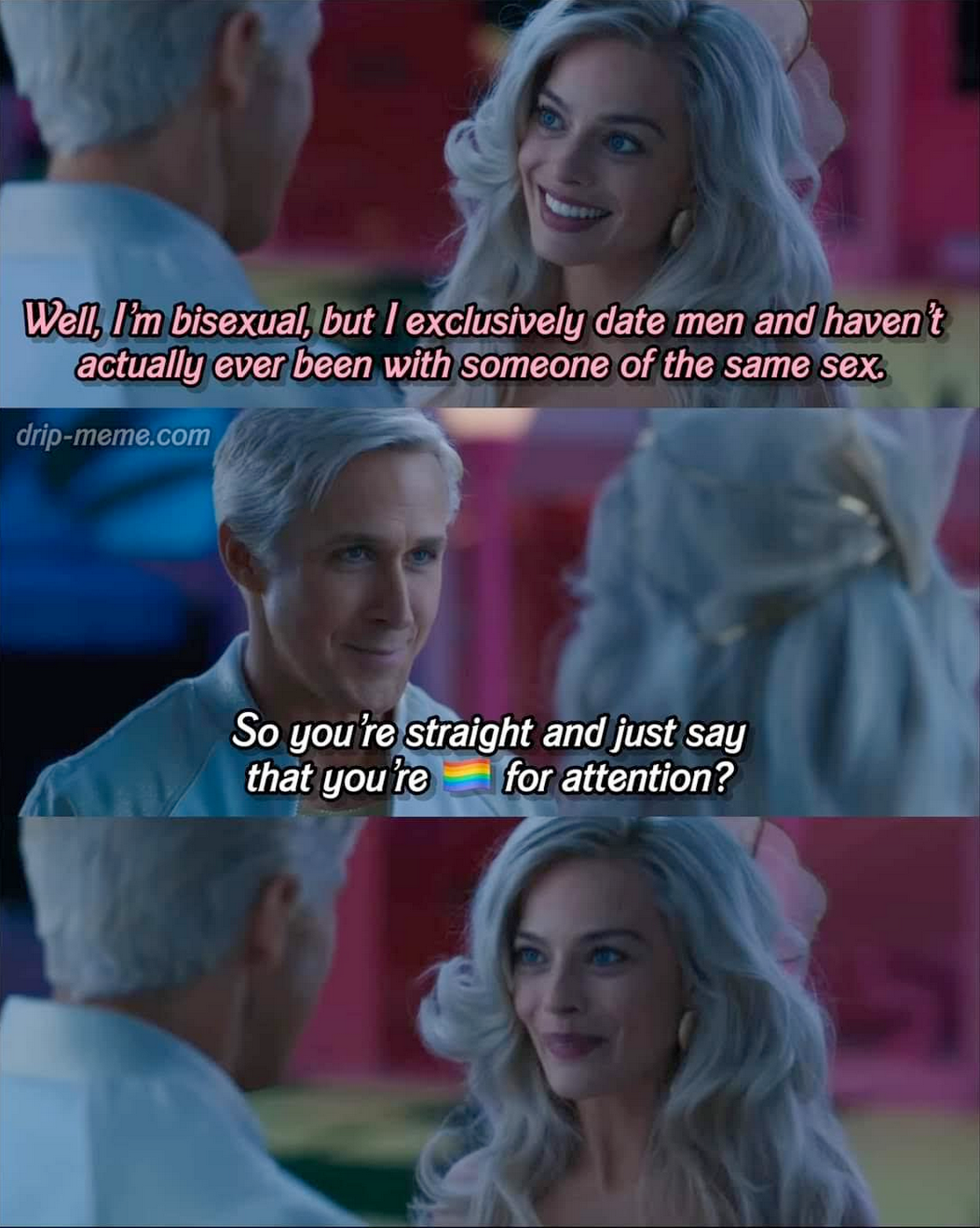
This is the second key way that bisexuality is conceptualized in far-right spaces: as a social contagion similar to the way that transness is discussed. Drawing from discussions of “rapid onset gender dysphoria,” but without the same level of vitriol, bisexuality is sometimes framed as a social trend that acts as a gateway into other, more “serious” queer identities (such as being trans or gay), or into other progressive beliefs. Statistics around the number of young women identifying as bisexual—according to recent statistics, one in five Gen Z women are bisexual—are often cited as proof that bisexuality is “spreading” among young women. For example, in 2023, the New York Post ran the headline “Gen Z women are identifying as bisexual in unprecedented numbers—but are they just following a trend?” The article hinged on recent Gallup polling and spoke to parents who believed that their bisexual children were only identifying as bisexual to fit in.
Writing about similar statistics in the U.K. for Unherd, J. Michael Bailey said: “Progressives have recently been especially fond of embracing identity politics and marginalized groups, and rejecting traditional norms. To some, bisexual identity could be a badge promoting these ideas.” Bailey has written articles for the anti-trans website 4thWaveNow about so-called “rapid onset gender identity,” according to the Southern Poverty Law Center.
Bisexuality troubles the gender binary in a similar way to transness. If gender is the most important factor in sexual attraction, as heteronormativity tells us it is, people who are attracted to multiple genders or don’t care about gender at all in their attraction call that notion into question. Right-wing and authoritarian world views are built on creating hierarchies, usually out of binaries: men over women, straight over gay, white people over people of colour, abled over disabled and so on. Identities that don’t fit into those binaries, or that undermine their legitimacy, make it harder to enforce those hierarchies.
People being able to change their gender, or even desiring to do so, makes it harder to enforce a patriarchal hierarchy that relies on the idea that being male or female is an immutable or essential characteristic, and one is inherently better and stronger than the other. The possibility that you might still be attracted to the same gender even if you’re in a different gender relationship makes it harder to access the privileges of heterosexuality—or to even prove that you’re straight at all, if desiring the other gender doesn’t automatically negate desire for the same gender.
“Within the U.S. constitutional protections, to qualify as a protected class of people that deserve a heightened level of scrutiny on laws that discriminate, you need to have certain hallmark characteristics, including that the class needs to be immutable,” explains Heron Greenesmith, deputy director of Policy at the Transgender Law Centre, adding that characteristics such as race, religion and age are considered immutable characteristics. Heron points out that sex is given a middle level of legal scrutiny, compared to race, religion and ethnicity, which are given the highest. Characteristics that are easily changed, such as hair colour, or where you live, are given the lowest level.
“There have been arguments by the right that trans status should not even get the middle level of scrutiny because if you’re literally changing your sex, it’s not an immutable characteristic, and therefore shouldn’t be protected,” says Greenesmith. Greenesmith has previously argued for Xtra that bisexuality raises similar issues for protections based on immutability: if the sex of your partner can change, how can you fight for protections based on your same-sex attraction?
Right-wing Christian writers have made similar arguments, but for different reasons: If your sexuality can change, it should not deserve legal protection. But also, if sexual desire can change, perhaps identities like bisexuality act like a gateway into other queer identities. It was the prevalence of this argument, which I had seen multiple times from the right, which meant I wasn’t surprised to see that bisexuality had been removed from the Stonewall Monument by the Trump administration. For some people on the right, if they can erase any acknowledgement of bisexuality, they may be able to save some young women from falling down the “LGBT rabbit hole.”
The reaction among some people in the LGBTQ2S+ community was to speculate that, given that erasure of bisexuality followed the erasure of trans identities, erasing gay men and lesbians would be next. While I agree that those fears are founded, it’s still worth focusing on the fact that trans and bisexual people are being erased now. “[If bi people] are the next on the chopping block, there’s not much to chop. It’s not like there are millions of dollars for research into bi disparities. Despite us being the majority of the community, we’ve never received a fraction of the funding into research and services and programmes to support us,” says Greenesmith. According to the most recent LGBT Funders report, bi-specific causes received $96,500 of the total $164,083,728 donated to LGBTQ2S+ causes in 2023.
As Greenesmith points out, discussing who’s next on the chopping board also obscures discussions about who has always been on the chopping block; namely, Black and brown people. “What is really happening is they’re coming for Black people and for migrants, and they’re using a ton of different ways to do that, including attacking trans people and attacking bi people eventually. At the end of the day, white, wealthy trans people are still going to be able to access care. It’s low-income folks, of whom people of colour are disproportionately represented, who are not going to be able to access care.”
Understanding how bisexuality might be used to attack the rights and liberties of sexual minorities is important to understanding how we might fight back against them. But it’s equally important to understand that conversations about “whose rights are next” are just a line of falling dominoes. We need to understand what the far-right believes about different minorities to understand how we can fight for the rights of those who have already been attacked.

 Why you can trust Xtra