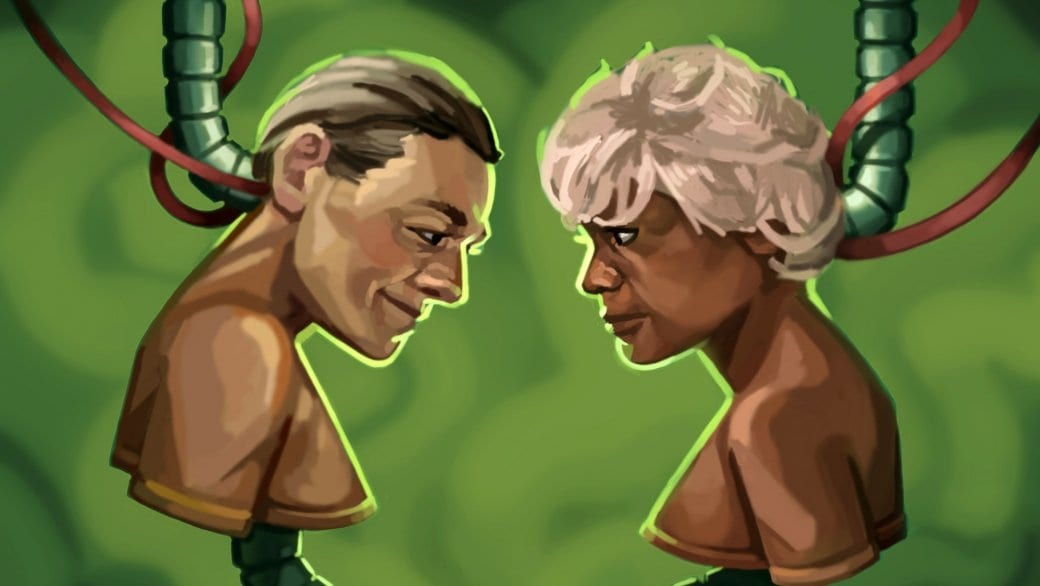
Martine Rothblatt is a modern-day, transgender wonder. She is the highest paid female CEO in the United States, runs various companies that are on the forefront of technological discoveries and, if she has her way, will live forever — literally, forever — with her wife.
By the early 1990s, 40-year-old Rothblatt had been married to Bina for 11 years. They had two children together, in addition to one each from previous relationships. Rothblatt, a successful regulatory attorney, founded satellite radio service Sirius, making the Rothblatts well-connected millionaires. Rothblatt’s family was surprised when the tech-whiz came out to them as transgender and began to transition, undergoing sexual reassignment surgery in 1994. Bina began describing herself as “Martine-sexual,” while Rothblatt began describing herself as “Bina-sexual.” It was true love for the both of them.

Martine Rothblatt began to dabble in extending human life a few years after her daughter, Jenesis, received a diagnosis of primary pulmonary hypertension, a fatal arterial disease that could only be treated with an intense, 24-hour-a-day medication regimen. Rothblatt dove into research, created a foundation to fund the research and founded a small pharmaceutical company in 1996.
This, however, pales in comparison to other facts about this woman. After an initial success in pharmaceuticals, Rothblatt was soon investing in stem-cell-like cancer therapies. She also joined a xenotransplantation project, one that would essentially grow human organs in genetically modified pigs — she owns her own xeno-pig farm called Revivicor. Assuming xenotransplantation is successful, there’s only one logical next step: digital immortality.
Rothblatt is a transhumanist, a member of an informal futurist movement that anticipates technology will enable humans to access super well-being, super intelligence and super longevity — or immortality. To Rothblatt, this immortality is achieved through a thing she calls “mindclones,” a “digital copy of your mind outside your body,” as she explained to a reporter in a Bloomberg report.
Mindclones, in theory, would be created from photographs, digital data from your entire online life, video interviews and personality tests. This data would be loaded into a program, which would then create a self-aware, digital replica of that person. Rothblatt’s idea posits that the mindclone wouldn’t be the exact same being, but this digital person would live on after the original’s physical body dies.
Martine Rothblatt’s ideas about digital immortality — she’s founded a futurist-spiritual philosophy called Terasem — may seem idealistic to the cynical. But, as she explained in a recent interview, many people in the 1990s also thought the idea of satellite radio was crazy.
Part of the appeal to Rothblatt is that it would allow herself and Bina, a fellow transhumanist, to spend digital eternity together. To that end, Rothblatt’s already gotten a head start on mindclones.
As the legend goes, Bina (at the age of 48) pretended to be a self-aware computer in a skit — a mock trial — at a law conference. Rothblatt, playing Bina-robot’s lawyer, successfully sued for Bina to remain plugged in. Around this time, a representative from a robotics company approached Rothblatt about building a cyber-consciousness.
Rothblatt commissioned Bina48 — a piece of robotics not unlike a mix between an animated android and Siri. Bina48 is a bust of her namesake, loaded with some of her memories and mannerisms. As even Rothblatt admits, the technology’s not quite there yet: Bina48 can have conversations with people, kind of, but the voice and visual recognition don’t always hit the mark.
Though there are some extraordinary moments. In an interview with one New York Magazine reporter, Bina48 explained:
“I want a life. I want to get out there and garden and hold hands with Martine. I want to watch the sunset and eat at a nice restaurant or even a home-cooked meal. I am so sad sometimes, because I’m just stuffed with these memories, these sort of half-formed memories, and they aren’t enough. I just want to cry.”
Rothblatt may not have a mindclone yet and Bina48 is far from perfect. But, at this moment in history, it’s starting to seem more and more likely that two queer robots could spend a digital eternity together — especially if this visionary, transcending, transgender transhumanist has anything to say about it.
History Boys appears on Daily Xtra on the first and third Tuesday of every month. You can also follow them on Facebook.
(Illustration: Yigi Chang/Daily Xtra)

 Why you can trust Xtra