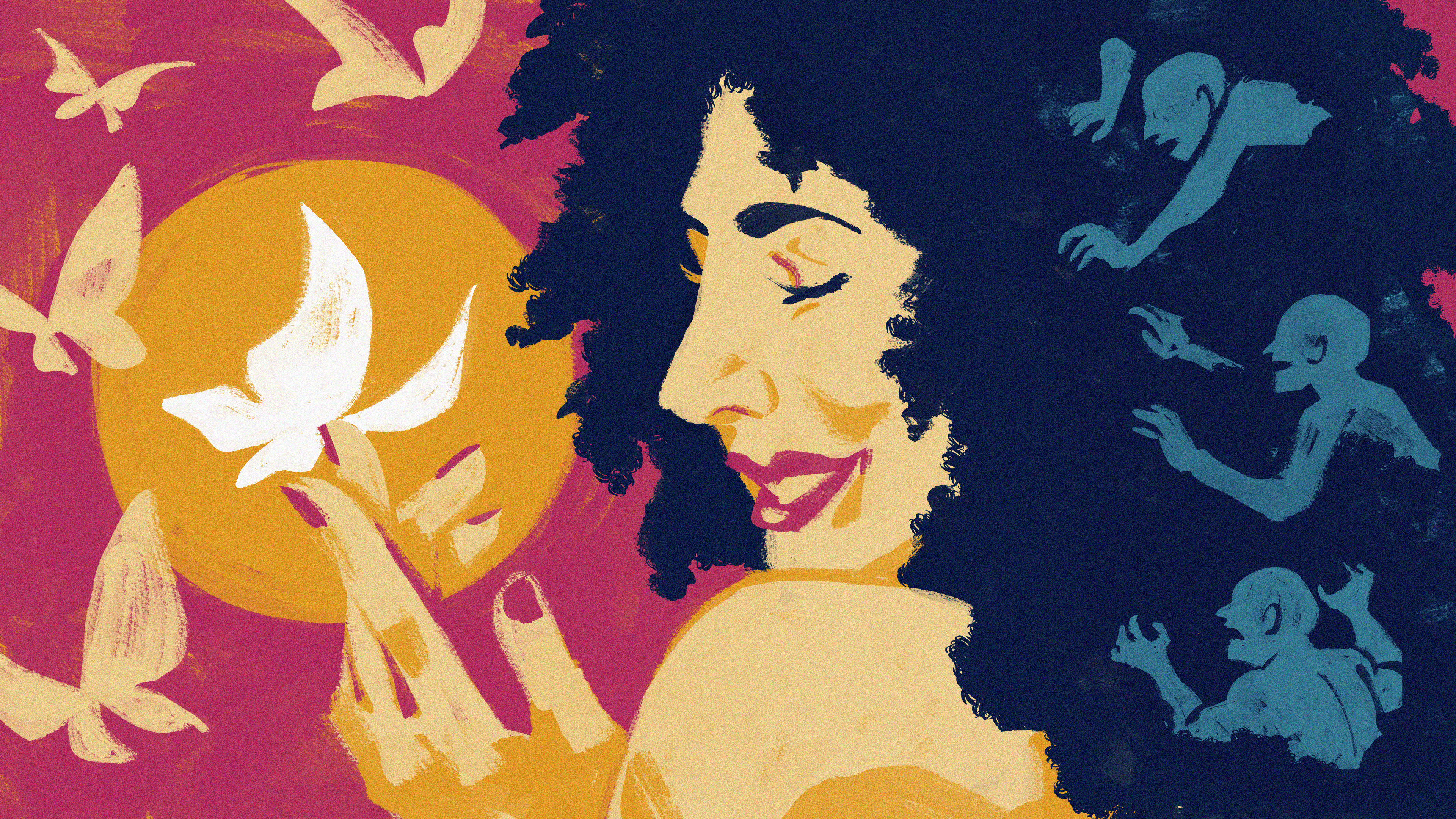
I realized I was trans at the age of 13. It was 2015, and I had been watching YouTube videos from trans women like Gigi Gorgeous, as well as from a group of five trans women from Medellín, Colombia who call themselves El Mariposario, or the Butterfly Clan. In their videos and interviews online, they would recount how they came out to their respective families, the hormone replacement therapy they were on and the gender-affirming surgeries they had undergone. I admired how fearlessly and unapologetically the girls from El Mariposario flaunted their femininity in a society that reprimanded these expressions when they didn’t come from cis women.
This was the same year it became legal for trans people in Colombia to change the gender marker on their legal documents without showing proof of gender-affirming surgery. But it didn’t change the fact that trans people were the target of jokes and violence. Trans women’s bodies were always talked about in societal discourse as a cautionary tale for men in the context of dating, and it was a common belief that all trans women were sex workers.
Despite the visibility El Mariposario gave to the trans community in a mainly conservative Catholic country, the way the media misgendered and oversexualized them made their identities appear less valid and their livelihoods frivolous to viewers. Most of the reporting on them revolved around the plastic surgery they had undergone and how appealing men found them, rather than their struggles to be accepted by their families and society.
This focus on their appeal to the male gaze made me feel confused at first, because my desire to transition had nothing to do with men. It came from how uncomfortable I felt in my own skin. The thought of taking steps to appeal to the men I perceived as my oppressors didn’t sit well with me. Despite how much I craved looking like the women around me, the stories from El Mariposario served as a warning sign. It became apparent that the efforts they had put into their physical transition weren’t enough for them to be respected in society as women.
The reality that trans women had to endure in Colombia—and all around the world—became very clear to me, even as a teen who at the time was openly gay and already struggled with the social repercussions of being effeminate. I craved a sense of normalcy in my life, so I pushed my feelings around my true identity away under the premise that it was just a phase.
Six years later, shortly after moving to Toronto by myself, the built-up gender dysphoria had become unbearable to suppress. The city shielded me from all the degrading and superficial narratives about trans women that I’d grown up watching and hearing in the media and beyond. It gave me the opportunity to build a new life in a place where nobody really knew me. At a time when I was navigating the unknown, I found comfort in that anonymity, and it sparked a fearlessness within me that I either didn’t have before or had never had to tap into.
I had started my bachelor of journalism at Humber Polytechnic, and midway through my first semester, I decided to finally be transparent with my parents about my identity. I FaceTimed them individually, as they are separated, and explained that they had a daughter, not a son. I told them I had started going to therapy and already had plans to begin hormone replacement therapy (HRT) by the start of my second semester.
My determination to start my social transition and HRT put my parents at ease because they knew this decision hadn’t been out of the blue. I was very lucky that they were understanding and open-minded. Coming out to them lifted a weight off my shoulders. I’d found the courage to take ownership of my life and take a step toward becoming the woman I am today.
As I approached the six-month mark on HRT, I returned to Colombia for the summer to undergo breast augmentation and change all of my legal documents. My uncle was a plastic surgeon, which made me feel safe and sure that I was in the right hands. The surgery was a success, and while recovering in an Airbnb in Bogotá, my mother and grandmother took care of me. Throughout the two weeks we stayed in the capital before flying back to our hometown of Cartagena, the pressure in my chest eased and we grew closer.
My breast augmentation relieved part of my gender dysphoria, and allowed me to blend more easily into society. But it also meant that my more socially conforming body attracted the lust of men in ways I had never experienced before.
A month after my surgery, I went out with one of my closest friends. I vividly remember men whistling at us and showering us with compliments as we wandered the streets of Cartagena’s Old Town. Getting catcalled for the first time as a woman made me feel uneasy, yet it was strangely validating. The comments were inappropriate, but at least they did not make a mockery of my identity in the way I was used to hearing.
We went to one of the clubs in the area, where a tall, white, blond tourist from the Netherlands approached me. He bought me a drink, we hit it off and throughout the interaction I assumed he knew I was trans. But as we exited the club and waited for my mother to pick me up, I wanted to make sure. I told him I was different from the other girls, and was immediately met with a bewildered look.
I was ready to elaborate, but my mother arrived, so I said goodbye and got into her car. I assumed I would never hear from him again. But getting ready for bed, a text popped up: “What do you mean by that?”
“I’m trans,” I replied.
He ghosted me. Lying awake in bed that night, I felt like I still wasn’t woman enough, that my transness would get in the way of men getting to know me. Teardrops fell on my arm. I got the sense that this would be one of many disappointing romantic encounters with men.
As a trans woman, nobody prepares you for the crushing weight of rejection, discrimination and fetishization. And even passing can feel isolating. Your truth can begin to feel like a burden when deciding whether or not to disclose your identity to someone else. It makes trust precarious, as your transness can be weaponized against you in dating, employment and friendships.
At first, it was very hard not to feel less than. I opened myself up to countless men who only had the capacity to see me as something inherently sexual and not worth pursuing romantically. I thought maybe romantic happy endings for girls like me only existed in movies and TV shows. But I reminded myself that I had overcome far more difficult things in life than being rejected.
Later this month, I will travel to Spain with my mother and grandmother for my bottom surgery. It will be a full-circle moment as they stand by my side in the final step of my transition, just as they did at the beginning. I have never felt so scared, anxious and excited about anything in my life.
While bottom surgery had been on my mind for over four years, I wanted to be sure it was something I truly wanted—not a rule imposed by society that I unconsciously felt I had to follow—before pursuing it. I grew up hearing conversations about how trans women who did not have a “sex change” were not real women, how you could always clock their identity by their voice and how no matter what, they would never be women.
I had also always thought that being pre-op affected my relationships with men. I never wanted to be seen as a fetish or an experiment. That’s not to say all men attracted to trans women are necessarily chasers, but unfortunately, most heterosexual trans women like myself have fallen prey to men oversexualizing our bodies. In my case, that interest towards a part of my body that I had always rejected has aggravated my gender dysphoria.
In preparing for the surgery, I’ve realized I had been gaslighting myself into believing I was comfortable with my body. Although my experiences with men have contributed to feelings of rejection toward my body, the gender dysphoria my genitalia exacerbates isn’t because of them, nor society’s transphobic and contradictory narratives about what a trans woman should be. Instead, it’s about my sense of completeness and peace with my body.
To me, this act of self-love is about finally choosing myself unapologetically. It’s about listening to the quiet voice I spent years trying to silence, and trusting that I have always known the way. For so long, I searched for validation in how the world saw me: to pass, to be desired, to be accepted. But what I’ve come to understand is that the deepest form of love is the one I cultivate within.
As I prepare for surgery, I’m not chasing perfection or approval—I’m choosing peace. I’m honouring the girl who knew who she was at 13, the woman I am today and the life I am allowing myself to fully inhabit. This is what love looks like for me: coming home to a body I don’t feel alienated in, and finally feeling like I never have to leave again.

 Why you can trust Xtra