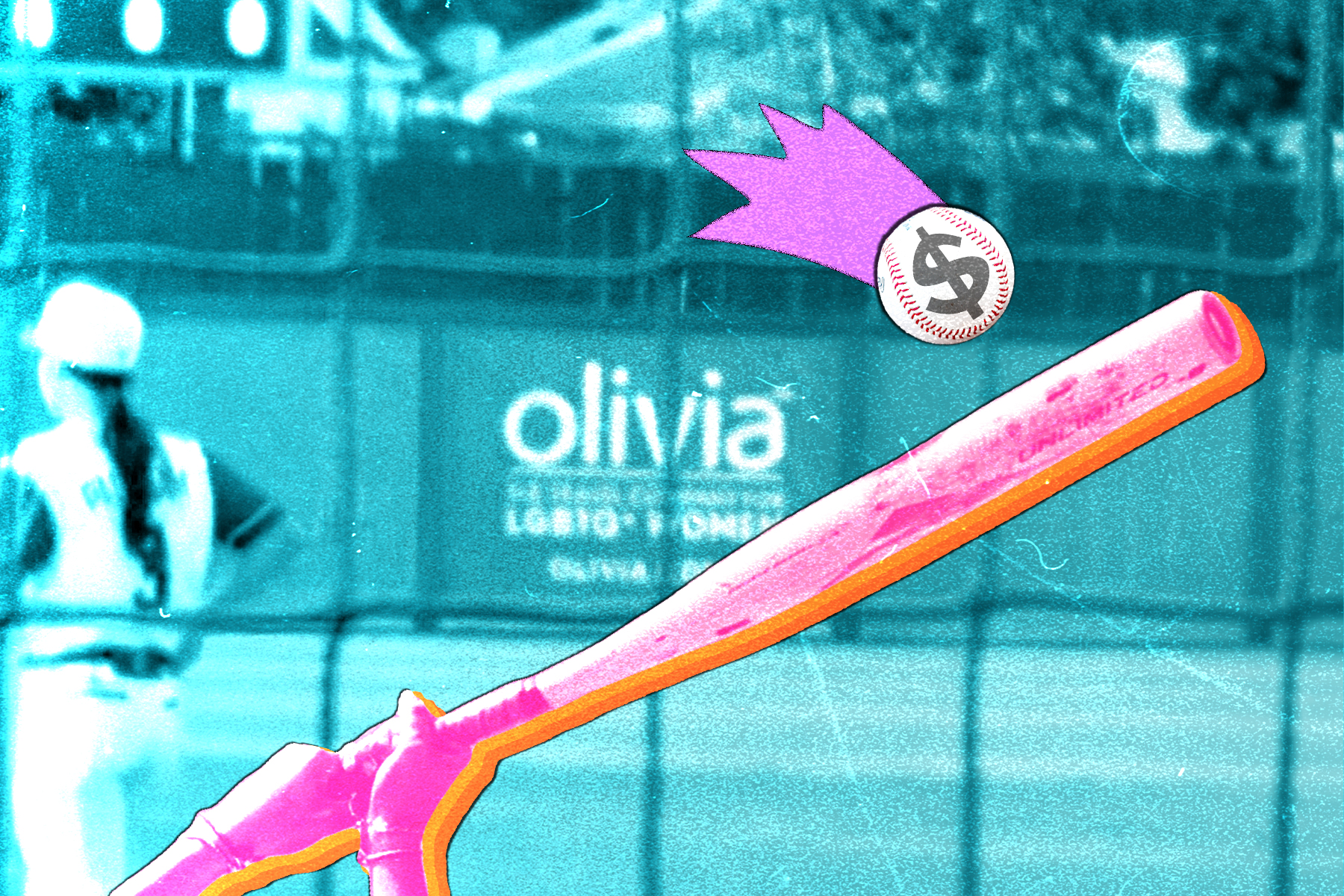
Turn on any game featuring the new Women’s Pro Baseball League (WPBL) in the United States, and you’ll see that there’s no question who the league is marketing to. On the outfield wall, next to the logos of each of the four teams, is an ad for Olivia Travel, described as “the travel company for LGBTQ+ women.”
That one small ad in Robin Roberts Stadium in Springfield, Illinois—where the inaugural WPBL season is taking place—is tied to queer history and a queer future, all at once. Olivia’s founding partnership with the WPBL is one that makes so much sense for both the league and the travel brand, but it’s the kind of sponsorship that has fallen away from women’s sports leagues as they have become more mainstream. As the WPBL becomes the first mainstream professional women’s baseball league in the U.S. in nearly 70 years, this partnership shows how far the sport has come.
There has always been an alliance between lesbian bars and companies and women’s sports leagues, even if that collaboration was hidden or unspoken, according to Susan Cahn, professor emeritus of history at the University at Buffalo and the author of Coming On Strong: Gender and Sexuality in Women’s Sport. In the 1950s and ’60s, some of the most visible places to find lesbians were in rec softball leagues. Many of those leagues were either run out of local women’s bars, or quietly aided by them as they helped pay for shirts or equipment. In return, the players would go drink there after games. Such was the arrangement that a gay softball team in Chicago’s Horner Park league had in 1974 with Ms. Lounge, the predominantly Black lesbian bar that sponsored them, according to historian Finn Enke’s 2007 book, Finding the Movement: Sexuality, Contested Space, and Feminist Activism.
In the 1970s, local lesbian bars were some of the first businesses to throw their support behind the National Women’s Football League (NWFL), the first professional women’s football league in the U.S. I explored this in my book, Hail Mary: The Rise and Fall of the National Women’s Football League. In Dallas, one team started after a group of women hanging out at a lesbian bar decided to go try out for the league. Later on, lesbian bars the Maidenhead and Sassy’s bought ad space in the Dallas-Fort Worth Shamrocks game programs.
Other NWFL teams were worried about what visible association with a lesbian establishment would mean for their ability to succeed. “[Columbus lesbian bar] Summit Station would have bought an ad,” Linda Stamps, a player for the NWFL’s Columbus Pacesetters, said in an interview for my book. “We were homophobic enough ourselves in the sense that we did not do it because we were afraid it would destroy everything, that we wouldn’t be able to sell one ticket.” By the late 1980s, when the NWFL eventually stopped operating, the Pacesetters felt comfortable enough to run a Summit Station ad in their program.
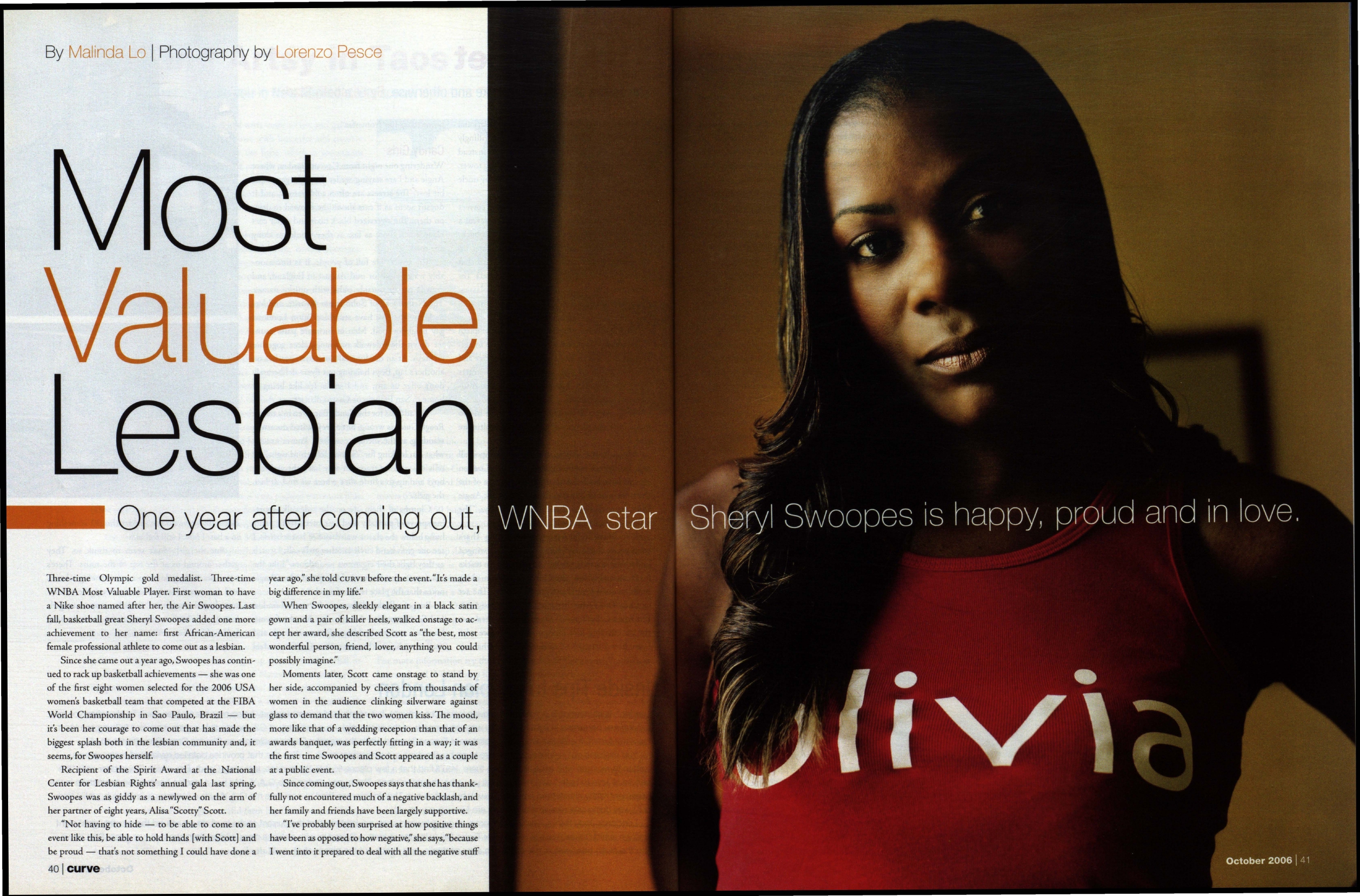
Olivia Travel was early to women’s sports sponsorships. It first began in 1973 as Olivia Records, a record label that exclusively signed women artists. In 1990, it transitioned into being a travel company for lesbian and queer women, then known as Olivia Cruises. In the ensuing years, the company sponsored openly queer athletes like Billie Jean King, Sheryl Swoopes and Diana Nyad.
“Olivia has supported women’s athletics for decades, so it wasn’t necessarily a new concept,” says Autumn Nazarian, Olivia’s vice-president of marketing. “We look at women athletes—they’re incredible sports figures and celebrities, but by the nature of women’s sports, they also tend to be history-makers and leaders. So for us, hearing that this league was happening and having the opportunity to be part of its inaugural season, it was a no-brainer, and something we knew we couldn’t watch from the sidelines.”
Research shows that major brands have been pulling their financial support for Pride events in recent years as LGBTQ2S+ acceptance has become more controversial in the current political climate—and they’ve been funnelling that money into women’s sports instead. Suddenly, women’s sports have more investment than ever. “Brands didn’t discover a new audience—they found one they could sponsor without a single headline about ‘controversy,’” noted Lesbians Who Tech, a company that hosts tech summits with a focus on queer women, in a recent Instagram post.
Much of the investment in women’s sports is likely to come from major brands that have mainstream appeal, rather than smaller, queer-run companies. “I don’t have quantitative evidence, but my sense is that now the WNBA and the higher-level pro teams are trying to get mainstream sponsors,” says Cahn. “The business sponsorships are more mainstream than they were in the ’70s, ’80s and even ’90s.” Even with the boom in money going toward partnerships with women’s sports leagues, brands continue to underinvest in them, according to ADWEEK. That is likely due to a combination of misogyny and homophobia.
“With the WPBL, there was a natural connection from our very first conversation, there was an understanding that Olivia vacations and women’s baseball returning are both spaces where women can see representation and finally feel like they belong,” says Nazarian.
“In our initial conversations, we felt strongly that Olivia was supportive of the WBPL and our mission,” says Natalie Mikolich, the WPBL’s director of public relations.
Mikolich says that the league also felt that “the WPBL’s constituents overlapped with Olivia’s key demographics”—in other words, many fans of the WPBL are members of the queer and lesbian communities. This extends to players on the field as well. While not all players are queer, of course, New York Heights catcher Denae Benites estimated during a recent podcast appearance that “probably 90 percent” of the league is, while Los Angeles Queens third baseman Ashton Lansdell jokingly guessed in an Autostraddle interview that “95 percent” of women’s baseball players overall are gay.
As I’ve previously reported, in the 1940s and ’50s, when women played in the All-American Girls Professional Baseball League (AAGPBL), they wore skirts and makeup, in part so that audiences wouldn’t think they were gay, though many of them were. Players could be sent home if they were discovered having relationships with a teammate, or even if they got a haircut the league deemed “too butch.” The fact that players can be open about who they are in the WPBL shows that times have changed, as does the willingness of the league to partner with an explicitly queer brand like Olivia.
The players have been leveraging their identities as a way to try to encourage brands to partner with their league too. There’s been a running joke on social media that Subaru should sponsor the WBPL, with players like San Francisco Firebells pitcher Liz Gilder and Heights infielder Keira Izumi tagging the brand on Instagram in the hopes of getting its attention.
Gilder tells Xtra that while the tags may be a joke, there’s also something serious about them. She cites the ads that Subaru ran in the 1990s that were aimed at the lesbian community, which showed that the brand had already aligned itself with the demographic. On top of that, Gilder says that proactively tagging Subaru is a way to turn hateful comments—where social media users are assuming that Subaru sponsors the league, implying in a homophobic dig that all the players are queer—into something that the athletes can reclaim for themselves.
“I think they’re meant to be hate comments, but I think it would be great if [Subaru] sponsored us,” Gilder says. “Not all of the girls have cars, so it would actually be an optimal situation if they sponsored us and we were able to get around Springfield a little bit better.”
Cahn points out that the decline of lesbian bars over the last several decades likely contributed to fewer opportunities for partnerships of this kind, as they just didn’t exist. In the early aughts, the WNBA’s Miami Sol had partnerships with local lesbian bars like Kicks and J’s, and sponsored the Miami lesbian music festival Aqua Girl, but the explicit marketing to lesbian audiences came after WNBA fans protested that the league was failing to acknowledge one of its largest contingents of supporters. But with the growth of women’s sports bars—most of which cater to a queer audience—those community ties and supports are being forged again. Olivia Travel did an event with A Bar of Their Own in Minneapolis, Minnesota, last year, and many women’s sports bars hosted watch parties for the WPBL’s opening weekend in August.
“Starting with the WPBL’s inaugural draft last fall, we have received tremendous, widespread support from women’s sports bars and queer women across the country,” says Mikolich.
Mikolich says that the league has wanted to explicitly be inclusive of the queer community from the beginning. Not only is the league’s mascot based on former AAGPBL player Maybelle Blair, who came out at the age of 95 in 2022, but the WPBL is hosting its first Pride Night on Sept. 3.
Gilder says it’s been “awesome to see the community come out” to games “and really put their money where their mouth is.
“It would be awesome to see more LGBTQ2S+ brands come out and sponsor us, as well.”
 Why you can trust Xtra