Bisexuals don’t exist. A bisexual is someone who can’t bring themselves to admit they’re actually gay or lesbian. Being bisexual is transphobic. Bisexuals are the main spreaders of HIV.
These are some of the misconceptions people have about bisexuality. These biases make it hard for bisexuals to come out and may be the reason there isn’t much of an organized bisexual community; it’s a rare thing to find an event geared specifically for bisexuals.
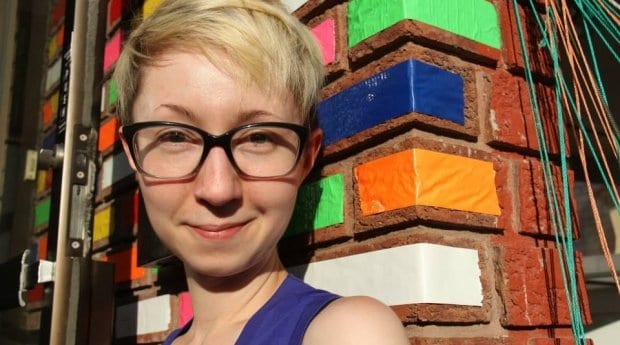
And playwright/performer Katie Sly is sick of it.
“I’ve encountered a fair amount of biphobia, even from some people within the queer community,” Sly says. “I’m sort of used to the generic forms of biphobia, like the idea that I’m not necessarily queer because I don’t happen to have a same-sex partner at a particular moment or how people treat me in queer spaces if I happen to bring a partner of the opposite sex.”
This kind of treatment is common and not usually too difficult to tolerate, but Sly’s found that lately it’s gotten worse. “More recently, I’ve encountered some things that were more insidious and ugly, like I had a couple of people tell me that identifying as bisexual was transphobic because it reinforced the gender binary, and I should just use the word ‘queer” instead,” she says. “I think that kind of thing is ridiculous and harmful, and it made me feel ostracized.”
It’s important to Sly that she identifies as bisexual. “The reason the word is important to me, and why I don’t veer away from that as a label and don’t just say ‘I’m queer and what that means you don’t need to know,’ is because a community can’t mobilize without a thing to call itself,” she says. “Otherwise, what are we? Just a generic group that can’t use language to say anything, and isn’t that another way to silence people — saying you aren’t allowed to use language.”
To combat these biases and create a space that specifically showcases and promotes work by bisexuals or about bisexuality, Sly is doing what any good artist would do: she’s curating a cabaret at Videofag.
“The aim of the Bi Visibility Cabaret is to make bisexual people visible to one another, because being bisexual can often be very isolating, and to make ourselves visible to and heard by other communities,” she says. “There have been too many moments I’ve been told I don’t exist.”
Sly hopes the cabaret will become an ongoing thing. It’s off to a strong start, with the inaugural event featuring approximately 11 people performing in a variety of styles. The roster of the inaugural event includes burlesque performer Sly Maria, the dance collective inAMORata, and playwright/performer Franny McCabe-Bennett.
Bisexuals do exist and Sly wants to ensure they’re heard.
Too Queer: A Bi Visibility Cabaret is Fri, June 6, 7pm, at Videofag, 187 Augusta Ave. videofag.com

 Why you can trust Xtra