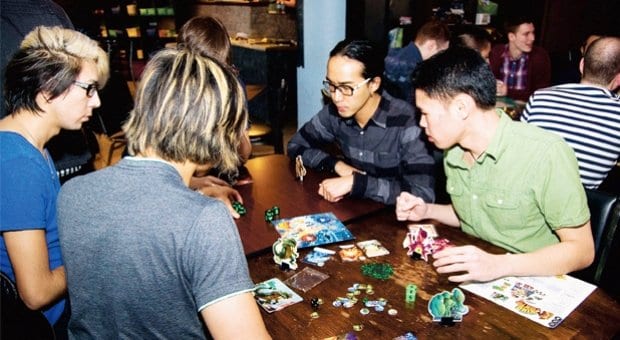
In a corner of La Fontana Caffe in Burnaby, amid the noise of the Vancouver Gaymers’ fifth anniversary party on Feb 28, Reina Sato looks up from the rules of Clue to explain why she tagged along with a friend to play board games with complete strangers.
In doing so, she inadvertently sums up why 70 or so other people have joined her and why this group of queer gaming enthusiasts — who generally refer to themselves as gaymers or geeks — continues to grow.
“I’m kind of an introvert,” she says. “I really wanted to meet new people, share interests and play games, just have fun. I learned that it’s a really safe place for everyone to play and be accepted, so I came along.”
Beyond their love for board and video games (and the people who play them), the Vancouver Gaymers are filling what its members see as a gap in the gay community.
“They’ve been around gaming their whole lives; they’ve grown up with it, and now they identify in that fashion, and there’s no real connection to find other people of that same ilk,” says founding member Justin Saint.
“Even now in the geek community, there are a lot of issues surrounding safety,” he explains. “At standard geek events, there’s still that level of ‘I can’t hold my boyfriend’s hand.’ So for me, creating that space was really important because there is a need to connect with other people who like the geeky things you do.”
Gay gamers can suffer a double-edged sword: alienated from the straight gaming community by homophobic themes and language and straight-male-centric imagery, yet not particularly part of a gay scene that might feel less than welcoming to some geeks.
“You grow up and you’re gay, you’re a recluse in that way. You grow up and you’re a nerd, and you’re a recluse that way,” says 25-year-old Shane Flynn, who helped start the Vancouver Gaymers along with Saint. “A lot of people who come for the first time, they’ve never met anybody in the gay community at all.”
Five years ago, Saint posted a call-out on the forum of a popular queer-focused gaming website and essentially opened the floodgates, as a whole new subculture of gay video- and board-game enthusiasts has since come out to play.
Saint estimates that about 50 people, gay and straight, now turn up to any given meeting. And the worldwide gaymer community is becoming a more viable phenomenon every year — it even hosts its own gaming convention, GaymerX, launched in San Francisco in 2013.
To the Vancouver Gaymers, it’s about creating an accepting space, Saint says.
“It’s arguably the most positive space for gaming groups in Vancouver, because usually other ones are very hostile and they’re very rooted in ideas of heterosexism,” Vi L says. “I don’t identify as male … this group has been the most receptive to pronoun changes in reference to me, as opposed to other groups who haven’t been as receptive … for video games, or even other queer groups in general. This seems to be the mixture of gaming and queer that is the most accepting.”
As the Gaymers continue to grow and to search for bigger venues (ideally in the West End), Saint suggests that their subculture is still taking shape. “Because we don’t have a hierarchy to call on,” he notes, “like the queens or the leathers or the bears — all the established groups — we are still figuring out exactly how to be a community.”
 Why you can trust Xtra