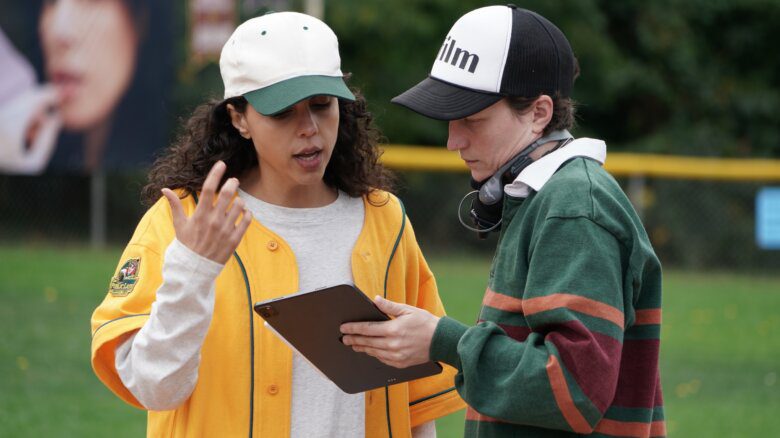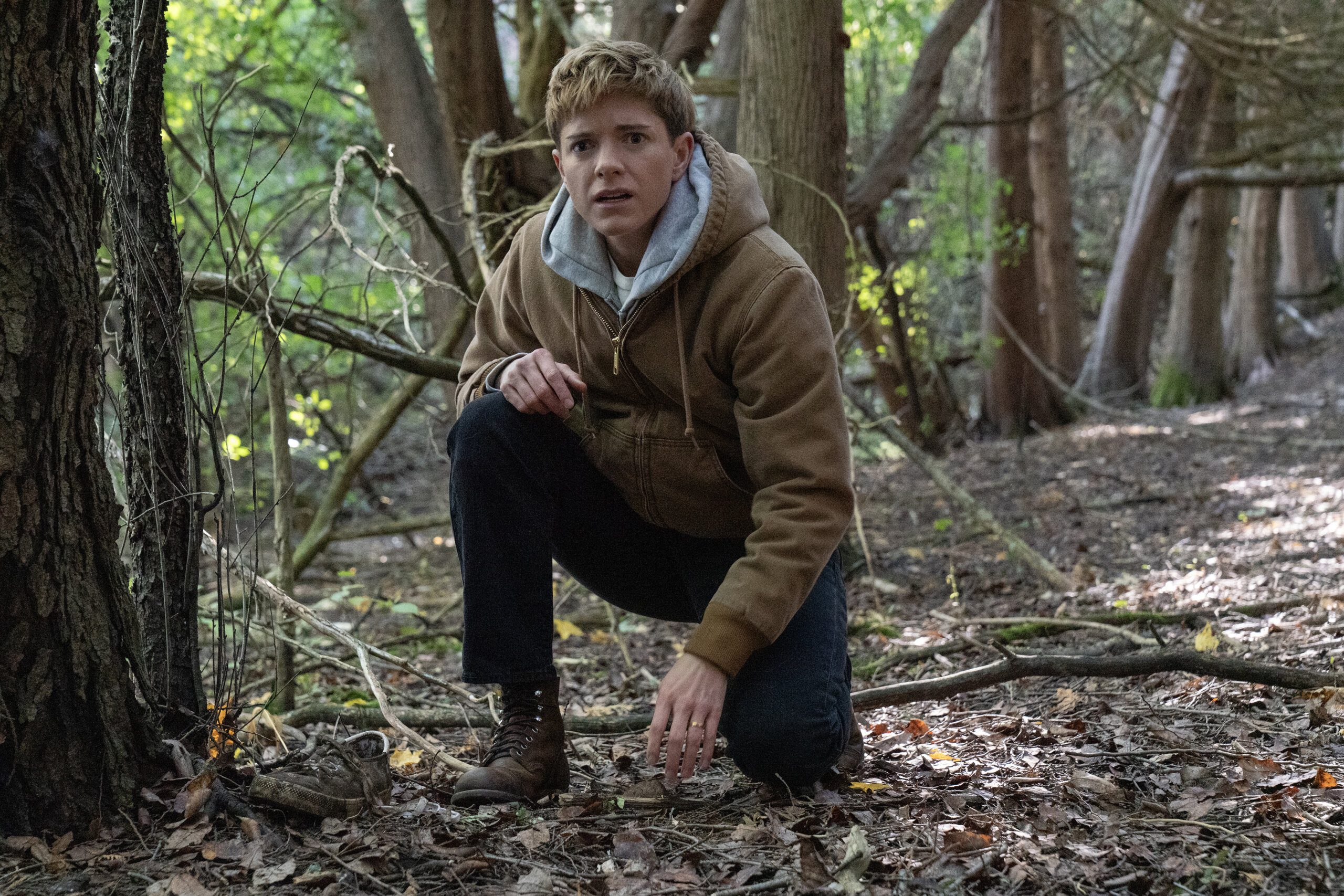
From its first episode, Wayward would like us to understand that no one is to be trusted in Tall Pines, a fictional Vermont town that houses a sprawling facility for troubled teens. Mae Martin’s latest limited series opens with a young boy, body covered in bruises and cuts, escaping into the woods from a mysterious institution. We then meet two teenage girls smoking a joint on their school’s roof in Toronto before heading back to Vermont to join a cop by the name of Alex (played by Martin) and his pregnant wife as they move into a new home. Anyone with even a basic familiarity with the thriller genre will quickly recognize that these latter two storylines will coalesce to shed light on the first, and this convergence happens, as expected, soon after, when one of the teen girls is taken against her will and sent to the school, just as Alex begins to notice that something is amiss in his new town. This is one of the pitfalls of Wayward—it is wholly conventional in its story structure and character tropes.
Martin’s earlier work for Netflix—Feel Good, a comedy series that ran for two seasons—is a good showcase of their ability to mix comedy with serious topics like PTSD and addiction. They take a similar, though much more muted, approach in Wayward by attempting to incorporate moments of levity into their exploration of a dark and complicated subject. For the most part, these comedic moments work—it is the representation of the troubled teen facility as well as the faculty that populate it that make up the weak points of the show.
In the past couple of years, the troubled teen industry has come into the limelight. It was the subject of two documentaries on major streaming platforms (Hell Camp: Teen Nightmare on Netflix and Teen Torture Inc. on Max/Crave), and has found famous advocates in Paris Hilton and Danielle Bregoli, each of whom spent time in these institutions in their teenage years. On the Canadian side, Rachel Browne’s reporting for The Walrus on Robert Land Academy, a school for troubled teens located in southern Ontario, shared explosive details about the torture and abuse that young boys had to suffer for generations under the guise of rehabilitation. The school closed in April of this year and has 80 pending lawsuits filed against it. Yet, despite so many major outlets choosing to platform survivors’ stories, this industry is not one that everyone will be familiar with.
The primary issue with Wayward’s treatment of its subject is that it often feels confused in what it wants to be; its attempts to showcase the goings-on of the troubled teen school are overpowered by its desire to equate the school with a cult. We are introduced to the mastermind behind this program early, a woman by the name of Evelyn (Toni Collette), whose large, thick glasses and perpetually untrusting expression conjure up images of cult leaders like David Koresh and Jim Jones (though this series is set in the early 2000s). Evelyn uses her charisma and charm to maintain a reputation of credibility throughout town—she leaves a generous gift basket on Alex and Laura’s porch on their first morning in town and stops by the police station to drop off freshly baked goods for the crew. Alex, however, sees through her veneer and soon learns that she has a network of spies in the town and has even left microphones in his home. In the school itself, we see Evelyn push her experimental therapies, which range from hypnosis to straight-up torture.
It is largely believed that the originating inspiration for schools like Tall Pines is a cult by the name of Synanon, whose “tough-love” methods in adult drug rehabilitation inspired the same practices for teens, but the main problem with this comparison as Wayward portrays it is that it oversimplifies the nature of the victimhood of the students. Typically, cults like Synanon target adults, manipulating them through their vulnerabilities to attract them to join of their own volition, the illusion of agency further strengthening their grip on them. These troubled teen programs, on the other hand, quite literally organize the kidnapping of their victims from their beds; through physical and psychological force, they wear them down to obtain obedience. In a way, the charisma of Evelyn matters little; were she to have been replaced by a gaggle of suit-wearing administrators, the school could still just as effectively achieve its main purpose of strong-arming its wards into unquestioning submission.
In placing its institution within the narrative and aesthetic confines of a cult, Wayward avoids the urgent and uncomfortable questions thrumming throughout this story. What leads guardians to make this decision, and are they themselves aware of what is going on in these schools? How can local officials, like police officers and doctors, not notice the abuse happening within their town? And if corruption is the answer, what is the ultimate incentive for all of these high-placed individuals to either keep quiet or abet these institutions?
Instead, the show is interested in exploring a different question, one that is more abstract: what does it mean to be bad? It argues that, in the eyes of these institutions, “badness” is not a concrete quality but the absence of three key ones: militance, obedience and discipline. And through the guise of correction, students are primed to become followers and respectors of authority. It’s certainly a compelling exploration, but it once again defaults to cult tropes to portray the impact of this enforced obedience on graduates, focusing more on brainwashing (what else would you call a group of half-naked people gathering together for a birth?) than the psychological and social issues that follow survivors.
As such, Wayward is at its most compelling when it follows Laura (Sarah Gadon), Alex’s wife, who we learn is a graduate of Tall Pines, herself having been a troubled teen. Having moved back to the town surrounding the school to accompany her husband in his new job posting, her positive demeanour begins to chip away as she finds herself in an environment that shaped her profoundly (for the better, she always thought, but perhaps not), while also finding herself complicit in normalizing the structures that keep the teens secluded and alienated. Laura is key to understanding the long-term impact of this facility: at first, she frequently lauds the support she received while emphasizing what a “bad” kid she was. (“Were you really that bad?” Alex asks her once, half joking. “Yes,” she responds in a serious, deadpan manner.) In order to uplift the school and its teachings—something all of the students are trained to do—one must devalue themselves, the ethos being that the program only works if it treats the most delinquent of behaviours. We begin to understand that a key to surviving this experience and living with its after-effects is depersonalization; turning not just against others but against yourself.
And this is only one component of the problem surrounding these institutions. The show only very briefly hints at the other, which is that the troubled teen industry can be a very lucrative business. Universal Health Services, an American Fortune 500 company, is only one example of a company profiting off vulnerable teens: it runs hundreds of youth facilities in the U.S. and the U.K., and generated over 15 billion dollars in profit, despite longtime allegations of abuse and mistreatment, including those from a shocking 2016 Buzzfeed investigation.
While Netflix and HBO have recently capitalized on the increasing interest and curiosity about these institutions, troubled youth programs have been present in our culture for much longer. Take Louis Sachar’s book Holes (1998), which follows a teenage boy being sent to a correctional boot camp after he is wrongly accused of stealing shoes. Sachar notes the ludicrous nature of making disobedient young people do hard labour, emphasizing that these programs are more about control than any kind of rehabilitation. Wayward attempts to tell a similar story, but gets lost in the details: it overemphasizes the influence of the head of these schools while failing to flesh out the circumstances that allow society to turn a blind eye to these kids. It often veers into melodrama and is more interested in developing plot twists than an actually nuanced perspective on this industry. In blurring the lines between these militant schools and cults, it fails to adequately portray the scope of this problem. These are not one-off programs popping up at the behest of charismatic, power-hungry leaders; these are institutions that are deeply embedded into both the healthcare and youth justice systems, and are supported by bands of bystanders.

 Why you can trust Xtra