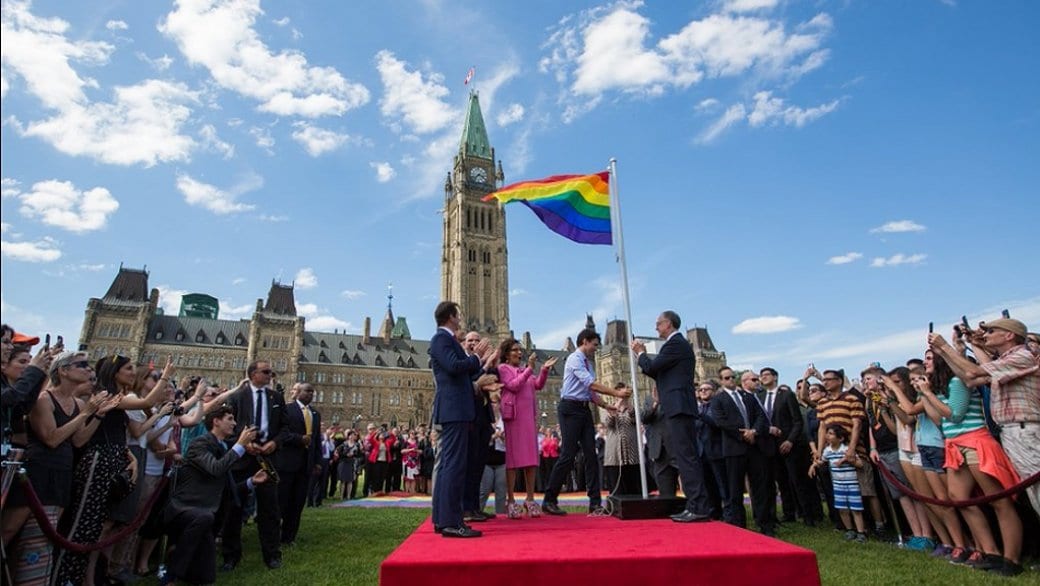
Prime Minister Justin Trudeau raised a rainbow flag on the lawn of Parliament Hill on June 1, 2016, as part of the Liberal government’s charm offensive toward LGBT Canadians.
“It hasn’t been easy; It hasn’t been automatic. A lot of people fought for a long time for this day,” Trudeau said, flanked by members of Parliament from each major party. “Canada is united in its defence of rights, and its standing up for LGBTQ rights.”
To kick off Pride Month, Trudeau pulled up the flag on a temporary platform in front of West Block. A permanent flagpole on the east side of the Hill is normally used for flags for visiting foreign dignitaries, but was not used for the rainbow flag. While activists have hoisted the multicolour banner at rallies, it’s the first time the Canadian government has officially done so.
“I feel a sense of pride, but also a sense that there’s a lot more work to be done,” said Liberal MP Scott Brison, who became Canada’s first openly gay cabinet minister in 2004.
Brison talked about being born a year before homosexuality was decriminalized, and now being able to marry a man and have children. “This is very exciting, and I feel very fortunate as a Canadian to have been able to live during such a period of remarkable social progress,” he said.
Trudeau was flanked by scores of LGBT activists who were in Ottawa to launch a report the next day examining Canada’s support for queer people at home and abroad.
The flag-raising is part of the government’s outreach to LGBT Canadians, which has been hailed for its symbolism and criticized over its substance.
The government tabled Bill C-16 on May 17, which would codify trans people in human-rights and hate-speech laws. For its announcement, the government had a transgender flag placed in the lobby of the House of Commons. But later that day, the government voted down a motion to fast-track the bill.
The government also promised on Feb 28 to review criminal convictions, military discharges and public-service dismissals based on homosexual activity, though activists say they still haven’t been consulted. The government told Daily Xtra in April it is also reviewing Criminal Code prohibitions on anal sex.
Trudeau is set to march July 3 in the Pride Toronto parade, the first sitting prime minister to do so.
 Why you can trust Xtra