Toronto’s annual Pride parade will move to the July long weekend in 2016, following six weeks of queer-themed programming that will have June dubbed as “Pride month,” executive director Mathieu Chantelois announced at the Pride annual general meeting Oct 22, 2015.
The move is part of a new strategic direction that Chantelois says will attract more tourists to the final weekend of the festival, as Canadians and Americans will be able to take advantage of the long weekend. Toronto Pride will also no longer overlap with nearby New York Pride, which traditionally takes place on the same weekend, commemorating the June 28, 1969, Stonewall riots.
The last time Pride was moved to the July long weekend was in 2010, and the move was one of several controversies that year that sparked the creation of a Community Advisory Panel (CAP) to demand greater accountability from Pride Toronto. With the parade in the shadow of that year’s massive G20 conference and competing protests over whether a group called Queers Against Israeli Apartheid would be allowed to march, anecdotal reports were that additional tourists did not show up, and many community members spent the long weekend away.
Pride had planned to move to the July long weekend for WorldPride 2014 but was stymied by a competing international conference that had booked the majority of the city’s hotel rooms in advance.
One of the recommendations of the 2011 CAP report was that the Pride festival should always incorporate the anniversary of the Stonewall riots. If the parade were held on the final Sunday of June, it would land on June 26, missing the anniversary by two days.
Chantelois also announced that this year’s Pride festival will expand from a Pride week to a June “Pride month,” which will actually stretch from the end of May to early July. It will incorporate many already planned LGBT events including the Inside Out film festival, which has moved down its dates to May 26–June 5. Pride month will officially kick off with a flag-raising at city hall on June 1.
“I like to think we’re just going to build great momentum,” Chantelois says. “Pride month is super exciting. It’s not going to cost us a lot more money as well, it’s mostly partnership. It’s just a good way for us to partner with everybody. Things were so condensed, some days we had 30 events. This is going to help us to say that ‘today, this is what’s happening and nothing else.’”
Chantelois says Pride consulted with its staff, board of directors, partner organizations and with the city before moving the dates.
Pride’s new strategic plan for 2016–2021, “Beyond 20/20,” also raises eyebrows in that it no longer names the LGBTT2QSA community as the one being celebrated. The words “gay,” “lesbian,” “bi,” and “trans” don’t appear in the document. Instead, the new mission statement is “Pride Toronto brings people together to celebrate the history, courage and diversity of our community,” with the vision that “As a leader in the Pride movement, we aspire to unite and empower people with diverse sexual orientations, gender identities, and gender expressions.”
Board chair Aaron GlynWilliams says that the move was to make Pride more inclusive of diverse and emerging identities that are not necessarily encompassed by the increasingly large and unwieldy acronym.
“Every member of the board can tell you our email is full of people who say that they don’t see themselves in the acronym,” GlynWilliams says. “‘Community’ means many things to many people. We want to make sure that this was a term that everyone saw themselves in.”
At the end of the meeting, the Pride membership voted in five new board members from a slate of six candidates. There was some controversy over the fact that the board had only initially approved of five candidates for the five positions, with a sixth who was added to the ballot by presenting the signatures of ten Pride members, in accordance with the rules.
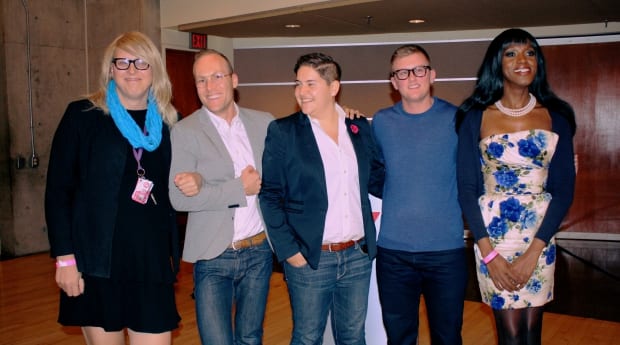
Ultimately, members voted in trans activists Biko Beauttah and Evan Kirkman, Daily Xtra arts editor Phil Villeneuve, Out on Bay Street director Michelle Cherny, and returning board member and trans activist Rachel Lauren Clark. The members did not return Paul Saguil, who had been seeking re-election, to the board.
(Editor’s note: Since Phil Villeneuve announced his candidacy for Pride Toronto’s board, he is no longer involved in any Daily Xtra editorial matters, decisions or coverage related to Pride Toronto.)
With three trans board members, the Pride Toronto board has the largest trans representation in its history. Answering a question from the audience before the vote, Kirkman said he would like to work on improving trans inclusion in the broader community.
“We still feel kept apart from the community at Pride,” he said.
Beuttah, who hails from Kenya, told the audience that her first Toronto Pride in 2006 “allowed me to see myself for who I truly am,” and that she would like to see Pride organize a float to celebrate African queer people.

 Why you can trust Xtra