Noel Coward was a prominent member of a line of obviously gay English playwrights who flourished beginning in the middle third of the 20th century. Unlike earlier writers these men were able to live unmarried lives, sometimes with “longtime male companions.” But the relative social freedom won by women around this same time meant that these men were able to form long-term friendships with equally strong-minded straight females and empathize with the stilted ambitions of repressed female relatives.
With the benefit of their outsider status and their female connections they began to write witty, truthful and incisive plays about the façades created in front of family relationships and troubled marriages. Coward, Terence Rattigan and Somerset Maugham are the best known of these authors.
This summer, gay theatregoers looking for relationship advice have a pair of comedies to give them some pause for thought amidst the plentiful laughter. Maugham’s The Constant Wife is being mounted by the Shaw Festival, while its Stratford counterpart is producing Coward’s Fallen Angels.
For the latter, the Stratford Festival has decided to cast from strength. Director Brian Bedford, set and costume designer Susan Benson and lighting designer Michael Whitfield have decades of festival experience between them. If they wished, these three old pros could produce this play in their sleep. Of course one of the reasons that they have become veterans is that they can be relied upon to give their all in honour of an old pro just like themselves.
Bedford has a lot in common with Coward, with whom he was acquainted, including an English theatre background, a debonair stage presence and a long history of success. As a director he is a sure-footed guide to the brittle and sophisticated world of this play, keeping his cast working at just the right speed for the fun to develop.
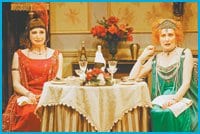
Meanwhile Benson has come up with yet another of her stunning productions. In many ways she has been the guiding hand behind the expensive visual look of the Stratford Festival for the last quarter century. For Fallen Angels she has encouraged the costume department to make the two leading women on stage look like a million dollars with exquisite fabrics and gorgeous dress-making, while at the same time building a simple yet elegant set.
Wearing Benson’s stunning outfits are Stratford stalwarts, Lucy Peacock and Seana McKenna coming together here as Jane and Julia, the Fallen Angels of the title, playing two upright matrons who come undone at the imminent arrival of a former beau they shared. Like the production trio, these two actresses gobble up this Cowardly confection with glee.
Written specifically as a showcase for two actresses, the male actors involved are to be commended mainly for keeping out of Peacock and McKenna’s way, while yet another veteran, Joyce Campion, steals scene after scene playing Saunders, an aging retainer who is far more cultured and educated than her simple-minded employers.
 Why you can trust Xtra