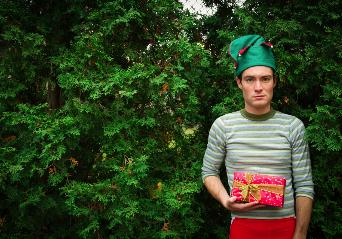
David finds himself decked in red-and-white striped tights, ready to spread artificial holiday cheer. Credit: Leah Good
The catalyst for Jesse Nerenberg’s production of The Santaland Diaries came in an odd form: a bulk email from retail giant Holt Renfrew. The Ryerson theatre school graduate, who often works odd jobs between acting gigs, got a message that the store was looking for folks to work as “Christmas Ambassadors” during the holidays.
“It wasn’t immediately clear what that meant, but I started to wonder if we would be forced to wear some kind of strange elf costumes or something,” the Montreal expat says. “I was seriously considering following up with them, justifying it as ‘research.’ And then I thought, ‘Why don’t I just do this show instead?’”
Based on the 1992 essay of the same name, The Santaland Diaries is the mostly true story of author David Sedaris’s first Christmas in New York. A struggling writer with hopes of a career penning soap operas, David takes a temp job as an elf in Macy’s over-the-top holiday wonderland. Adapted as a one-man play in 1996 by celebrated New York actor Joe Mantello, the text’s deadpan observational humour became Sedaris’s trademark style and launched his career.
After a surprisingly rigorous multistage interview, including a personality quiz and a drug test, David finds himself in Elf Training, where he learns to deliver lines like “Oh my goodness! I think I see Santa!” with an enthusiasm so forced it makes his jaw ache. Also included are more practical matters like the location of emergency exits and the point in the hours-long lineup to sit on Santa’s lap where children tend to vomit.
Training complete, David finds himself decked in red-and-white striped tights and a forest-green velvet smock, ready to spread artificial holiday cheer. Even though he’d never donned a work outfit so garish, Nerenberg had no trouble identifying with David’s plight.
“As an actor, I’ve had all kinds of jobs I didn’t want to do,” he says. “There’s the feeling of being a cog in some giant corporate machine that you don’t want to be a part of, that’s trying to force you to get excited about things you’re not excited about.”
In the largest department store in the largest city in the richest nation in history, David sees the worst of humanity on display. Children throw tantrums while their parents argue. A mother slaps her daughter when she refuses to smile for a photo. A husband sits on Santa’s lap to ask for a wife with bigger tits for Christmas, while his spouse watches awkwardly.
“It’s a sea of angry, impatient, obnoxious people who are only concerned with how much they can buy,” Nerenberg says. “It shows how Christmas has been perverted by American capitalism and why people find it so stressful. It’s become all about greed and consumption rather than relaxation and family.”
 Why you can trust Xtra