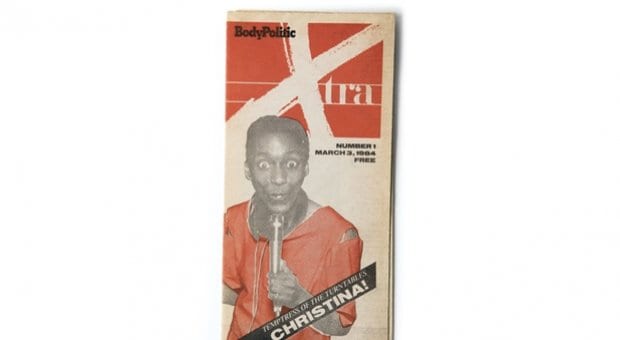
The first issue of Xtra, March 3, 1984. Credit: Adam Coish
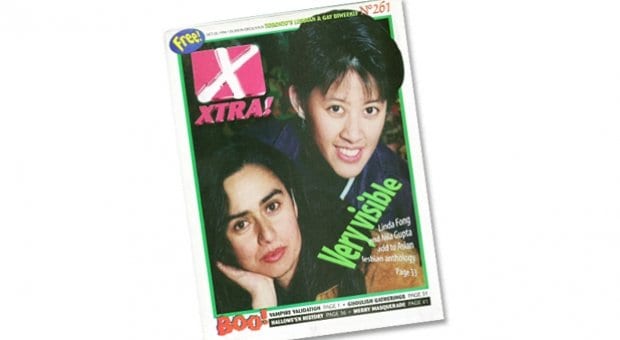
Xtra #261, Oct 28, 1994 — the first issue that included Lucinda Wallace on the masthead. Credit: Xtra archives
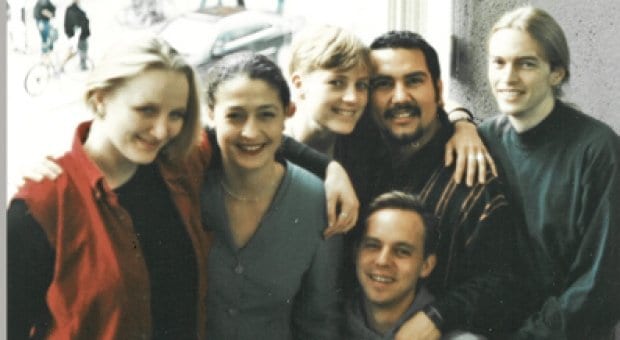
Some of the gang at Xtra in their new digs at 491 Church St, 1994. Credit: Xtra archives
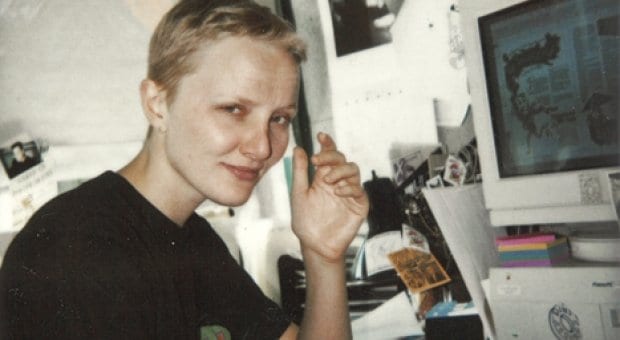
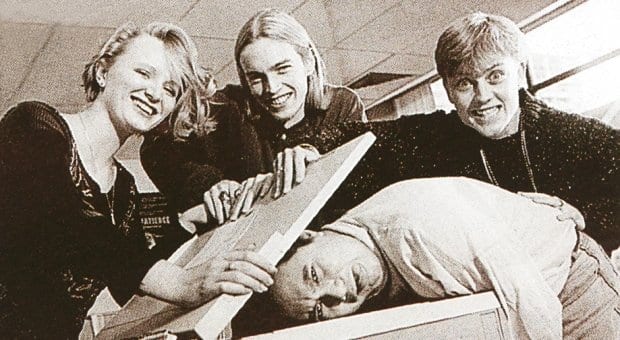
Lucinda Wallace, circa 1998, with the same “press-day face” that she has today. Credit: Courtesy of Lucinda Wallace
To celebrate Xtra’s 30 years of publishing in Toronto, we’re running a series of memories and musings from community members, current staff, writers and former staff members.
Thirty years. Where to start? How to begin to convey the impact that Xtra has had over three decades of activism and journalism? Digging through the stacks of editions in our archives, I’m looking for the “search” function to help me tell the story of this one-of-a-kind publication. But there are no shortcuts, no filters, just pages and pages of old-fashioned paper and ink, assembled with hard work, resolve and plenty of laughs.
I joined Xtra as a designer in 1994, and the job instilled in me a lifelong passion for editorial design. Although I left in 2001 to broaden my work experience, a little part of me always remained at Pink Triangle Press. When I returned in 2011 as creative director, I felt like I was coming home.
A lot has changed in the publishing industry since I started that first job nearly two decades ago; like any publication today, the print edition of Xtra faces increased competition for eyeballs and ad revenue.
Our revamped website, dailyxtra.com, is breaking all sorts of PTP records, in terms of both readership and advertising sales. But it’s not always an effective tool to convey a picture of what is going on at a given moment in time. We can’t go back and read xtra.ca as it appeared when it was launched in 1998 and, quite frankly, who would want to? Websites don’t age well. Digital files, coding and hyperlinks can become fractured and obsolete as time passes.
And yet here are these old Xtras, exactly the same as the day they rolled off the press, if a bit yellowed. Each provides a striking snapshot of what was happening in queer culture at the time. For all the speed and efficiency that online publishing promises, there is still a permanence that only print provides. And there is still a demand — our pick-up rates are close to 90 percent, remarkably high for a “niche” publication.
The future is uncertain, but at PTP there are a few things that can be relied on: The constant deadlines. The resolve to tell the stories that matter to us. The opportunity to work with wonderful colleagues who believe in what we do — and to have a lot of fun while we do it. It’s nice to be home.
Lucinda Wallace is the creative director at Pink Triangle Press. She was the advertising designer and then production manager of Xtra from 1994 to 2001.
Read more about Xtra’s 30th anniversary.
 Why you can trust Xtra