Recently the term “third places” has joined the ranks of “pick me girl” and “coquette” in TikTok’s growing list of terms that seem to mean everything and nothing at the same time. “Third place” was originally coined in 1989 by sociologist Ray Oldenburg in his book The Great Good Place. The simplest definition—and one used most frequently to get a baseline for what it describes—is that a third place is somewhere that is neither work nor home. Passionate debates have erupted on what makes a third place a third place—and whether the upscale gym-coffeeshop-coworking space that opened up down the street qualifies.
I’ll admit that when I was initially asked to write a piece about whether queer sex shops count as third places, I was thrown by the use of the buzzy terminology. But the attention toward “third places” is more interesting than some of the other TikTok catchphrases of the week (looking at you, “girl dinner”). It speaks to a dissatisfaction around urban design and, in a larger sense, urban life. This dissatisfaction is unsurprising since city centres are becoming increasingly inhospitable to human life; loitering is illegal, and benches have spikes that make me feel like an unwanted pigeon on a city statue. Of course, these efforts to make our cities less liveable are largely to do with a war on the unhoused—or whoever dares to exist without paying for it.
For most of us, both work and home are central forces of economic motivation. Home is what we pay for, and work is how we pay for it. Some sharp people have noticed that the live-to-work/work-to-live structure is kind of a rip, and they’re wondering what exists outside of the loop.
For queer people in particular, the home/work loop takes on additional challenges. Stigma—and increasingly violent social legislations—around queerness may require a queer person to be closeted in their workplace, or even their home. Maybe someone is living with conservative family or roommates (the expectation of being able to afford to live alone is deteriorating, and many of us wind up in less-than-ideal living situations).
Undoubtedly, space is political. Queerness is political. The politics of queer access to space is in the news every day—particularly as it relates to trans access to bathrooms. So for that reason, queer people do need to be thinking about third place theory.
Ray Oldenburg’s third place theory was more than just “work or home,” though. The original text involved breaking down third places into nine primary components:
- Neutrality
- Non-hierarchical in structure
- Prioritize conversation
- Host “regulars”
- Are accessible (in the original theory the example given was an establishment keeping long hours, allowing those with 9-5 jobs to access the space)
- Playful
- Keep a “low profile”
- Feel like a “home away from home”
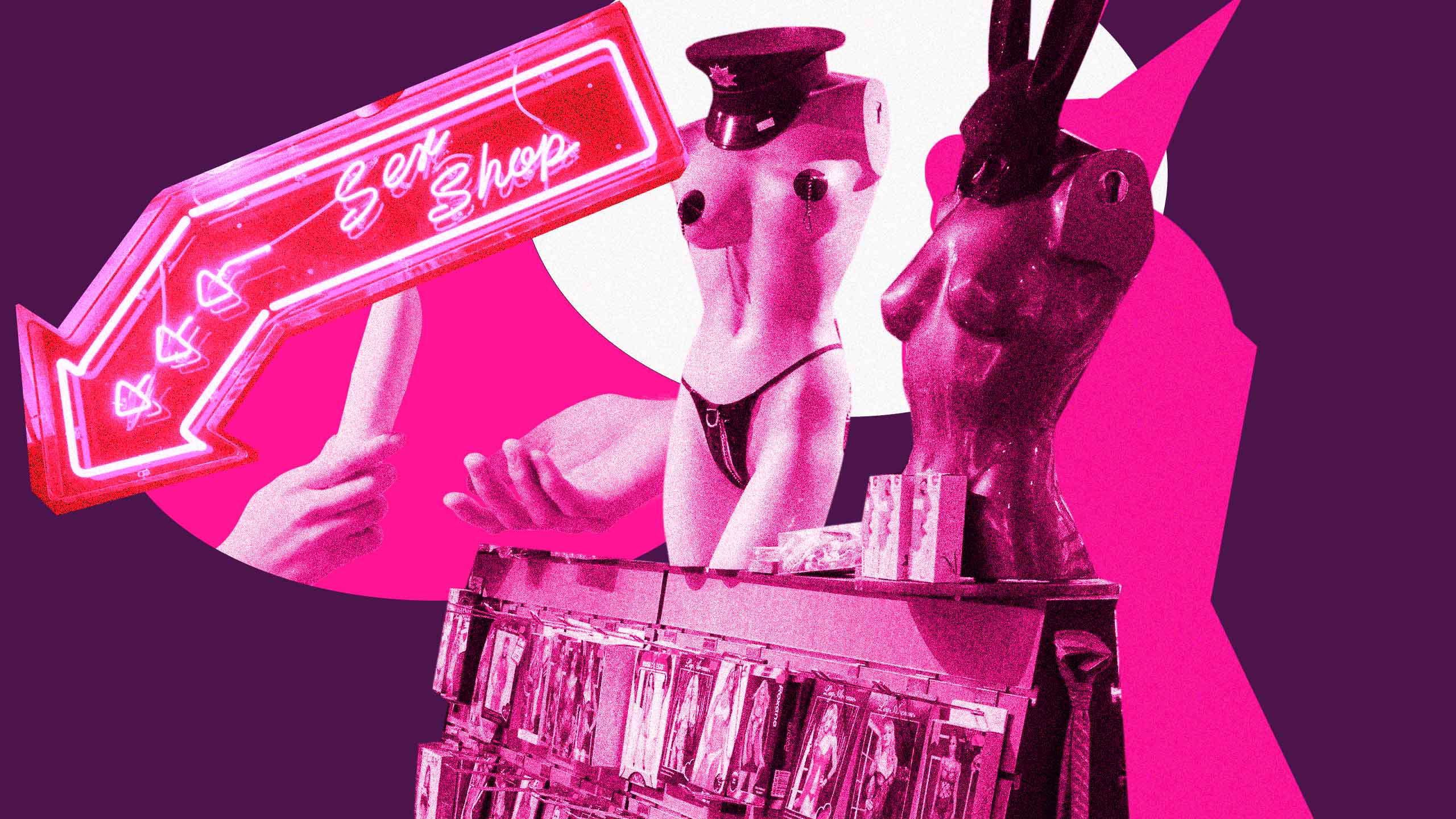
In the absence of federally funded queer community spaces/organizations, I often see sex shops picking up the community space slack; hosting workshops, events and providing space for queer people to openly exist, ask questions about gender and sexuality and even just hang out.
But can a sex shop be a third place, either in the original nine-part definition of the term or in its simplified evolution?
Carol Queen, Good Vibrations staff sexologist and curator of the Antique Vibrator Museum, hesitates to call Good Vibrations—a San Francisco-based sex shop—a “third space.”
“If there’s only three spaces—which of course there aren’t, there are more than three—but if there are only three kinds of space, I think it’s actually really problematic to think about third space as an economic entity,” she tells me. “I don’t wanna live in a culture where I have only one other alternative to go out and relate to my life, and it has to be going into, you know, shoe stores.”
But for some stores, providing an IRL space for their community actually comes at the cost of their bottom line. Take Toronto-based co-op Come As You Are; whose Kensington Market location is actively losing money. Worker-owner Jack Lamon describes the balancing act of financial stability and meaningful work.
“When our lease ran out and our landlord wanted us out, we went online only and for the first time realized, ‘Oh, this is actually a really profitable business if we have no physical space,’” Lamon says. “But it’s meaningless. It’s so hollow and meaningless. So because we actually did have a little bit of cash, you know, we could have actually paid that out to ourselves, or invested in or whatever, but we were like, ‘No, let’s reopen the shop.’”
Come As You Are has hosted in-person workshops on sexual education, healthcare and more; but having a space where people can just exist sometimes makes the most impact, particularly for underserved communities.
“One of the cool things about the space is that customers come and hang out for hours, they’ll just sit on the couch and read books,” Lamon hesitates. “Then again, it’s a less pure experience of a third space if you’re paying to be in it.”
Many queer-owned or queer-focused stores struggle with this; attempting to marry a capitalist project (the store) with an inherently transgressive ideology (queerness) creates blurred lines of identity and purpose.
Some of Oldenburg’s attributes are no-brainers in their application; a playful mood, for example, comes easily for a sex shop, where the business is play. Discreet packaging and a low-key facade can be applied to “having a low profile” without too much bastardization of its original intention.
The concept of “hierarchy” is a bit messy when it comes to sex shops. In some ways, employees are in positions of power in that they are acting as authorities in a space that for many feels extremely vulnerable to enter and interact with. To shop at a sex store often involves revealing information about oneself—whether through questions or purchases, that otherwise can be private and intimate. On the other hand, employees are financially reliant on the store, a relationship that often means catering to the desires of a customer (see: “the customer is always right” mentality).
Queerness, and by extension sex positivity, is still largely a transgressive ideology in most circles; at odds with elements of white heteropatriarchal capitalism. But the store by its nature is a capitalist object, or at least, an important mechanic. It’s a challenge to find or create community environments that can thrive (or even exist) outside of financial transactions—no small feat when space is such a contentious and blood-stained resource. Many sex shops have grown into “third place”-adjacent establishments by accident or by utilization.
“I don’t think we necessarily set out to be a ‘third space’—we are a business after all,” says Wren, a representative from Halifax- and Ottawa-based sex shop Venus Envy over email. “But because of the coming and going (and often lack of) queer spaces in this city, especially non-nightlife spaces, folks made this place what it is in a lot of ways.”
I can’t say I believe that stores—even worker-owned stores, or ones with really cool community outreach initiatives—will ever meet every expectation of a “third place,” even if every member of its makeup is community-oriented.
I believe community should be anti-capitalist the same way I want queerness to be; our relationships with one another existing in opposition to a system actively profiting off loneliness and isolation. Without better queer community systems in place, it makes sense that sex shops have risen to the occasion the same way that they’ve stepped in to fill gaps in sexual education, gender education and community history. Queer community is historically resilient, but that doesn’t mean we should be happy carving spaces for ourselves in the cracks in the sidewalk. I believe we deserve so many Great Good Places of our own, and we don’t have to act happy with anything less.

 Why you can trust Xtra