In the open market that is TikTok’s mysterious FYP, becoming famous is a process of introducing and re-introducing yourself to the viewer in fleeting moments until you cling to their brains, tongues, hearts and group chats. Becoming a fan of Sami Landri was like wondering how long my clothes had smelled like cigarettes.
Had it been the video in Québec City when she walked up, clacking those French tips and crouched down to spit right in my face? When she woke me up in the middle of the night, standing outside the window in half drag just to ask if I had a lighter? Popping her head under the bathroom stall to ask if I had cigarettes? Sometimes she was gay, sometimes homophobic, sometimes both; a city girl or country girl, a concerned friend or an enabler, but she was always messy and Acadian.
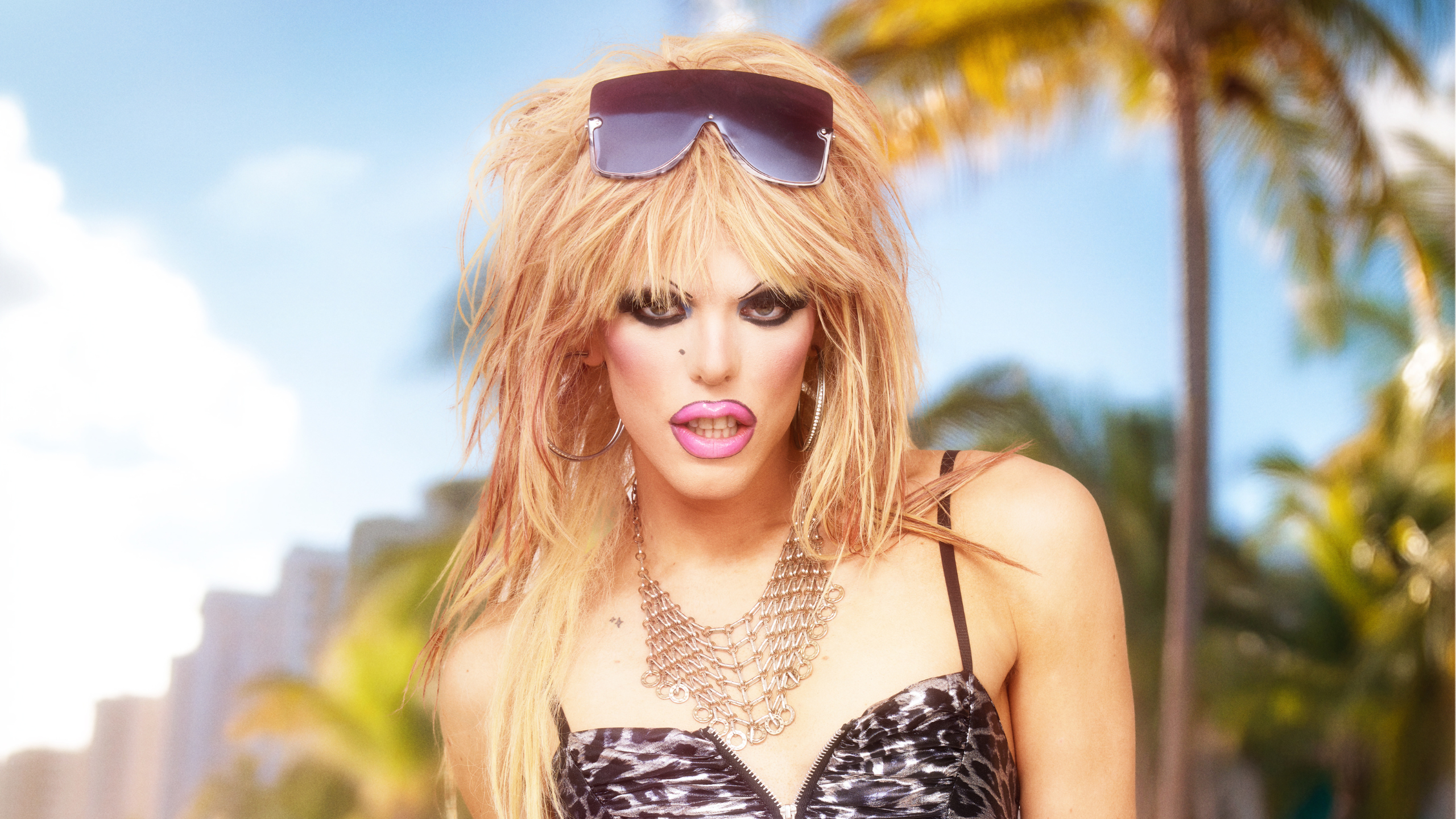
Even before she was cast on the sixth season of Canada’s Drag Race, her virality rivalled that of Drag Race alumni. If you’ve never seen Sami Landri on your FYP, you’re probably homophobic. For all her success, Sami Landri remains a largely enigmatic character, particularly because she’s rarely been interviewed in English. Ahead of her turn on Drag Race, I set out to change that.
The first time I meet Samuel Landry is on Zoom, out of drag with his boyfriend’s dog in his lap. Landry is so grounded, I half-consider moving to the Maritimes to touch grass. He has a leisure that isn’t lazy, something steady and straightforward, a quiet confidence.
Landry is from Moncton, New Brunswick, population 188,000. Moncton is a bilingual city with a significant community of Acadians, the descendants of early French settlers in the Maritime provinces of Canada. By the time Landry was a teenager with a fake ID, Moncton hadn’t had its own drag scene for a few years, instead largely hosting queens visiting from other cities in the Maritimes or touring Drag Race alumni. Starting drag became a sort of group project among Landry’s clique of queer friends.
“We were drinking some beers and we were like, here’s the tea: we all want to do drag, we’re all curious by it and there’s no drag scene in Moncton, and whenever there’s drag in Moncton, it’s in English,” says Landry. “We’re all Acadian here—let’s just do it.”
From there, Landry, then a bartender at a local gay bar, simply claimed the stage for what would become the Haus of Ménage. For most of them, that first performance was their first time even wearing makeup, but it was a great success. “Moncton is gritty and people there love grit. We did drag with a lot of grit,” says Landry.
Without an established scene, the Haus of Ménage got to throw themselves into drag headfirst, free of the usual big-city drag politics.
“Our mission was to explore what Acadian drag can be,” says Landry. “By creating our own scene, we were able to just do what the fuck we wanted with absolutely no deeper thought beyond instinct and fun.”
Originally performing as Mona Noose (a pun for “my anus” in French), Landry had no plans for drag, even once he’d dropped out of theatre school to be an artist. During this period, Landry started collaborating with Xénia Gould (also known as Chiquita Mére) who was part of the same group that became the Haus of Ménage.
Gould said she established a deep connection with Landry while talking about life and art, which led them to become a couple. They went on to co-write Mona, a found-footage-style short film starring Landry and directed by Gould, which follows a small-town drag queen auditioning for America’s Next Top Model.
“It’s very clear that [the protagonist] loves l’Acadie, loves Moncton, but to achieve her dreams she has to leave,” Landry summarizes, connecting the character’s experiences to their own. “It’s very meta. I’m not the type of queer kid who’s like ‘I had to move away because I hated my small town’—au contraire, I fucking love Moncton. Factually, I would not be able to do what I do if I was still there.”
In 2021, Landry found their path to the big city after posting a string of viral comedic TikToks. Their catchphrase, “as-tu des cigarettes? (do you have cigarettes?),” came to define Landry’s brand. Within months, Landry went from being a hobby drag queen with a few hundred followers to being a full-time drag queen in Montreal. Landry’s career trajectory changed so abruptly that his social media wasn’t even under his drag name when he went viral, and so Mona Noose became Sami Landri, a diminutive of his legal name.
After performing, Landry would party with friends and they’d film late at night, often in half drag. The setting is usually unrecognizable and Landry is never predictable. A Sami Landri video could be a PSA just as much as it could be nightmare fuel or trendy brainrot. That’s the formula: it’s addictive, and it’s earned Landry 18.6 million likes on TikTok.
Landry enjoyed the high numbers, but didn’t think much of it. “People on TikTok go viral all the time,” they said. “You have a viral video and life goes on.” It was only once Landry was flown into Montreal for Pride in the summer of 2021 that they truly saw the numbers translate into recognition and acclaim; he was recognized constantly in Montreal’s gay village—out of drag. The trip made Landry realize virality might not be as ephemeral as he thought. “I will always be ‘as-tu des cigarettes girl’ and I realized … this is something, let’s go all in.” Shortly thereafter, Landry and Gould moved to Montreal. The next day, Landry performed his first show at the city’s iconic Cabaret Mado, effectively announcing her arrival in the big city.
“In the city, pressure’s on. Back home there was no competition—it was just us doing what the fuck we wanted. Here you have to show up or go home.”
Landry’s star continued to rise at an incredible pace. He became a regular performer around Montreal, started touring Canada and Europe, appeared in Québécois media and earned a monthly headlining show at Mado, all while continuing to produce viral videos. Sami Landri was a success, but she had taken over. “It would just slowly chip away at any identity that I had built of myself as a person beyond just what Sami Landri is and that drag is,” said Landry. “I literally had a complete breakdown.”
It took a year to recover, during which Landry took a step back from drag to reflect, and stripped things back before deciding to move forward with intention. “This whole Sami Landri thing that popped into my life, the greatest gift that the universe has ever given me, [and] I want to do it justice, I want to go all the way and I really just want to see how far I can take this thing. But, I now have to focus on making sure I have a life beyond that.”
These days, Landry is more of a homebody, and life is more simple. He enjoys the outdoors, reading and spending time with his boyfriend. Drag is his outlet for the “cuckoo crazy.” Landry still loves being asked if he has cigarettes and dreams of having a pied-à-terre back in Moncton.
As for Landry and Gould, they have been best friends since breaking up in 2023, and in the first episode of their YouTube advice show Helpez-Moi (Help Me), they tackle how to stay friends with your ex. Their parents went to high school together, but the duo’s creative collaboration goes beyond shared history.
“We both are extremely proud of our Acadian heritage and Acadian culture, and we’re both very much obsessed with the folkloric side of our culture,” Gould explains. Acadians have developed a distinct culture and varieties of French, including Landry and Gould’s trademark chiac, which borrows from English. “We both have a mission of creating within that universe but in a queer way without purifying our dialect, our chiac—that’s who we are and what has gotten us to this point in our careers.”
While outsiders might make the mistake of grouping Acadians and Quebec’s French Canadians, Landry maintains that, “Being Acadian is a very unique identity, it’s an identity that is always in existence of in-betweeness.” Maybe that’s why his videos tend to blend sincerity and satire, realism and surrealism, the familiar and the strange.
“I love playing on the line of ‘Is this bitch for real?’” Landry smiles. He isn’t really interested in offering any explanations. “I kind of like that the meaning is a little hidden.”
If Landry wants the work to speak for itself, I realize I should give it a chance. So after a few hours of interviews with Landry, I head to Cabaret Mado for Landri’s trademark Sami Party show, which is currently on tour across Quebec.
The show is sold out. I meet Landry and the other performers backstage but I can’t stay long before I need to go save a seat. Landry sets the tone for the show by lipsynching “Stupid Shit” by Girlicious, wearing an S.L. monogrammed denim miniskirt. On the mic, Landri turns her baseball cap backward for sports mode and declares Sami Party a safe space with a tra-chique motto: be messy and wild, but be the best version of yourself.
I recall what Landry had told me earlier in the day: “As much as I wanted to be very glamorous, when the whole internet thing happened, that was the world telling me, when you put all your guards down and you are messy in a fun way and you are having fun, that resonates.”
Over the course of the show, Landri sits down in the crowd with her beer to watch fellow Canada’s Drag Race season six castmates Hazel and Paolo Perfección perform. Their dynamic and hungry performances contrast with Landri’s intuitive and familiar performance style. On the mic, Landri is quick and dry, so quick and dry that the audience doesn’t always catch the joke, but she breezes along, never lingering for a laugh or applause. She doesn’t seem to be looking for the crowd’s approval. She only seems interested in having fun.
With such a distinct aesthetic and sense of humour, Landry is one of the biggest question marks in Drag Race history. Ahead of the casting announcement, Landry agrees with the consensus. “I think if I did Drag Race, I would either do really good or really bad.
“A lot of people go on to the show wanting to get their flowers. And I view it very differently, if you go to Drag Race, you need to put every ounce of ego you have and bury it deep, not even bring it in your suitcase,” Landri explains. “I think if you do Drag Race, it’s because you’re willing to bring your best, bring your talent and see what happens.”
Joining a mainstream juggernaut of a franchise won’t test whether Landri remains punk, contrarian, Acadian and tra-chique. It will test what a demanding, global, English-language audience is willing to embrace. Landri could be a franchise messiah for members of the fandom who yearn for something raw and unserious. Or she could be the troll we all need.

 Why you can trust Xtra