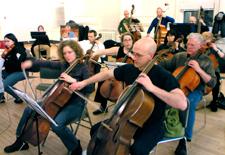
In celebration of its 25th anniversary Toronto’s Counterpoint Orchestra is gearing up to perform Ludwig van Beethoven’s iconic Symphony No 9.
Consider it the big kahuna of classical music.
“It’s absolutely colossal,” says Counterpoint music director and conductor Terry Kowalczuk. “Most people don’t have the opportunity to perform it, especially in a community orchestra.”
Running approximately 70 minutes, the symphony, composed in 1824, is divided into four jam-packed movements of woodwinds, brass, percussion and strings. It was Beethoven’s last symphony and is considered to be some of the edgiest work of its time.
“He was the first major composer to use a choir in a symphony,” says Kowalczuk. “It was groundbreaking.”
The choir section of the 9th symphony appears in the fourth movement and tends to be the most recognizable part. It is the famous, celebratory and gleeful “Ode to Joy.”
That’s right, the same tune used in those catchy Drink Milk, Love Life commercials in the late ’90s. No wonder musicians at Counterpoint are singing “holy cow.”
Beethoven’s 9th isn’t exactly something you learn overnight.
“We’ve been practising since December,” says violinist Paul Willis, Counterpoint’s concert master.
Willis says a concert master is “the one that tunes the orchestra.”
Willis, a lawyer and 24-year member of Counterpoint Orchestra, is amazed by how large Counterpoint has become. From what began as a tiny gay and lesbian chamber group that played at the Metropolitan Community Church of Toronto in the early 1980s, the community orchestra today boasts a roster of more than 50 musicians.
The orchestra is comprised of mostly gay and lesbian members, with some heteros thrown into the musical mix. There is no audition to join but space is limited depending upon the instrument you play.
“Flutes call us all the time,” says Kowalczuk, noting the limited space available in Counterpoint’s packed woodwind section. “We’re always open to more strings.”
The orchestra performs music by Mozart, Verdi, Tchaikovsky and others. It even does numbers for the show queens and movie buffs out there, including hits from West Side Story and movie scores like the theme from the Indiana Jones films.
Still Willis says getting the masses excited about classical music is half the battle.
“The orchestra is a hard sell,” he says, noting the patience and open-mindedness one requires to fully appreciate a symphony.
While classical music may not compare to thumping house beats at the Barn and Stables, it does have blissful benefits. It is, for example, a creative muse for Toronto drag legend Michelle DuBarry.
“I listen to classical music while sewing my dresses,” says DuBarry, who has performed drag in Toronto for over 50 years.
For classical music virgins, Counterpoint’s 25th anniversary show is the ultimate cherry popper.
In addition to Beethoven’s 9th, the orchestra will perform Flute Concerto in D Minor by CPE Bach (Johann Sebastian Bach’s son). Community choir the Bell’Arte Singers and other sopranos, tenors, and baritones are also scheduled to perform.
“We’re pulling out all the stops,” says Kowalczuk.
 Why you can trust Xtra