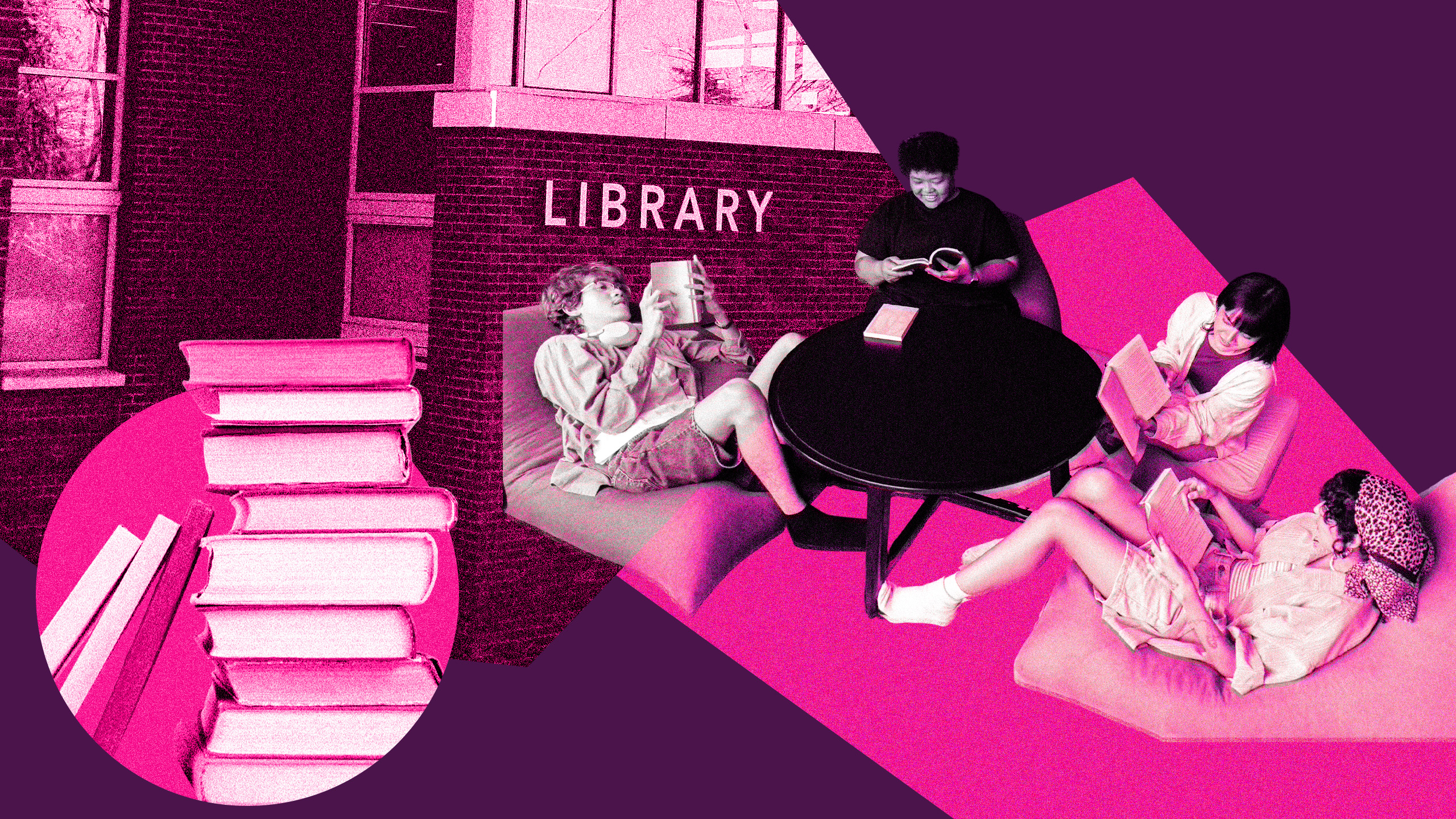
Grade 11 student Aria Iliakis says she “just wanted to meet more queer people” when she co-founded Queerly Quilled, a LGBTQ2S+ book club, at her local North Vancouver library.
“I didn’t have any queer friends, so it was hard to relate to people in that way,” she says.
Iliakis wasn’t alone in this experience. As more teenagers joined the group, it shifted away from book discussions and more toward games, crafts and socializing. In the almost three years the group’s been running, its monthly meetings have grown to attract a membership of 15-20 regular attendees from grades 8 to 12 around North Vancouver.
“Now, I have a lot of queer friends,” Iliakis says.
Queerly Quilled offers a rare third place, away from school or home, for LGBTQ2S+ youth to connect and express themselves freely. Safe spaces for queer and trans people are already scarce and diminishing. But for those too young to get into the bars and nightclubs that have historically served as LGBTQ2S+ safe havens, they are even harder to come by.
Sara Oremland, the teen engagement librarian for the North Vancouver District Public Library, which hosts Queerly Quilled, feels the need for this safe space among the club’s participants, a group she says has grown faster than the library’s other teen groups.
“When the group started getting bigger, they weren’t there for the books. They were there to be together and feel a sense of belonging,” Oremland explains. “I run multiple teen groups, and with [Queerly Quilled], you feel it a lot that there’s just a feeling of belonging and gratitude that they have something like this.”
While some schools offer Gender and Sexuality Alliance (GSA) clubs, Queerly Quilled’s other cofounder, London Clark, points out that such clubs can pose barriers for LGBTQ2S+ students who don’t want their identities exposed to other students at school, particularly trans students who face a higher risk of bullying than their cis peers. A 2021 study from the University of British Columbia and McCreary Centre Society found that more than 80 percent of trans boys, 60 percent of trans girls and 70 percent of non-binary youth aged 12-19 had experienced bullying in the past year.
“When you’re younger, or just in a situation where you’re not as comfortable with yourself, [coming out is] a bit harder,” Clark says. “I know people that don’t go to GSA because of that. But our club is a lot more low-key. It’s easier to slip in the door and then not be seen.”
Many queer and trans youth can’t find that safe space at home either. The University of British Columbia’s Stigma and Resilience Among Vulnerable Youth Centre’s 2019 Canadian Trans and Non-binary Youth Health Survey found that nearly one in four respondents aged 14-25 did not feel safe in their own home and one in 10 had experienced physical violence by a family member.
Karen Pinkoski, the youth support navigator at the Pride Centre of Edmonton, emphasizes the importance of third places for young queer and trans people to find support and safety.
“They face so much gender-based violence when they walk outside anywhere. It hits them in school. It hits them in their families. Quite often, on the street. And so having a space that they can come to just be and be their authentic selves is what we focus on,” Pinkoski says.
The Pride Centre of Edmonton offers a weekly in-person drop-in space for youth ages 12-24 to hang out and socialize. The space includes a closet of donated clothes that participants can freely take from, leading to many moments of what Pinkoski describes as gender euphoria. “When somebody finds that piece of clothing or paints their nails or puts on a binder for the first time … you see them just blossom.”
According to Pinkoski, the number of people accessing the weekly drop-in space has doubled from last year, with around 50 people visiting regularly. The Pride Centre of Edmonton also offers a weekly online meeting through Discord for those who can’t access the in-person meetings, where over 100 youth participate.
“It’s a huge necessary space for these kids who cannot come to programming because of families who have extreme religious ideology leading to homophobia and transphobia, as well as rural kids who have zero support in their communities,” Pinkoski says.
She attributes both groups’ growing membership to the lack of safe spaces for queer and trans youth in Alberta, especially after last year’s sudden closure of LGBTQ2S+ resource centre the Outloud Foundation in St. Albert, a small city just northwest of Edmonton. Outloud’s closure was especially hard on the community, Pinkoski explains, as a wave of anti-LGBTQ2S+ legislation in Alberta has led to an increased need for support.
“Homophobia and transphobia have ramped up, certainly in Alberta, and it’s been weaponized by the bills that have been passed in the legislature,” she says.
LGBTQ2S+ groups in the U.S. are facing similar struggles as safe spaces disappear while the need for them rises. In 2023, the University of Houston’s LGBTQ Resource Center was forced to shut down due to a state-imposed anti-DEI law. Hatch Youth, a LGBTQ2S+ social group operating out of the Montrose Center in Houston, responded by starting programming for young people ages 18-24.
Hatch Youth’s younger membership has also been impacted by legislative changes. The Montrose Center’s Director of Youth Services Jenn Brock describes trans members being forced to stop taking hormones after a Texas law banned gender-affirming care for minors last year.
“It was devastating,” Brock says. “We’re constantly trying to respond to all of the legislation and hold space for the youth, keep them appropriately informed, but not scared. It’s really tricky to navigate.”
Hatch Youth provides a much-needed place for young queer and trans people to unpack these hardships with their peers while also making space for them to have fun and make friends. The group’s weekly programming includes a variety of youth-led activities like karaoke and presentations on members’ niche interests as well as more informative sessions on mental health, LGBTQ2S+ history and queer sex education.
For JuJu Faragher, the Montrose Center’s youth services specialist, striking this balance between providing educational resources and social activities is key. If the youth coming in each week have fun and make friends, he considers the program a success.
“We want to make sure that is at the core of our community, and all of the extra stuff is there as a safety net,” he says. “Come make friends and be in this environment, and if there’s anything that you need, we’re going to be able to be here to empower you and support you.”
Youth who come to programs like those offered by Hatch Youth and the Pride Centre of Edmonton also benefit from having access to more accepting adults outside of home or school. According to research from The Trevor Project, LGBTQ2S+ youth with at least one accepting adult in their lives are 40 percent less likely to attempt suicide.
To Faragher, there’s value in young people learning from the perspective and generational knowledge of queer adults, who can help them navigate the political attacks that the LGBTQ2S+ community has long had to face. Alternatively, adults also benefit from being around the hopeful energy of their younger counterparts.
“It’s perhaps easy to get caught up in the noise and the chaos and feel really pessimistic about the future. But I think it’s one of those things that as soon as you start to interact with youth and actually start to hear their conversations, these are still very hopeful kids,” Faragher says. “Because the space allows them to dream, and it allows them to hope.”
Queerly Quilled’s co-founders Iliakis and Clark acknowledge that while there’s probably still a lack of third places for queer and trans youth, they don’t feel the absence anymore because they created that space for themselves. For other teens looking for community, Clark encourages them to do the same.
“It’s nice to have a space that’s dedicated to the queer community because it lets everyone know that they’re welcome to come,” she says. “It’s good to be assured that it will be a safe space, and also not just a safe space, but an understanding space.”

 Why you can trust Xtra