“And
you know, I’m 32 years old and I still cry when I see little black girls in red
ribbons. You wouldn’t buy me them; you said I was too black to wear red.”
Speaking to the memory of her dead mother, Nia, a character in Trey Anthony’s
Da Kink In My Hair, represents the plight of a black woman in a world where
whiteness continues to impose itself upon the “other.”
The primary narrative posture of this poignant and entertaining piece of
theatre recalls the work of Frantz Fanon in the mid-1960s and Ntosake Stange’s
mid-’70s performance poetry. Anthony’s work, however, takes Fanon’s Black Skin,
White Masks premise, shifts gender focus and projects it onto a contemporary
landscape similar to yet strikingly more contemporary than Stange’s famous work
For Colored Girls Who Have Considered Suicide When The Rainbow Is Enuf. This is
a racialized Steel Magnolias, politically more astute and elegantly positioned
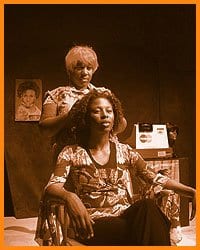
on an open earthy stage replete with hairdressing posters, a stylist’s chair
and a salon owner (played by Anthony) who possesses an abundance of wit and
compassion that acts as a series of bridges between the monologues delivered by
six of her customers.
When Sharmaine, beautifully portrayed by Raven Dauda, exclaims that being a
black lesbian means, “she ain’t black no more! Of course, that’s something only
white girls do,” the play reaches one of many pivotal moments regarding the
plight of women defending and celebrating their race in a world that tries to
dilute it.
Music is skillfully interspersed by off-stage vocalist/drummers Amina Alfred
and Weyni Mengesha while the dancer/actors sing to and among themselves.
Mengesha also directed the piece and has created powerful spaces in which these
women can celebrate themselves and each other.
Dub poet d’bi young, as Staci-Anne, delivers one of the strongest performances
of the evening. Playing the part of a child she is utterly magnetic as the
joyful yet abused little girl who is able to dance her way comically and
tragically into the hearts of her listeners.
The eight-woman ensemble is consistently powerful. Some of the spoken
monologues rely a little too much on shouting in a small space without enough
emotional nuance, and a minor edit with an eye for repetition could tighten up
the piece. Nevertheless, the overall experience is not to be missed.
As a quotation from August Wilson suggests in the program, Da Kink In My Hair
reminds Torontonians, and “demonstrate[s] to the world – not to white folks,
not to black folks, but to the world. that there is no idea or concept in the
human experience that cannot be examined through black life and culture.”
* Da Kink In My Hair continues at Theatre Passe Muraille (16 Ryerson Ave) until
Sun, Jun 29; call (416) 504-PLAY.
 Why you can trust Xtra